Han Shichao, Zhu Jinming, Zhang Yilei
Department of Gynecology, Second Affiliated Hospital of Dalian Medical University, Dalian, Liaoning, China (mainland).
Department of Oncology, Affiliated Zhongshan Hospital of Dalian University, Dalian, Liaoning, China (mainland).
Med Sci Monit Basic Res. 2018 Feb 15;24:40-46. doi: 10.12659/msmbr.907333.
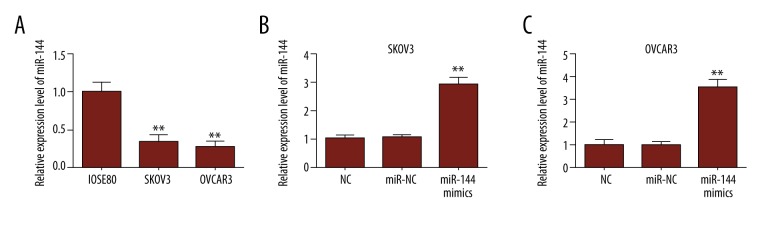
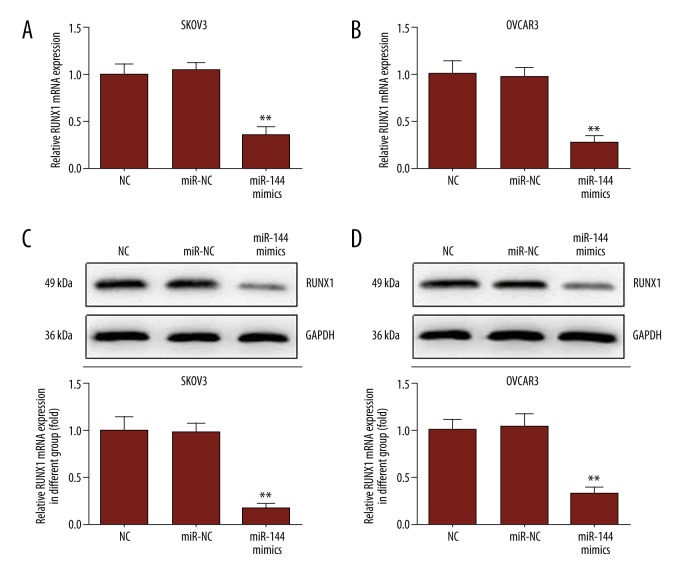
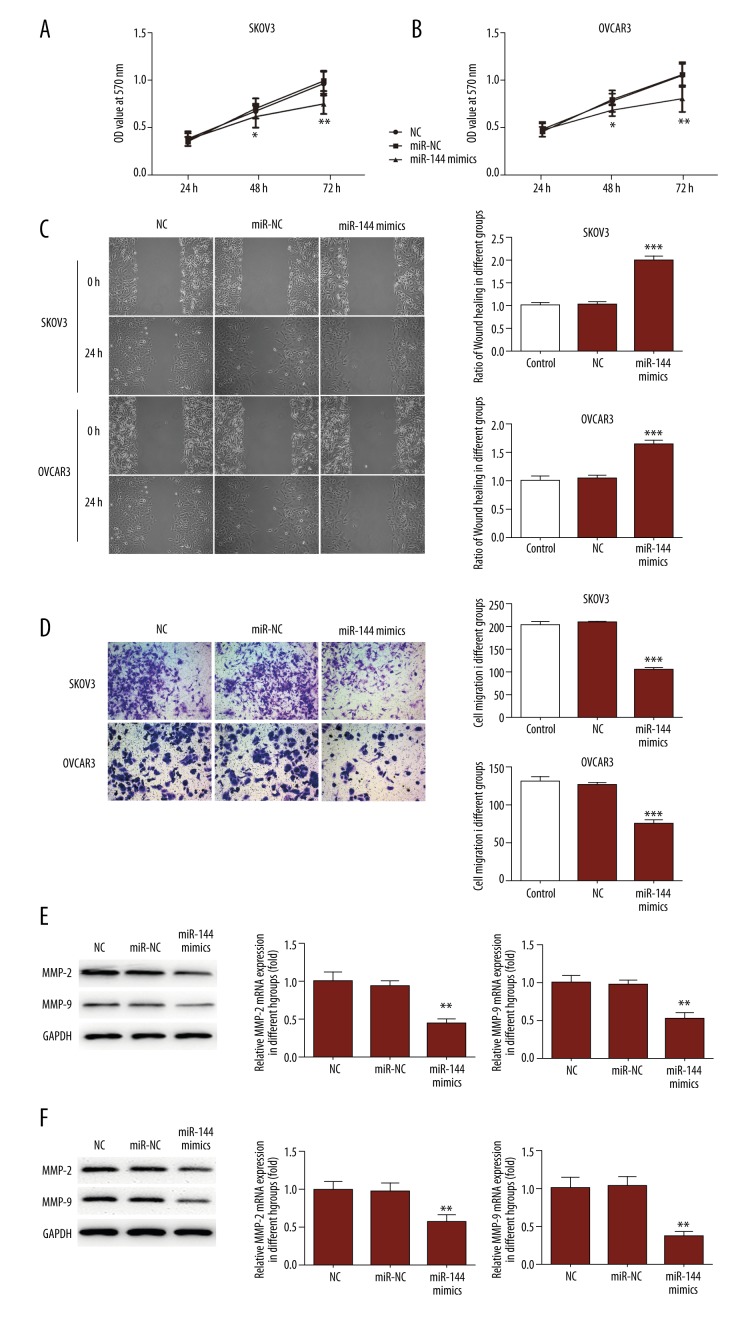
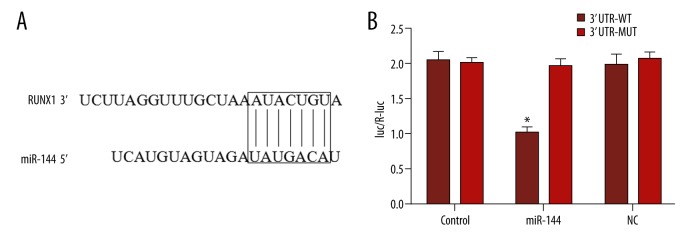
BACKGROUND Ovarian cancer (OC) is one of the most common malignant diseases of the female reproductive system worldwide. Evidence has shown that microRNAs are involved in the development of ovarian cancer. miR-144, one of these microRNAs, has been found have upregulated expression in various human malignancies. The present study aimed to investigate the role miR-144 in ovarian cancer cell lines and to elucidate the mechanism involved. MATERIAL AND METHODS Human ovarian cancer cell lines (SKOV3/OVCAR3) and a normal ovarian cell line (IOSE80) were used to identify the miR-144 expression though qRT-PCR method. SKOV3/OVCAR3 cells were transfected with miR-144 mimics by Lipofectamine, and the proliferation, migration, and invasion ability of these cells were detected by MTT assay, wound healing assay, and Transwell assays, respectively. MMP2 and MMP9 expression were detected at mRNA and protein levels. The results of dual luciferase reporter assay confirmed that miR-144 could down-regulate RUNX1 expression level. Finally, the expression of runt-related transcription factor 1 (RUNX1) was examined using qRT-PCR and Western blot analysis. RESULTS Our results demonstrate that the expression level of miR-144 was downregulated in SKOV3/OVCAR3 compared to IOSE80, and we found that miR-144 suppresses the proliferation and migration of ovarian cancer cells. Moreover, RUNX1 was predicted and confirmed to be a target of miRNA-144. Additionally, after 48-h transfection with miR-144 mimics, the expression of RUNX1 was downregulated in OC cells. CONCLUSIONS miR-144 mimics can inhibit the proliferation and migration of ovarian cancer cells though regulating the expression of RUNX1.
卵巢癌(OC)是全球女性生殖系统最常见的恶性疾病之一。有证据表明,微小RNA参与了卵巢癌的发展。其中一种微小RNA,即miR-144,已发现在各种人类恶性肿瘤中表达上调。本研究旨在探讨miR-144在卵巢癌细胞系中的作用,并阐明其相关机制。
采用人卵巢癌细胞系(SKOV3/OVCAR3)和正常卵巢细胞系(IOSE80),通过qRT-PCR方法鉴定miR-144的表达。用Lipofectamine将miR-144模拟物转染到SKOV3/OVCAR3细胞中,分别通过MTT法、伤口愈合试验和Transwell试验检测这些细胞的增殖、迁移和侵袭能力。在mRNA和蛋白质水平检测MMP2和MMP9的表达。双荧光素酶报告基因检测结果证实miR-144可下调RUNX1的表达水平。最后,采用qRT-PCR和蛋白质印迹分析检测 runt相关转录因子1(RUNX1)的表达。
我们的结果表明,与IOSE80相比,SKOV3/OVCAR3中miR-144的表达水平下调,并且我们发现miR-144抑制卵巢癌细胞的增殖和迁移。此外,预测并证实RUNX1是miRNA-144的一个靶标。另外,用miR-144模拟物转染48小时后,OC细胞中RUNX1的表达下调。
miR-144模拟物可通过调节RUNX1的表达抑制卵巢癌细胞的增殖和迁移。