Liu Jun, Xue Hui, Zhang Jianjun, Suo Tao, Xiang Yijin, Zhang Wen, Ma Jun, Cai Dingfang, Gu Xixi
Department of Integrative Medicine, Zhongshan Hospital, Fudan University, Shanghai, PR China.
Shanghai University of Traditional Chinese Medicine, School of Basic Medicine, institution of Neijing, Shanghai, 201203, China.
J Exp Clin Cancer Res. 2015 Apr 17;34(1):35. doi: 10.1186/s13046-015-0154-5.
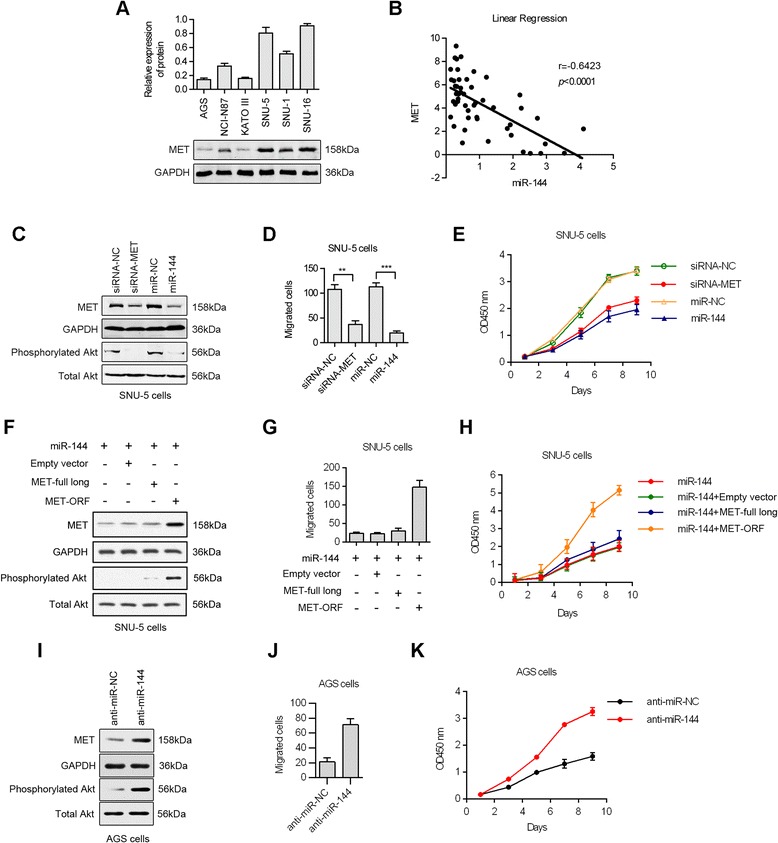
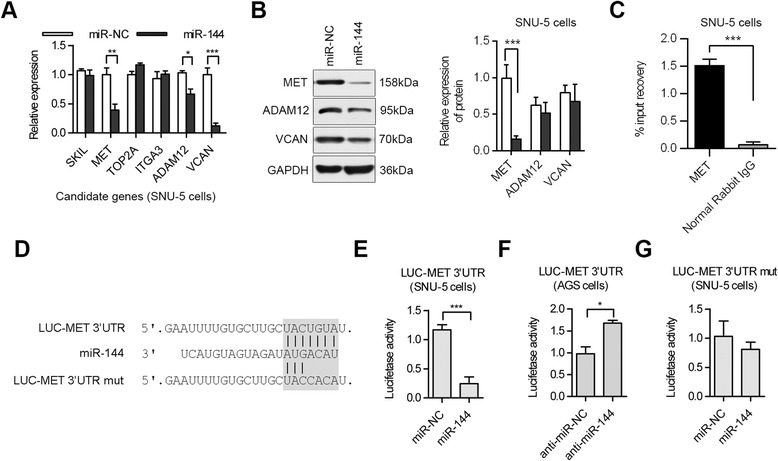
Gastric cancer (GC) remains one of the most common types of malignant cancer, and the molecular mechanism underlying its metastasis is still largely unclear. MicroRNAs have emerged as important regulators of metastasis because of their ability to act on multiple signaling pathways. In our study, we found that miR-144 is significantly downregulated in both highly metastatic GC cell lines and tissues. Results from both gain-of-function and loss-of-function experiments demonstrate that increased miR-144 expression significantly reduced GC cell migration, whereas decreased miR-144 expression dramatically enhanced GC cell migration. The met proto-oncogene (MET), which is often amplified in human cancers and functions as an important regulator of cell growth and tumor invasion, was identified as a direct target of miR-144. Moreover, silencing of MET using small interfering RNA (siRNA) recapitulated the anti-metastatic function of miR-144, whereas restoring MET expression attenuated the function of miR-144 in GC cells. Furthermore, we found that miR-144, by targeting MET, suppresses phosphorylation of Akt. Finally, we observed an inverse correlation between the expression of miR-144 and MET mRNA in GC metastatic tissues. In summary, miR-144 suppresses GC progression by directly downregulating MET expression, which subsequently prevents activation of the pro-oncogenic Akt pathway. Reintroduction of miR-144 expression in GC cells presents an attractive therapeutic approach to block the metastasis of gastric cancer.
胃癌(GC)仍然是最常见的恶性肿瘤类型之一,其转移的分子机制仍不清楚。微小RNA因其能够作用于多种信号通路而成为转移的重要调节因子。在我们的研究中,我们发现miR-144在高转移性GC细胞系和组织中均显著下调。功能获得和功能丧失实验的结果表明,miR-144表达增加显著降低了GC细胞的迁移,而miR-144表达降低则显著增强了GC细胞的迁移。原癌基因(MET)在人类癌症中常被扩增,是细胞生长和肿瘤侵袭的重要调节因子,被确定为miR-144的直接靶点。此外,使用小干扰RNA(siRNA)沉默MET可重现miR-144的抗转移功能,而恢复MET表达则减弱了miR-144在GC细胞中的功能。此外,我们发现miR-144通过靶向MET抑制Akt的磷酸化。最后,我们观察到GC转移组织中miR-144和MET mRNA的表达呈负相关。总之,miR-144通过直接下调MET表达来抑制GC进展,进而阻止促癌Akt途径的激活。在GC细胞中重新引入miR-144表达是一种有吸引力的阻断胃癌转移的治疗方法。