Department of Marine Sciences, University of Georgia, Athens, GA, 30602, USA.
Key Laboratory of Marine Ecosystem and Biogeochemistry, Second Institute of Oceanography, State Oceanic Administration, Hangzhou, 310012, Zhejiang, China.
ISME J. 2018 Jun;12(6):1473-1485. doi: 10.1038/s41396-018-0066-4. Epub 2018 Feb 14.
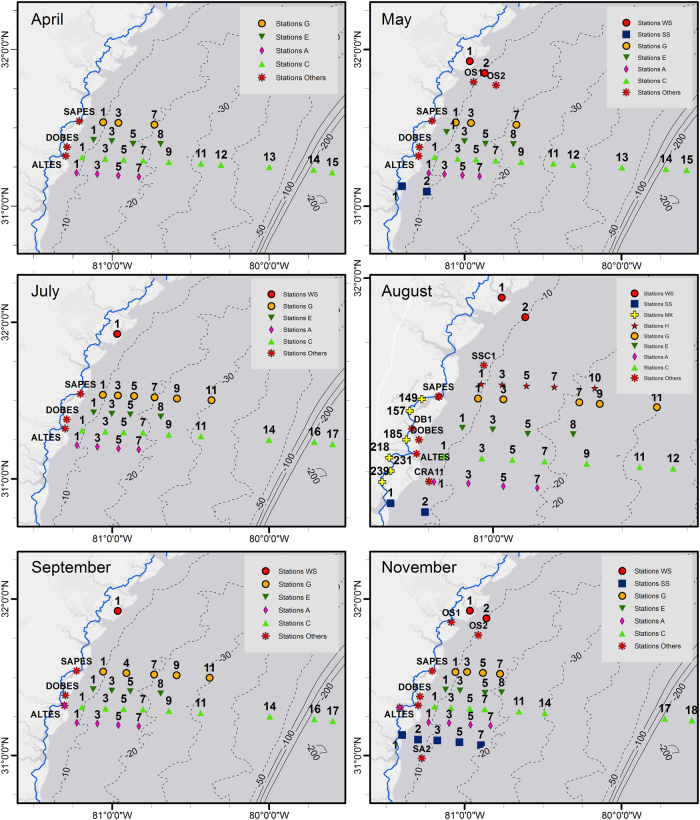
Mid-summer peaks in the abundance of Thaumarchaeota and nitrite concentration observed on the Georgia, USA, coast could result from in situ activity or advection of populations from another source. We collected data on the distribution of Thaumarchaeota, ammonia-oxidizing betaproteobacteria (AOB), Nitrospina, environmental variables and rates of ammonia oxidation during six cruises in the South Atlantic Bight (SAB) from April to November 2014. These data were used to examine seasonality of nitrification in offshore waters and to test the hypothesis that the bloom was localized to inshore waters. The abundance of Thaumarchaeota marker genes (16S rRNA and amoA) increased at inshore and nearshore stations starting in July and peaked in August at >10 copies L. The bloom did not extend onto the mid-shelf, where Thaumarchaeota genes ranged from 10 to 10 copies L. Ammonia oxidation rates (AO) were highest at inshore stations during summer (to 840 nmol L d) and were always at the limit of detection at mid-shelf stations. Nitrite concentrations were correlated with AO (R = 0.94) and were never elevated at mid-shelf stations. Gene sequences from samples collected at mid-shelf stations generated using Archaea 16S rRNA primers were dominated by Euryarchaeota; sequences from inshore and nearshore stations were dominated by Thaumarchaeota. Thaumarchaeota were also abundant at depth at the shelf-break; however, this population was phylogenetically distinct from the inshore/nearshore population. Our analysis shows that the bloom is confined to inshore waters during summer and suggests that Thaumarchaeota distributions in the SAB are controlled primarily by photoinhibition and secondarily by water temperature.
美国佐治亚州沿海夏季中期,氨氧化古菌和亚硝酸盐浓度达到峰值,可能是由于原地活动或从其他来源的种群扩散。我们在 2014 年 4 月至 11 月期间,在南大西洋湾进行了六次巡航,收集了氨氧化古菌、氨氧化β-变形菌(AOB)、硝化螺旋菌、环境变量和氨氧化速率的数据,以研究近海海域硝化作用的季节性,并检验这样的假设,即这种水华局限于近岸水域。从 7 月开始,近海和近岸站位的氨氧化古菌标记基因(16S rRNA 和 amoA)丰度增加,并在 8 月达到峰值,超过 10 拷贝 L。水华并未扩展到中陆架,在那里,氨氧化古菌基因的范围从 10 到 10 拷贝 L。夏季,近岸站位的氨氧化速率(AO)最高(达 840 nmol L d),而中陆架站位的氨氧化速率始终低于检测限。亚硝酸盐浓度与 AO 呈正相关(R = 0.94),而在中陆架站位从不升高。使用古菌 16S rRNA 引物在中陆架站位采集的样品的基因序列主要由广古菌组成;近海和近岸站位的序列主要由氨氧化古菌组成。在陆架坡折处的深海中,氨氧化古菌也很丰富;然而,该种群与近岸/近岸种群在系统发育上是不同的。我们的分析表明,水华在夏季仅限于近岸水域,并表明南大西洋湾的氨氧化古菌分布主要受光抑制控制,其次受水温控制。