Haghighi Ladan, Rashidi Mandana, Najmi Zahra, Homam Homa, Hashemi Neda, Mobasseri Alireza, Moradi Yousef
Endometriosis Research Center, Rasoul-e-Akram Hospital. Iran University of Medical Sciences. Tehran. Iran.
Shahid Akbar-abadi Hospital, Iran University of Medical Sciences, Tehran, Iran.
Med J Islam Repub Iran. 2017 Sep 6;31:56. doi: 10.14196/mjiri.31.56. eCollection 2017.
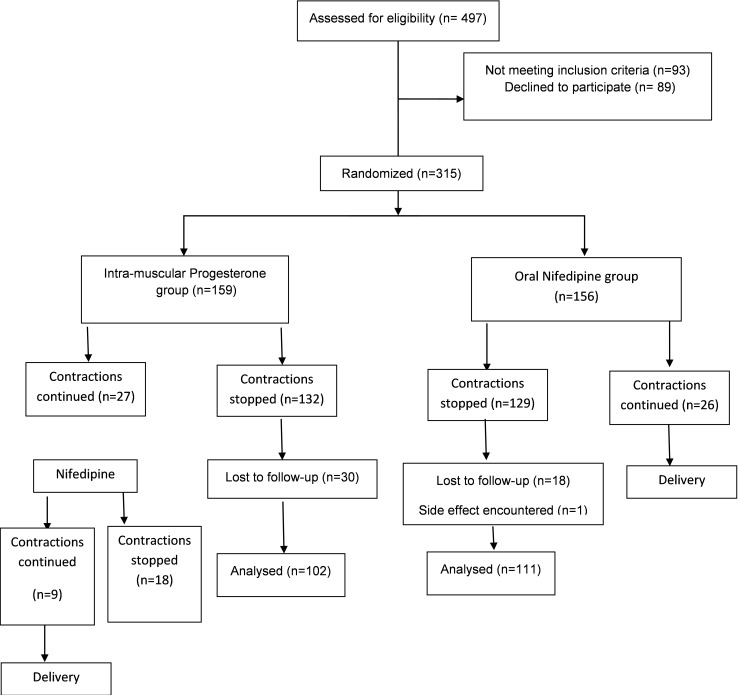
Threatened preterm labor (TPL) is the leading cause of hospitalization during pregnancy. Tocolytic agents are the primary therapeutic options for TPL. The aim of this study is to compare intramuscular progesterone with oral nifedipine as a tocolytic agent. This randomized controlled trial was carried out in a teaching hospital (Shahid Akbarabadi) in Tehran, Iran, from December 2011 to November 2012. Three hundred and fifteen singleton pregnant women aged >18 yrs at 26-34 weeks' gestation with the diagnosis of threatened preterm labor (TPL) were randomly received either intramuscular progesterone or oral nifedipine for tocolysis. Maternal and neonatal outcomes were then compared between the two interventions. P value less than 0.05 was considered statistically significant. IRCT registration number of this study is IRCT201112198469N1 The success rate of progesterone and nifedipine in treating TPL were 83% and 82.7%, respectively. There was no significant difference between the two interventions with regard to gestational age at delivery, type of delivery, the time interval until the delivery, birth weight, NICU admission rate and hospital stays. Progesterone administration was associated with lower duration of NICU stay as compared with nifedipine (0.33±0.77 days vs.1.5±3.2 days, p<0.05). None of the two drugs caused any major side effects. Single dose intramuscular progesterone is as effective as oral nifedipine in treating TPL. It also significantly reduces the NICU stay.
先兆早产(TPL)是孕期住院的主要原因。宫缩抑制剂是治疗先兆早产的主要治疗选择。本研究的目的是比较肌内注射黄体酮与口服硝苯地平作为宫缩抑制剂的效果。这项随机对照试验于2011年12月至2012年11月在伊朗德黑兰的一家教学医院(沙希德·阿克巴拉巴迪医院)进行。315名单胎妊娠妇女,年龄>18岁,孕26 - 34周,诊断为先兆早产(TPL),被随机分为接受肌内注射黄体酮或口服硝苯地平进行宫缩抑制治疗。然后比较两种干预措施的母婴结局。P值小于0.05被认为具有统计学意义。本研究的伊朗临床试验注册中心(IRCT)注册号为IRCT201112198469N1。黄体酮和硝苯地平治疗先兆早产的成功率分别为83%和82.7%。在分娩孕周、分娩方式、至分娩的时间间隔、出生体重、新生儿重症监护病房(NICU)入住率和住院时间方面,两种干预措施之间没有显著差异。与硝苯地平相比,使用黄体酮治疗后新生儿在NICU的住院时间更短(0.33±0.77天 vs.1.5±3.2天,p<0.05)。两种药物均未引起任何严重副作用。单剂量肌内注射黄体酮在治疗先兆早产方面与口服硝苯地平效果相同。它还能显著缩短新生儿在NICU的住院时间。