Department of Biochemistry, Stanford University, Stanford, United States.
Department of Physics, Stanford University, Stanford, United States.
Elife. 2018 Feb 15;7:e29602. doi: 10.7554/eLife.29602.
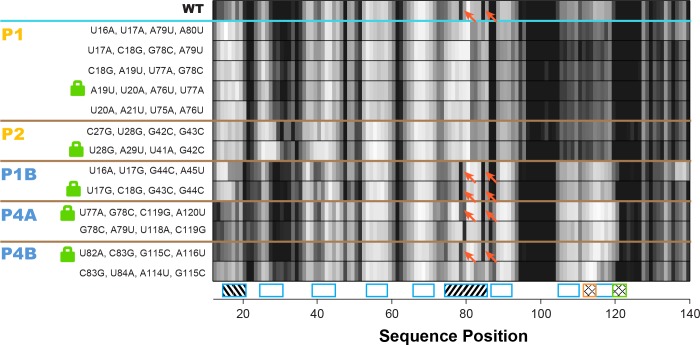
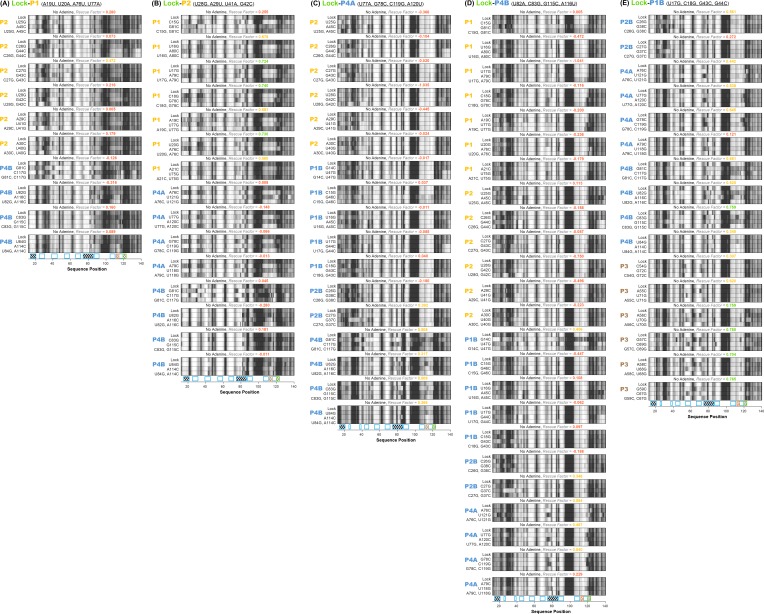
The structural interconversions that mediate the gene regulatory functions of RNA molecules may be different from classic models of allostery, but the relevant structural correlations have remained elusive in even intensively studied systems. Here, we present a four-dimensional expansion of chemical mapping called lock-mutate-map-rescue (LMR), which integrates multiple layers of mutation with nucleotide-resolution chemical mapping. This technique resolves the core mechanism of the adenine-responsive riboswitch, a paradigmatic system for which both Monod-Wyman-Changeux (MWC) conformational selection models and non-MWC alternatives have been proposed. To discriminate amongst these models, we locked each functionally important helix through designed mutations and assessed formation or depletion of other helices via compensatory rescue evaluated by chemical mapping. These LMR measurements give strong support to the pre-existing correlations predicted by MWC models, disfavor alternative models, and suggest additional structural heterogeneities that may be general across ligand-free riboswitches.
介导 RNA 分子基因调控功能的结构互变可能与经典的变构模型不同,但即使在深入研究的系统中,相关的结构相关性仍然难以捉摸。在这里,我们提出了一种称为锁定-突变-映射-拯救(LMR)的化学绘图四维扩展,它将多个突变层与核苷酸分辨率的化学绘图相结合。该技术解决了腺嘌呤反应性核酶的核心机制,核酶是一个典范的系统,已有 Monod-Wyman-Changeux(MWC)构象选择模型和非-MWC 替代模型被提出。为了在这些模型之间进行区分,我们通过设计突变锁定每个功能上重要的螺旋,并通过化学绘图评估的补偿性拯救来评估其他螺旋的形成或耗尽。这些 LMR 测量结果强烈支持了 MWC 模型预测的先前存在的相关性,不支持替代模型,并表明可能在配体游离核酶中普遍存在的其他结构异质性。