Program for Evolutionary Dynamics, Department of Mathematics and Department of Organismic & Evolutionary Biology, Harvard University, Cambridge, Massachusetts, United States of America.
Department of Physics, Harvard University, Cambridge, Massachusetts, United States of America.
PLoS Comput Biol. 2018 Feb 15;14(2):e1005947. doi: 10.1371/journal.pcbi.1005947. eCollection 2018 Feb.
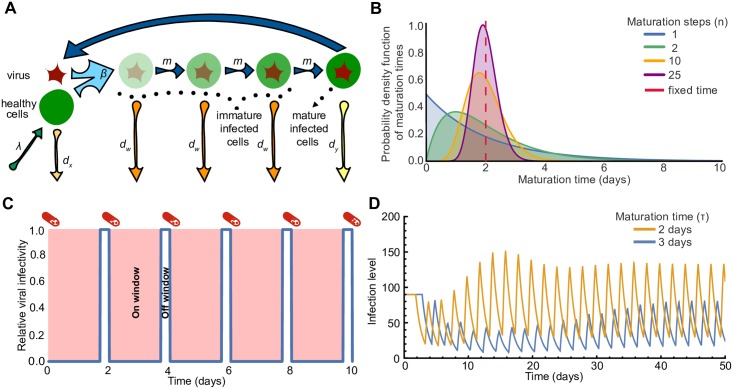
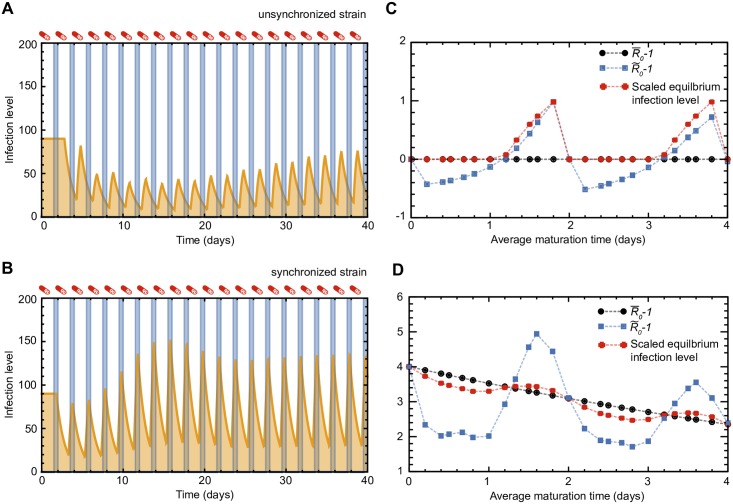
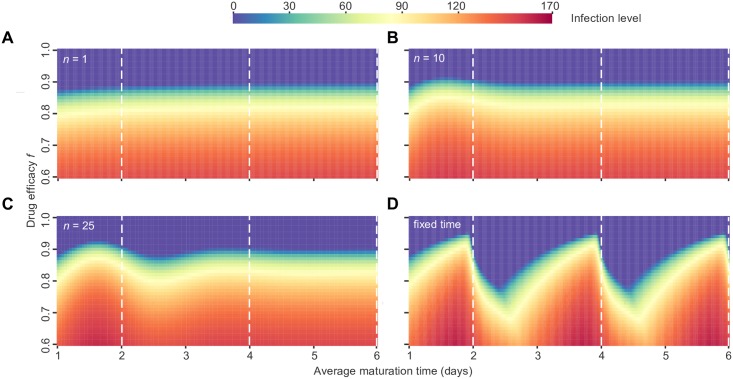
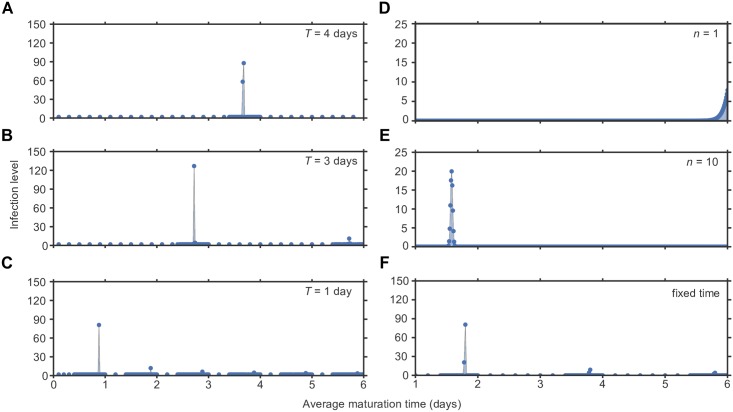
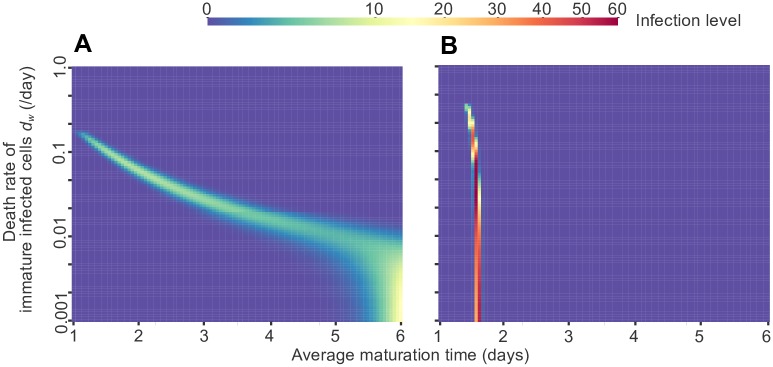
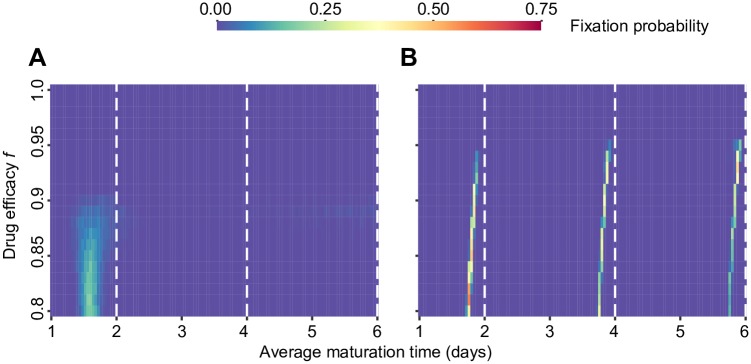
Viral infections are one of the major causes of death worldwide, with HIV infection alone resulting in over 1.2 million casualties per year. Antiviral drugs are now being administered for a variety of viral infections, including HIV, hepatitis B and C, and influenza. These therapies target a specific phase of the virus's life cycle, yet their ultimate success depends on a variety of factors, such as adherence to a prescribed regimen and the emergence of viral drug resistance. The epidemiology and evolution of drug resistance have been extensively characterized, and it is generally assumed that drug resistance arises from mutations that alter the virus's susceptibility to the direct action of the drug. In this paper, we consider the possibility that a virus population can evolve towards synchronizing its life cycle with the pattern of drug therapy. The periodicity of the drug treatment could then allow for a virus strain whose life cycle length is a multiple of the dosing interval to replicate only when the concentration of the drug is lowest. This process, referred to as "drug tolerance by synchronization", could allow the virus population to maximize its overall fitness without having to alter drug binding or complete its life cycle in the drug's presence. We use mathematical models and stochastic simulations to show that life cycle synchronization can indeed be a mechanism of viral drug tolerance. We show that this effect is more likely to occur when the variability in both viral life cycle and drug dose timing are low. More generally, we find that in the presence of periodic drug levels, time-averaged calculations of viral fitness do not accurately predict drug levels needed to eradicate infection, even if there is no synchronization. We derive an analytical expression for viral fitness that is sufficient to explain the drug-pattern-dependent survival of strains with any life cycle length. We discuss the implications of these findings for clinically relevant antiviral strategies.
病毒感染是全球主要死亡原因之一,仅 HIV 感染每年就导致超过 120 万人死亡。目前,针对包括 HIV、乙型肝炎和丙型肝炎以及流感在内的多种病毒感染,都在使用抗病毒药物进行治疗。这些疗法针对病毒生命周期的特定阶段,但它们的最终成功取决于多种因素,例如遵循规定的治疗方案以及病毒耐药性的出现。耐药性的流行病学和演变已经得到了广泛的描述,人们普遍认为耐药性是由于改变病毒对药物直接作用的敏感性的突变而产生的。在本文中,我们考虑了病毒群体可能朝着使其生命周期与药物治疗模式同步的方向进化的可能性。药物治疗的周期性可以允许其生命周期长度是给药间隔的倍数的病毒株仅在药物浓度最低时复制。这个过程被称为“通过同步实现药物耐受性”,可以使病毒群体在不改变药物结合或在药物存在下完成其生命周期的情况下,最大限度地提高其整体适应性。我们使用数学模型和随机模拟表明,生命周期同步确实可以成为病毒药物耐受性的一种机制。我们表明,当病毒生命周期和药物剂量定时的变异性都较低时,这种效应更有可能发生。更一般地,我们发现,在周期性药物水平存在的情况下,即使没有同步,病毒适应性的时间平均计算也不能准确预测消除感染所需的药物水平。我们推导出一个病毒适应性的解析表达式,该表达式足以解释具有任何生命周期长度的菌株对药物模式依赖性生存的原因。我们讨论了这些发现对临床相关抗病毒策略的意义。