Svefors Pernilla, Selling Katarina Ekholm, Shaheen Rubina, Khan Ashraful Islam, Persson Lars-Åke, Lindholm Lars
International Maternal and Child Health, Department of Women's and Children's Health, Uppsala University, Uppsala, Sweden.
International Centre for Diarrhoeal Disease Research, Bangladesh (icddr,b), Dhaka, Bangladesh.
PLoS One. 2018 Feb 15;13(2):e0191260. doi: 10.1371/journal.pone.0191260. eCollection 2018.
Nutrition interventions may have favourable as well as unfavourable effects. The Maternal and Infant Nutrition Interventions in Matlab (MINIMat), with early prenatal food and micronutrient supplementation, reduced infant mortality and were reported to be very cost-effective. However, the multiple micronutrients (MMS) supplement was associated with an increased risk of stunted growth in infancy and early childhood. This unfavourable outcome was not included in the previous cost-effectiveness analysis. The aim of this study is to evaluate whether the MINIMat interventions remain cost-effective in view of both favourable (decreased under-five-years mortality) and unfavourable (increased stunting) outcomes.
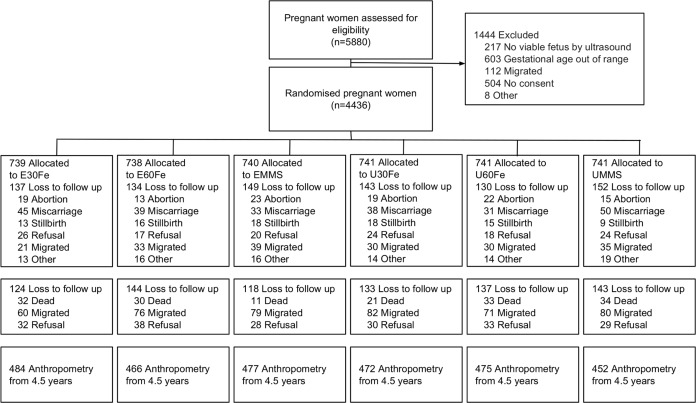
Pregnant women in rural Bangladesh, where food insecurity still is prevalent, were randomized to early (E) or usual (U) invitation to be given food supplementation and daily doses of 30 mg, or 60 mg iron with 400 μg of folic acid, or MMS with 15 micronutrients including 30 mg iron and 400 μg of folic acid. E reduced stunting at 4.5 years compared with U, MMS increased stunting at 4.5 years compared with Fe60, while the combination EMMS reduced infant mortality compared with UFe60. The outcome measure used was disability adjusted life years (DALYs), a measure of overall disease burden that combines years of life lost due to premature mortality (under five-year mortality) and years lived with disability (stunting). Incremental cost effectiveness ratios were calculated using cost data from already published studies.
By incrementing UFe60 (standard practice) to EMMS, one DALY could be averted at a cost of US$24.
When both favourable and unfavourable outcomes were included in the analysis, early prenatal food and multiple micronutrient interventions remained highly cost effective and seem to be meaningful from a public health perspective.
营养干预可能产生有利和不利的影响。在Matlab开展的母婴营养干预项目(MINIMat),通过早期产前食物和微量营养素补充,降低了婴儿死亡率,据报道具有很高的成本效益。然而,多种微量营养素(MMS)补充剂与婴儿期和幼儿期发育迟缓风险增加有关。这一不利结果未包含在先前的成本效益分析中。本研究的目的是鉴于有利(五岁以下儿童死亡率降低)和不利(发育迟缓增加)两种结果,评估MINIMat干预措施是否仍然具有成本效益。
在孟加拉国农村地区,粮食不安全问题仍然普遍存在,将孕妇随机分为早期(E)或常规(U)组,分别给予食物补充剂以及每日30毫克或60毫克铁加400微克叶酸,或含有15种微量营养素(包括30毫克铁和400微克叶酸)的MMS。与U组相比,E组在4.5岁时发育迟缓情况减少;与Fe60组相比,MMS组在4.5岁时发育迟缓情况增加;而与UFe60组相比,EMMS组合降低了婴儿死亡率。所使用的结果指标是伤残调整生命年(DALYs),这是一种衡量总体疾病负担的指标,它综合了因过早死亡(五岁以下儿童死亡率)导致的生命年损失和因残疾(发育迟缓)导致的生存年数。使用已发表研究中的成本数据计算增量成本效益比。
将UFe60(标准做法)增加到EMMS,每避免一个伤残调整生命年的成本为24美元。
当分析中同时纳入有利和不利结果时,早期产前食物和多种微量营养素干预措施仍然具有很高的成本效益,并且从公共卫生角度来看似乎是有意义的。