Demoersman Julien, Pochard Pierre, Framery Camille, Simon Quentin, Boisramé Sylvie, Soueidan Assem, Pers Jacques-Olivier
UMR1227, Université de Brest, Inserm, Brest, France.
LabEx IGO, Brest, France.
PLoS One. 2018 Feb 15;13(2):e0192986. doi: 10.1371/journal.pone.0192986. eCollection 2018.
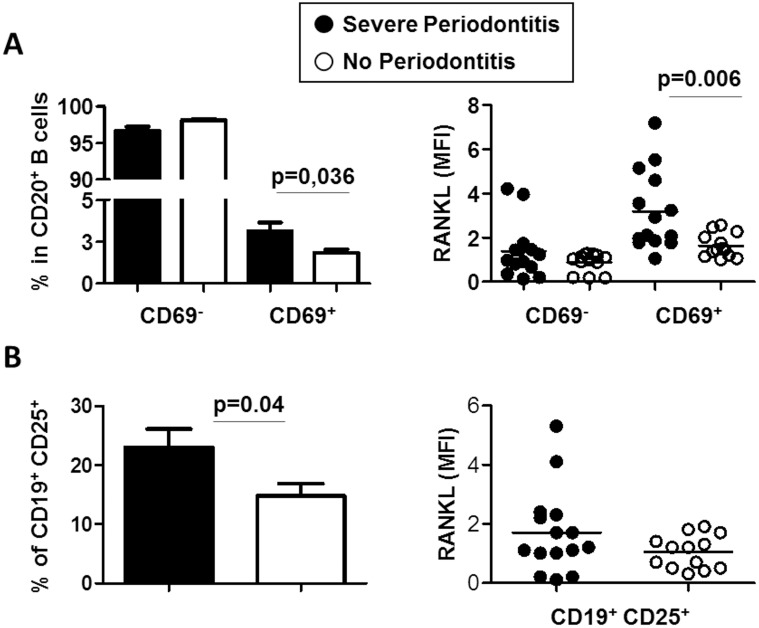
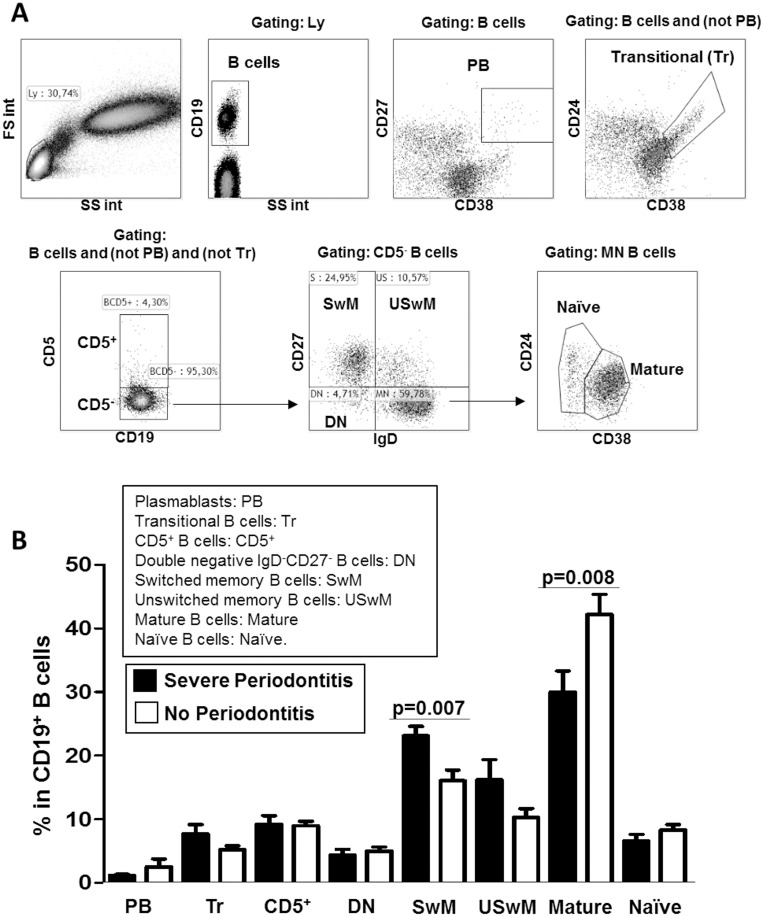
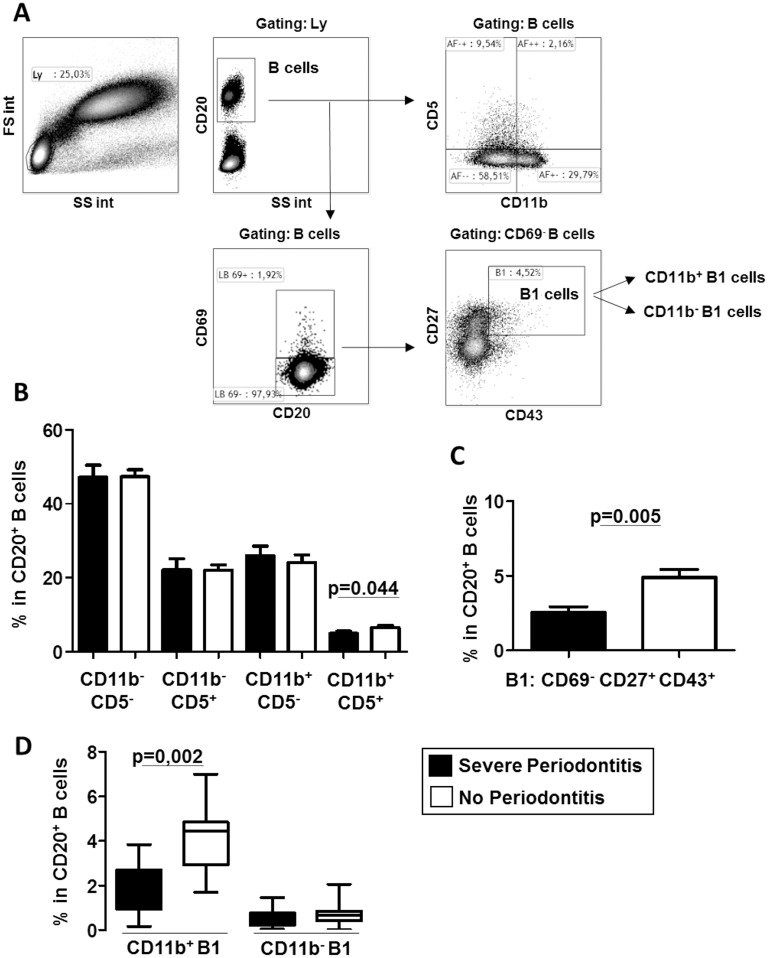
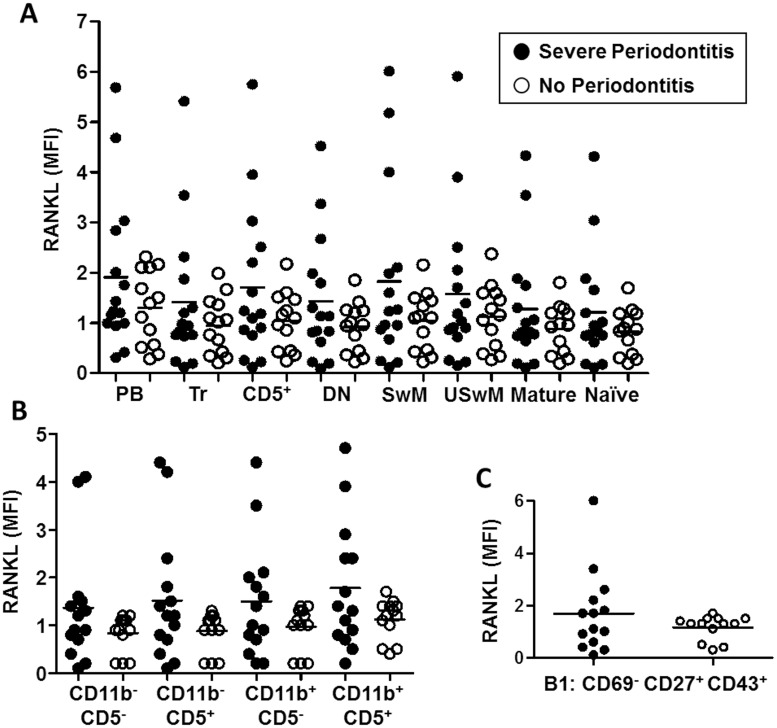
Several studies have recently highlighted the implication of B cells in physiopathogenesis of periodontal disease by showing that a B cell deficiency leads to improved periodontal parameters. However, the detailed profiles of circulating B cell subsets have not yet been investigated in patients with severe periodontitis (SP). We hypothesised that an abnormal distribution of B cell subsets could be detected in the blood of patients with severe periodontal lesions, as already reported for patients with chronic inflammatory diseases as systemic autoimmune diseases. Fifteen subjects with SP and 13 subjects without periodontitis, according to the definition proposed by the CDC periodontal disease surveillance work group, were enrolled in this pilot observational study. Two flow cytometry panels were designed to analyse the circulating B and B1 cell subset distribution in association with the RANKL expression. A significantly higher percentage of CD27+ memory B cells was observed in patients with SP. Among these CD27+ B cells, the proportion of the switched memory subset was significantly higher. At the same time, human B1 cells, which were previously associated with a regulatory function (CD20+CD69-CD43+CD27+CD11b+), decreased in SP patients. The RANKL expression increased in every B cell subset from the SP patients and was significantly greater in activated B cells than in the subjects without periodontitis. These preliminary results demonstrate the altered distribution of B cells in the context of severe periodontitis. Further investigations with a larger cohort of patients can elucidate if the analysis of the B cell compartment distribution can reflect the periodontal disease activity and be a reliable marker for its prognosis (clinical trial registration number: NCT02833285, B cell functions in periodontitis).
最近的几项研究通过表明B细胞缺陷会导致牙周参数改善,突出了B细胞在牙周疾病发病机制中的作用。然而,重度牙周炎(SP)患者循环B细胞亚群的详细特征尚未得到研究。我们假设,重度牙周病变患者血液中可能检测到B细胞亚群分布异常,正如在系统性自身免疫性疾病等慢性炎症性疾病患者中所报道的那样。根据美国疾病控制与预防中心(CDC)牙周疾病监测工作组提出的定义,15名SP患者和13名无牙周炎患者参与了这项初步观察性研究。设计了两个流式细胞术分析方案,以分析循环B细胞和B1细胞亚群分布与RANKL表达的关系。在SP患者中观察到CD27+记忆B细胞的百分比显著更高。在这些CD27+ B细胞中,转换记忆亚群的比例显著更高。同时,先前与调节功能相关的人类B1细胞(CD20+CD69-CD43+CD27+CD11b+)在SP患者中减少。SP患者每个B细胞亚群中的RANKL表达均增加,且活化B细胞中的RANKL表达显著高于无牙周炎的受试者。这些初步结果表明,在重度牙周炎情况下B细胞分布发生了改变。对更大患者队列的进一步研究可以阐明,B细胞区室分布分析是否能够反映牙周疾病活动情况,并成为其预后的可靠标志物(临床试验注册号:NCT02833285,牙周炎中的B细胞功能)。