Division of Respiratory Medicine, Department of Internal Medicine, Kobe University Graduate School of Medicine, Kobe, Japan.
PLoS One. 2018 Feb 15;13(2):e0193018. doi: 10.1371/journal.pone.0193018. eCollection 2018.
Nivolumab improves the survival of advanced non-small cell lung cancer (NSCLC), but a significant number of patients still fail to benefit from this treatment. In this study, we evaluated the efficacy of the time-series behavior of neutrophil-to-lymphocyte ratio (NLR) in a complete blood count from advanced NSCLC patients as a predictive marker of the anticancer effect of nivolumab.
We performed a retrospective review of medical records and collected data on patients with advanced NSCLC treated with nivolumab as second- and further-line treatments from December 2015 to March 2017. The NLRs were calculated before each treatment cycle for four cycles. These parameters were tested for its association with the overall survival (OS), progression-free survival (PFS) and time to treatment failure (TTF).
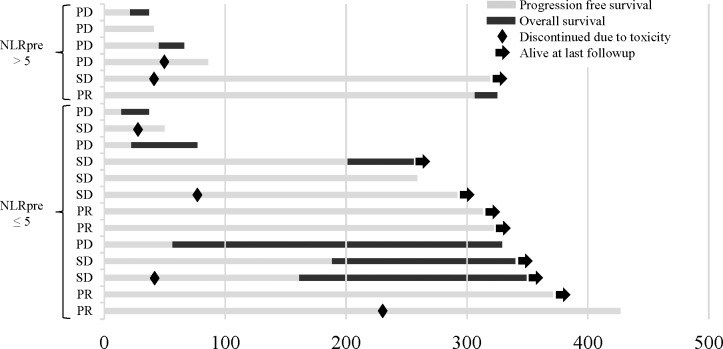
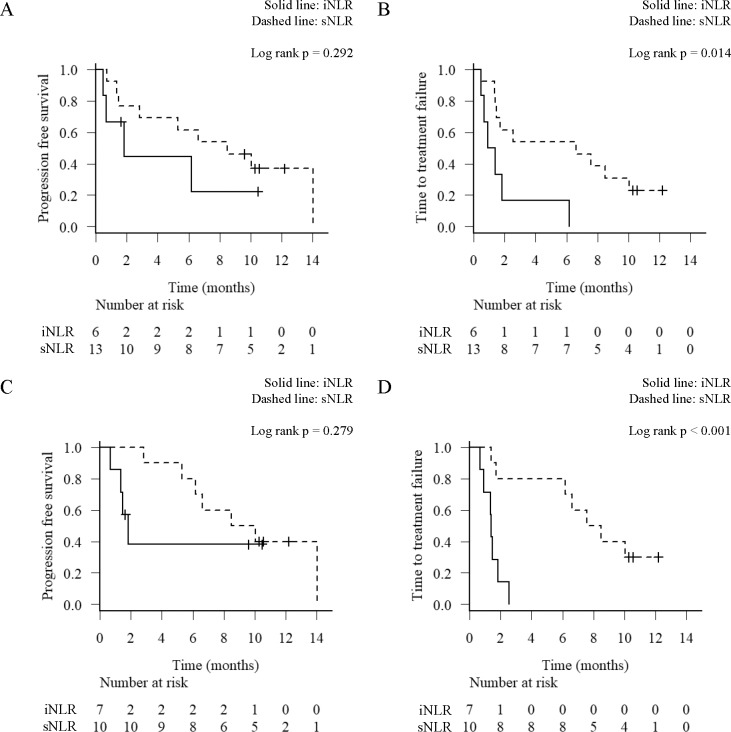
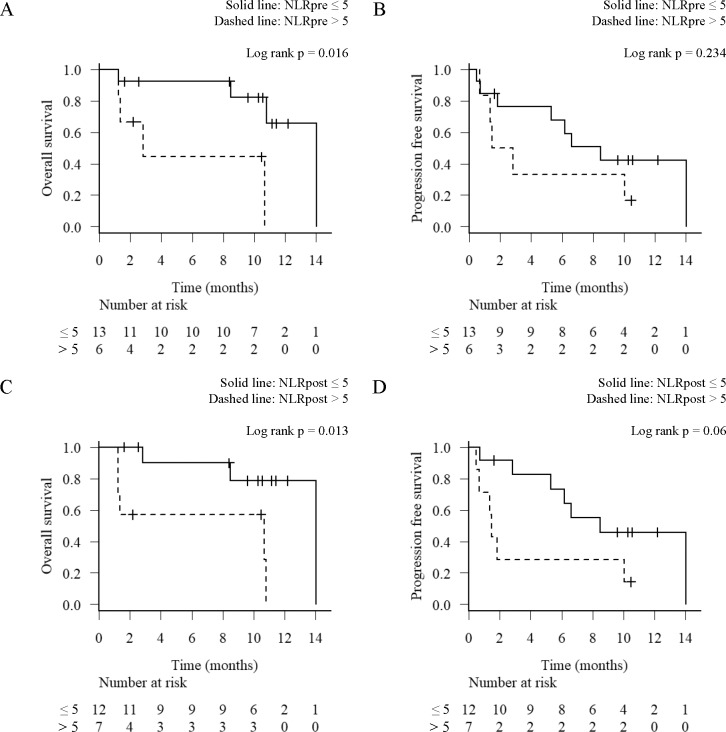
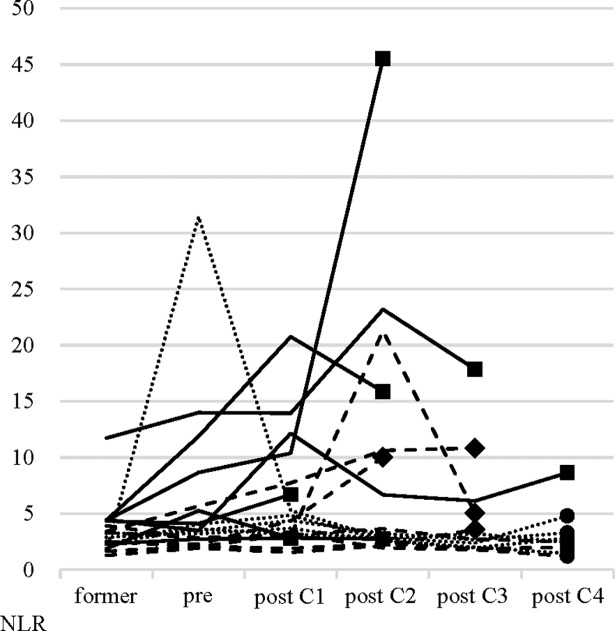
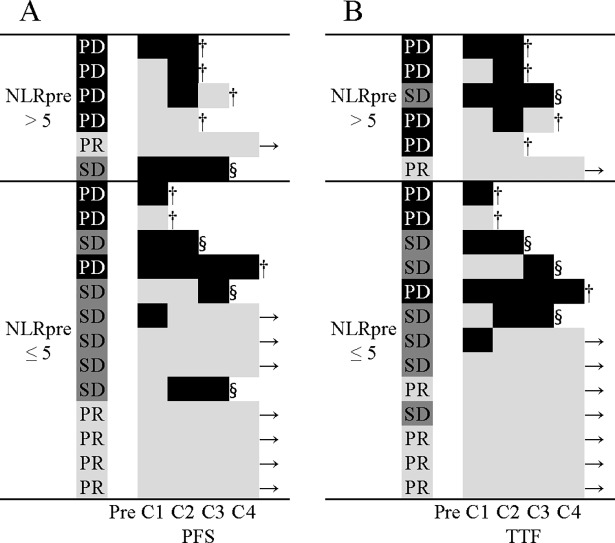
Nineteen patients were treated with nivolumab. Stratified by the response to nivolumab, the median OS was 2.8 months in progressive disease (PD) and 14.0 months in non-PD (p = 0.002). Before discontinuation of PD or toxicity, an NLR is rising from baseline in 5 out of 7 patients with PD and all of 4 patients with discontinuation due to toxicity. Patients with an >30% increase in NLR were associated with a significantly shorter TTF compared with those with stable or decrease in NLR both after first cycle (p = 0.014) and second cycle (p < 0.001).
The NLR is suggested to be useful not only as a prognostic marker but also as a predictive marker for treatment with nivolumab. Further prospective study is warranted to develop a predictive algorithm to detect PD cases as early as possible by focusing the time-series behavior of NLR.
纳武利尤单抗可改善晚期非小细胞肺癌(NSCLC)患者的生存,但仍有相当一部分患者无法从中获益。本研究旨在评估全血细胞计数中性粒细胞与淋巴细胞比值(NLR)时间序列变化在预测纳武利尤单抗疗效方面的作用。
我们对 2015 年 12 月至 2017 年 3 月接受纳武利尤单抗二线或进一步治疗的晚期 NSCLC 患者的病历进行了回顾性分析,共纳入 19 例患者。在每个治疗周期前计算 NLR,共进行 4 个周期。评估 NLR 与总生存期(OS)、无进展生存期(PFS)和治疗失败时间(TTF)之间的相关性。
根据纳武利尤单抗的疗效进行分层,进展性疾病(PD)患者的中位 OS 为 2.8 个月,非 PD 患者的中位 OS 为 14.0 个月(p = 0.002)。在 PD 患者停止治疗或发生毒性反应前,7 例 PD 患者中有 5 例 NLR 基线升高,4 例因毒性反应停止治疗的患者中 NLR 全部升高。与 NLR 稳定或下降的患者相比,首次治疗周期后(p = 0.014)和第二次治疗周期后(p < 0.001)NLR 增加>30%的患者 TTF 显著缩短。
NLR 不仅可作为预后标志物,还可作为预测纳武利尤单抗治疗疗效的标志物。需要进一步开展前瞻性研究,以开发一种预测算法,通过关注 NLR 的时间序列变化,尽早发现 PD 病例。