National Center for Medical Imaging and Instrumentation Research, Universidad Autónoma Metropolitana-Iztapalapa, Mexico City, Mexico.
Central Norte Pemex, Hospital Angeles Pedregal, Mexico City, Mexico.
J Transl Med. 2018 Feb 15;16(1):27. doi: 10.1186/s12967-018-1398-6.
Magnetic stimulation of the facial nerve has been tested in preclinical studies as a new, non-invasive emergency treatment of ischemic stroke that acts by increasing cerebral blood flow (CBF). The objective of the studies reported herein was to identify minimal stimulation parameters that increase CBF in large animals and then test those stimulation parameters in healthy volunteers for safety, tolerability, and effectiveness at increasing CBF. This translational research is necessary preparation for clinical studies in ischemic stroke patients.
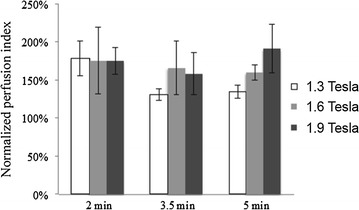
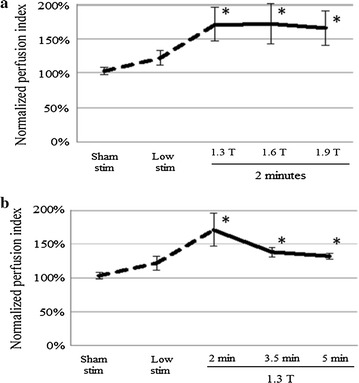
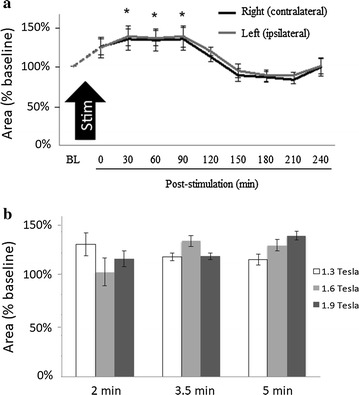
Initial experiments in anesthetized Yorkshire pigs were undertaken in order to identify the lowest stimulus power and duration that increase CBF. A full 3 × 3 factorial design was used to evaluate magnetic stimulation of the facial nerve at various stimulation powers (1.3, 1.6, and 1.9 Tesla field strength at coil surface) and for various durations (2, 3.5, and 5 min). CBF was measured with contrast MRI perfusion imaging and the internal carotid arteries were assessed with MR angiography. Magnetic facial nerve stimulation with parameters identified in the pig study was then applied to 35 healthy volunteers. Safety was assessed with adverse event reports and by medical examination. Tolerability was defined as each volunteer's ability to withstand at least 2 min of stimulation. Volunteers could determine the maximum power of stimulation they received during a ramp-up period.
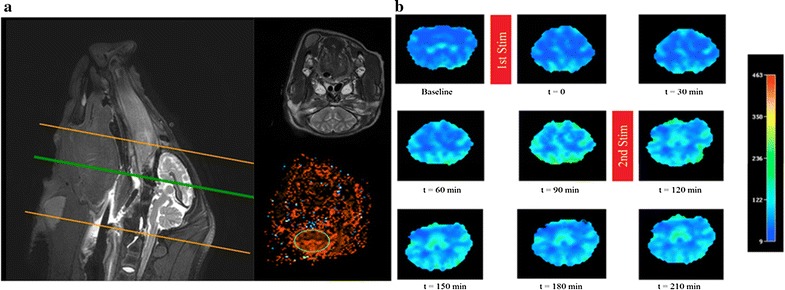
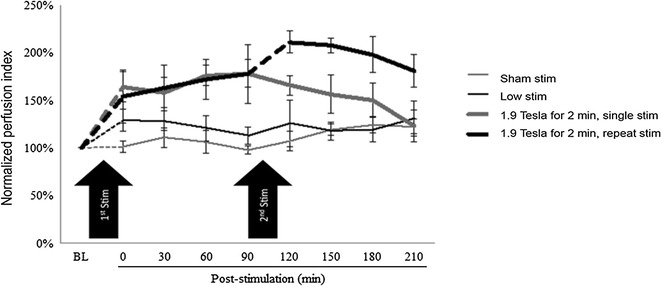
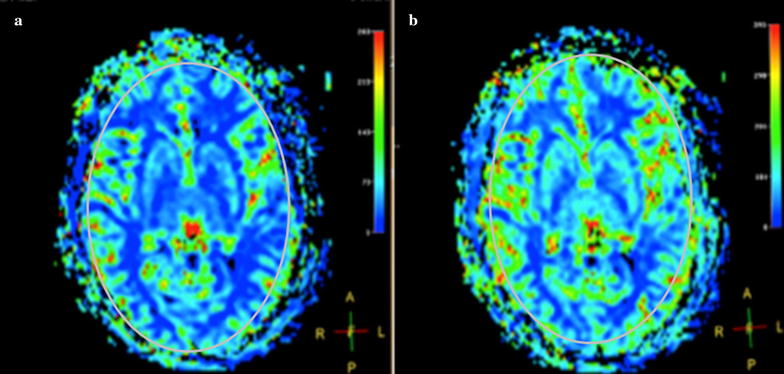
In pigs, unilateral facial nerve stimulation increased CBF by as much as 77% over pre-stimulation baseline when administered across a range of 1.3-1.9 Tesla power and for 2- to 5-min duration. No clear dose-response relationship could be observed across this range, but lower powers and durations than these were markedly less effective. The effect of a single stimulation lasted 90 min. A second stimulation delivered 100 min after the first stimulation sustained the increased CBF without evidence of tachyphylaxis. In human, bilateral facial nerve stimulation caused only non-serious adverse events that were limited to the 2-min stimulation period. Tolerability was greatly improved by gentle encouragement from the study staff, which enabled most volunteers to tolerate 1.6-1.8 Tesla of stimulation power. CBF measures taken approximately 10 min after stimulation demonstrated on average a 32 ± 6% increase in CBF, with ≥ 25% increases in CBF occurring in 10 of the 31 volunteers who had adequate CBF measurements.
The minimal effective stimulation parameters defined by increased CBF, as identified in the pig study, translated into safe, tolerable, and effective stimulation of healthy volunteers. These results support the future development and evaluation of non-invasive facial nerve stimulation for the emergency treatment of ischemic stroke. Trial Registration retrospectively registered with clinicaltrials.gov NRV_P1_01_15 on June 6, 2017.
面神经磁刺激已在临床前研究中进行了测试,作为一种新的非侵入性紧急治疗缺血性中风的方法,通过增加脑血流量(CBF)起作用。本报告研究的目的是确定增加大动物 CBF 的最小刺激参数,然后在健康志愿者中测试这些刺激参数的安全性、耐受性和增加 CBF 的有效性。这项转化研究是为缺血性中风患者的临床研究做必要的准备。
在麻醉的约克郡猪中进行了初步实验,以确定增加 CBF 的最低刺激功率和持续时间。采用完全 3×3 析因设计来评估面神经的磁刺激,刺激功率为不同(线圈表面的 1.3、1.6 和 1.9 特斯拉磁场强度)和不同持续时间(2、3.5 和 5 分钟)。使用对比 MRI 灌注成像测量 CBF,并使用 MR 血管造影评估颈内动脉。然后,使用在猪研究中确定的参数对面神经进行磁刺激,并将其应用于 35 名健康志愿者。通过不良事件报告和体检评估安全性。耐受性定义为每个志愿者至少耐受 2 分钟刺激的能力。志愿者可以在升压期确定他们接受的最大刺激功率。
在猪中,当在 1.3-1.9 特斯拉功率范围内进行 2-5 分钟的单侧面神经刺激时,CBF 增加了 77%,高于刺激前基线。在该范围内未观察到明显的剂量反应关系,但低于该范围的较低功率和持续时间效果明显较差。单次刺激的效果持续 90 分钟。在第一次刺激后 100 分钟进行第二次刺激可维持增加的 CBF,而没有出现脱敏迹象。在人中,双侧面神经刺激仅引起非严重的不良事件,仅限于 2 分钟的刺激期。通过研究人员的温和鼓励,大大提高了耐受性,这使大多数志愿者能够耐受 1.6-1.8 特斯拉的刺激功率。刺激后约 10 分钟进行的 CBF 测量显示,CBF 平均增加了 32±6%,31 名有足够 CBF 测量值的志愿者中有 10 名 CBF 增加≥25%。
在猪研究中,通过增加 CBF 确定的最小有效刺激参数转化为健康志愿者的安全、耐受和有效刺激。这些结果支持未来开发和评估非侵入性面神经刺激治疗缺血性中风的紧急治疗。试验注册号:NRV_P1_01_15,于 2017 年 6 月 6 日在 clinicaltrials.gov 上进行了回顾性注册。