• 文献检索
  • 文档翻译
  • 深度研究
  • 学术资讯
  • Suppr Zotero 插件Zotero 插件
  • 邀请有礼
  • 套餐&价格
  • 历史记录
应用&插件
Suppr Zotero 插件Zotero 插件浏览器插件Mac 客户端Windows 客户端微信小程序
定价
高级版会员购买积分包购买API积分包
服务
文献检索文档翻译深度研究API 文档MCP 服务
关于我们
关于 Suppr公司介绍联系我们用户协议隐私条款
关注我们

Suppr 超能文献

核心技术专利:CN118964589B侵权必究
粤ICP备2023148730 号-1Suppr @ 2026

文献检索

告别复杂PubMed语法,用中文像聊天一样搜索,搜遍4000万医学文献。AI智能推荐,让科研检索更轻松。

立即免费搜索

文件翻译

保留排版,准确专业,支持PDF/Word/PPT等文件格式,支持 12+语言互译。

免费翻译文档

深度研究

AI帮你快速写综述,25分钟生成高质量综述,智能提取关键信息,辅助科研写作。

立即免费体验

影响关于男性气质与自杀的对话:利用推特数据对“振作起来”多媒体宣传活动的评估

Influencing the Conversation About Masculinity and Suicide: Evaluation of the Man Up Multimedia Campaign Using Twitter Data.

作者信息

Schlichthorst Marisa, King Kylie, Turnure Jackie, Sukunesan Suku, Phelps Andrea, Pirkis Jane

机构信息

Centre for Mental Health, Melbourne School of Population and Global Health, The University of Melbourne, Parkville, Australia.

Heiress Films, Sydney, Australia.

出版信息

JMIR Ment Health. 2018 Feb 15;5(1):e14. doi: 10.2196/mental.9120.

DOI:10.2196/mental.9120
PMID:29449203
原文链接:https://pmc.ncbi.nlm.nih.gov/articles/PMC5832906/
Abstract

BACKGROUND

It has been suggested that some dominant aspects of traditional masculinity are contributing to the high suicide rates among Australian men. We developed a three-episode documentary called Man Up, which explores the complex relationship between masculinity and suicide and encourages men to question socially imposed rules about what it means to be a man and asks them to open up, express difficult emotions, and seek help if and when needed. We ran a three-phase social media campaign alongside the documentary using 5 channels (Twitter, Facebook, Instagram, YouTube, and Tumblr).

OBJECTIVE

This study aimed to examine the extent to which the Man Up Twitter campaign influenced the social media conversation about masculinity and suicide.

METHODS

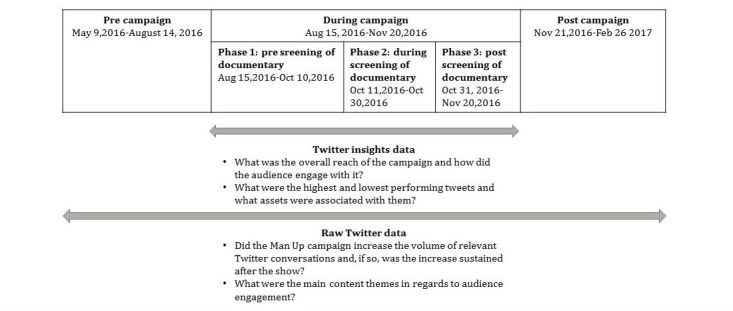
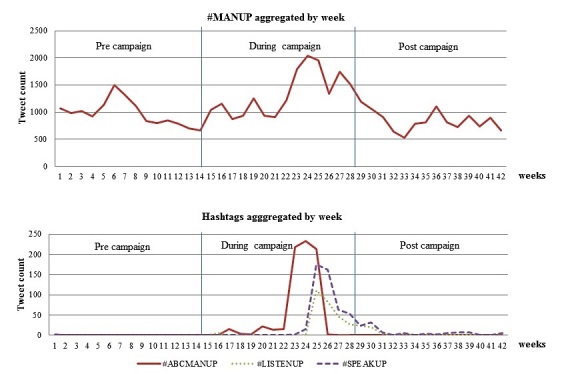
We used Twitter insights data to assess the reach of and engagement with the campaign (using metrics on followers, likes, retweets, and impressions) and to determine the highest and lowest performing tweets in the campaign (using an aggregated performance measure of reactions). We used original content tweets to determine whether the campaign increased the volume of relevant Twitter conversations (aggregating the number of tweets for selected campaign hashtags over time), and we used a subset of these data to gain insight into the main content themes with respect to audience engagement.

RESULTS

The campaign generated a strong following that was engaged with the content of the campaign; over its whole duration, the campaign earned approximately 5000 likes and 2500 retweets and gained around 1,022,000 impressions. The highest performing tweets posted by the host included video footage and occurred during the most active period of the campaign (around the screening of the documentary). The volume of conversations in relation to commonly used hashtags (#MANUP, #ABCMANUP, #LISTENUP, and #SPEAKUP) grew in direct relation to the campaign activities, achieving strongest growth during the 3 weeks when the documentary was aired. Strongest engagement was found with content related to help-seeking, masculinity, and expressing emotions. A number of followers tweeted personal stories that revealed overwhelmingly positive perceptions of the content of the documentary and strongly endorsed its messages.

CONCLUSIONS

The Man Up Twitter campaign triggered conversations about masculinity and suicide that otherwise may not have happened. For some, this may have been game-changing in terms of shifting attitudes toward expressing emotions and reaching out to others for help. The campaign was particularly effective in disseminating information and promoting conversations in real time, an advantage that it had over more traditional health promotion campaigns. This sort of approach could well be adapted to other areas of mental (and physical) health promotion campaigns to increase their reach and effectiveness.
https://cdn.ncbi.nlm.nih.gov/pmc/blobs/f597/5832906/223c1a7fba41/mental_v5i1e14_fig2.jpg
https://cdn.ncbi.nlm.nih.gov/pmc/blobs/f597/5832906/895e54efc186/mental_v5i1e14_fig1.jpg
https://cdn.ncbi.nlm.nih.gov/pmc/blobs/f597/5832906/223c1a7fba41/mental_v5i1e14_fig2.jpg
https://cdn.ncbi.nlm.nih.gov/pmc/blobs/f597/5832906/895e54efc186/mental_v5i1e14_fig1.jpg
https://cdn.ncbi.nlm.nih.gov/pmc/blobs/f597/5832906/223c1a7fba41/mental_v5i1e14_fig2.jpg
摘要

背景

有人认为,传统男性气质的某些主要方面导致了澳大利亚男性自杀率居高不下。我们制作了一部三集纪录片《振作起来》,探讨男性气质与自杀之间的复杂关系,并鼓励男性质疑社会强加的关于何为男性的规则,要求他们敞开心扉,表达复杂情感,并在需要时寻求帮助。我们在纪录片播出的同时,利用5个社交媒体渠道(推特、脸书、照片墙、优兔和汤博乐)开展了一个分三个阶段的社交媒体宣传活动。

目的

本研究旨在考察“振作起来”推特宣传活动对社交媒体上有关男性气质和自杀话题讨论的影响程度。

方法

我们利用推特洞察数据来评估宣传活动的覆盖面和参与度(使用关注者、点赞、转发和展示量等指标),并确定宣传活动中表现最佳和最差的推文(使用反应的综合表现指标)。我们利用原创内容推文来确定宣传活动是否增加了相关推特对话的数量(汇总选定宣传活动主题标签随时间变化的推文数量),并利用这些数据的一个子集来深入了解与受众参与度相关的主要内容主题。

结果

该宣传活动吸引了大量关注者,他们积极参与宣传活动的内容;在整个活动期间,该活动获得了约5000个赞和2500次转发,展示量约为102.2万次。主持人发布的表现最佳的推文包含视频片段,且出现在宣传活动最活跃的时期(纪录片播出前后)。与常用主题标签(#振作起来#、#澳大利亚广播公司振作起来#、#倾听#和#大声说出来#)相关的对话数量与宣传活动的开展直接相关,在纪录片播出的3周内增长最为强劲。与寻求帮助、男性气质和表达情感相关的内容参与度最高。许多关注者发布了个人故事,这些故事显示出对纪录片内容压倒性的积极看法,并强烈认可其传达的信息。

结论

“振作起来”推特宣传活动引发了关于男性气质和自杀的讨论,否则这些讨论可能不会发生。对一些人来说,这在改变对表达情感和向他人求助的态度方面可能具有变革性意义。该宣传活动在实时传播信息和促进对话方面特别有效,这是它相对于更传统的健康促进活动的一个优势。这种方法很可能适用于心理健康(和身体健康)促进活动的其他领域,以扩大其覆盖面和提高其有效性。

相似文献

1
Influencing the Conversation About Masculinity and Suicide: Evaluation of the Man Up Multimedia Campaign Using Twitter Data.影响关于男性气质与自杀的对话:利用推特数据对“振作起来”多媒体宣传活动的评估
JMIR Ment Health. 2018 Feb 15;5(1):e14. doi: 10.2196/mental.9120.
2
An Evaluation of the Boys Do Cry Suicide Prevention Media Campaign on Twitter: Mixed Methods Approach.一项关于推特上“男孩也会哭泣”自杀预防媒体宣传活动的评估:混合方法研究。
JMIR Form Res. 2023 Sep 7;7:e49325. doi: 10.2196/49325.
3
Evaluation of a Social Media Campaign in Saskatchewan to Promote Healthy Eating During the COVID-19 Pandemic: Social Media Analysis and Qualitative Interview Study.萨斯喀彻温省一项在新冠疫情期间促进健康饮食的社交媒体活动评估:社交媒体分析与定性访谈研究
J Med Internet Res. 2021 Jul 21;23(7):e27448. doi: 10.2196/27448.
4
Engaging Australian men in masculinity and suicide - A concept test of social media materials and a website.参与澳大利亚男性的男子气概和自杀问题 - 社交媒体材料和网站的概念测试。
Health Promot J Austr. 2019 Sep;30(3):390-401. doi: 10.1002/hpja.246. Epub 2019 Apr 14.
5
Earned media and public engagement with CDC's "Tips from Former Smokers" campaign: an analysis of online news and blog coverage.自有媒体与公众对美国疾病控制与预防中心“前吸烟者的小贴士”活动的参与:在线新闻与博客报道分析
J Med Internet Res. 2015 Jan 20;17(1):e12. doi: 10.2196/jmir.3645.
6
Raising Awareness About Cervical Cancer Using Twitter: Content Analysis of the 2015 #SmearForSmear Campaign.利用推特提高对宫颈癌的认识:2015年#涂片换涂片运动的内容分析
J Med Internet Res. 2017 Oct 16;19(10):e344. doi: 10.2196/jmir.8421.
7
Evaluating the effectiveness of a website about masculinity and suicide to prompt help-seeking.评估一个关于男子气概和自杀的网站在促使人们寻求帮助方面的有效性。
Health Promot J Austr. 2019 Sep;30(3):381-389. doi: 10.1002/hpja.237. Epub 2019 Mar 10.
8
Social Media and Men's Health: A Content Analysis of Twitter Conversations During the 2013 Movember Campaigns in the United States, Canada, and the United Kingdom.社交媒体与男性健康:对美国、加拿大和英国2013年“胡须月”活动期间推特对话的内容分析
Am J Mens Health. 2017 Nov;11(6):1627-1641. doi: 10.1177/1557988315617826. Epub 2015 Dec 14.
9
Examining the Pro-Eating Disorders Community on Twitter Via the Hashtag #proana: Statistical Modeling Approach.通过#proana标签在推特上研究支持饮食失调群体:统计建模方法
JMIR Ment Health. 2021 Jul 9;8(7):e24340. doi: 10.2196/24340.
10
Tweeting About Prostate and Testicular Cancers: Do Twitter Conversations and the 2013 Movember Canada Campaign Objectives Align?关于前列腺癌和睾丸癌的推文:推特上的对话与2013年加拿大“蓄须运动”目标一致吗?
J Cancer Educ. 2016 Jun;31(2):236-43. doi: 10.1007/s13187-015-0796-1.

引用本文的文献

1
An Evaluation of the Boys Do Cry Suicide Prevention Media Campaign on Twitter: Mixed Methods Approach.一项关于推特上“男孩也会哭泣”自杀预防媒体宣传活动的评估:混合方法研究。
JMIR Form Res. 2023 Sep 7;7:e49325. doi: 10.2196/49325.
2
A Model of Social Media Effects in Public Health Communication Campaigns: Systematic Review.社交媒体在公共卫生传播活动中的影响模型:系统综述。
J Med Internet Res. 2023 Jul 14;25:e46345. doi: 10.2196/46345.
3
Are social networks effective in promoting healthy behaviors? A systematic review of evaluations of public health campaigns broadcast on Twitter.

本文引用的文献

1
Suicide Prevention Media Campaigns: A Systematic Literature Review.自杀预防媒体宣传活动:系统文献综述。
Health Commun. 2019 Apr;34(4):402-414. doi: 10.1080/10410236.2017.1405484. Epub 2017 Nov 30.
2
Can a documentary increase help-seeking intentions in men? A randomised controlled trial.纪录片能否增加男性寻求帮助的意愿?一项随机对照试验。
J Epidemiol Community Health. 2018 Jan;72(1):92-98. doi: 10.1136/jech-2017-209502. Epub 2017 Nov 3.
3
#MyDepressionLooksLike: Examining Public Discourse About Depression on Twitter.#我的抑郁症表现为:审视推特上关于抑郁症的公众话语。
社交网络在促进健康行为方面有效吗?对在 Twitter 上播出的公共卫生运动评估的系统回顾。
Front Public Health. 2022 Nov 22;10:1045645. doi: 10.3389/fpubh.2022.1045645. eCollection 2022.
4
'We're welcomed into people's homes every day' versus 'we're the people that come and arrest you': The relational production of masculinities and vulnerabilities among male first responders.“我们每天都被欢迎进入人们的家中”与“我们是来逮捕你的人”:男性一线急救人员的男子气概和脆弱性的关系性生产。
Sociol Health Illn. 2022 Jul;44(7):1094-1113. doi: 10.1111/1467-9566.13481. Epub 2022 May 19.
5
Using Social Media to Engage Knowledge Users in Health Research Priority Setting: Scoping Review.利用社交媒体吸引知识用户参与健康研究重点制定:范围综述。
J Med Internet Res. 2022 Feb 21;24(2):e29821. doi: 10.2196/29821.
6
#BetterHealth: A qualitative analysis of reactions to the UK government's better health campaign.更好的健康:对英国政府更好的健康运动的反应的定性分析。
J Health Psychol. 2022 Apr;27(5):1252-1258. doi: 10.1177/1359105320985576. Epub 2021 Jan 10.
7
Examining the Self-Harm and Suicide Contagion Effects of the Blue Whale Challenge on YouTube and Twitter: Qualitative Study.考察蓝鲸挑战在YouTube和Twitter上的自我伤害及自杀传染效应:定性研究
JMIR Ment Health. 2020 Jun 5;7(6):e15973. doi: 10.2196/15973.
8
Infodemiology and Infoveillance: Scoping Review.信息流行病学与信息监测:范围综述
J Med Internet Res. 2020 Apr 28;22(4):e16206. doi: 10.2196/16206.
9
Naturalistic evaluation of a sport-themed mental health and wellbeing app aimed at men (MindMax), that incorporates applied video games and gamification.针对男性的一款以运动为主题的心理健康与幸福应用程序(MindMax)的自然主义评估,该应用融合了应用视频游戏和游戏化元素。
Internet Interv. 2020 Jan 31;20:100306. doi: 10.1016/j.invent.2020.100306. eCollection 2020 Apr.
10
Suicide, Stigma, and Utilizing Social Media Platforms to Gauge Public Perceptions.自杀、污名化以及利用社交媒体平台来衡量公众认知。
Front Psychiatry. 2020 Jan 13;10:947. doi: 10.3389/fpsyt.2019.00947. eCollection 2019.
JMIR Ment Health. 2017 Oct 18;4(4):e43. doi: 10.2196/mental.8141.
4
Raising Awareness About Cervical Cancer Using Twitter: Content Analysis of the 2015 #SmearForSmear Campaign.利用推特提高对宫颈癌的认识:2015年#涂片换涂片运动的内容分析
J Med Internet Res. 2017 Oct 16;19(10):e344. doi: 10.2196/jmir.8421.
5
Assessing Suicide Risk and Emotional Distress in Chinese Social Media: A Text Mining and Machine Learning Study.评估中国社交媒体中的自杀风险和情绪困扰:一项文本挖掘与机器学习研究。
J Med Internet Res. 2017 Jul 10;19(7):e243. doi: 10.2196/jmir.7276.
6
#WhyWeTweetMH: Understanding Why People Use Twitter to Discuss Mental Health Problems.# 我们为何在推特上谈论心理健康:理解人们使用推特讨论心理健康问题的原因
J Med Internet Res. 2017 Apr 5;19(4):e107. doi: 10.2196/jmir.6173.
7
Masculinity and suicidal thinking.男性气质与自杀念头。
Soc Psychiatry Psychiatr Epidemiol. 2017 Mar;52(3):319-327. doi: 10.1007/s00127-016-1324-2. Epub 2016 Dec 26.
8
Meta-analyses of the relationship between conformity to masculine norms and mental health-related outcomes.对符合男性规范与心理健康相关结果之间关系的荟萃分析。
J Couns Psychol. 2017 Jan;64(1):80-93. doi: 10.1037/cou0000176. Epub 2016 Nov 21.
9
Twitter as a Tool for Health Research: A Systematic Review.推特作为健康研究工具:一项系统综述
Am J Public Health. 2017 Jan;107(1):e1-e8. doi: 10.2105/AJPH.2016.303512. Epub 2016 Nov 17.
10
Suicide prevention strategies revisited: 10-year systematic review.自杀预防策略再探讨:十年系统综述
Lancet Psychiatry. 2016 Jul;3(7):646-59. doi: 10.1016/S2215-0366(16)30030-X. Epub 2016 Jun 8.