Kagambèga Assèta, Lienemann Taru, Frye Jonathan G, Barro Nicolas, Haukka Kaisa
1Bacteriology Unit, Department of Infectious Disease Surveillance and Control, National Institute for Health and Welfare (THL), Helsinki, Finland.
Laboratoire de Biologie Moléculaire, d'épidémiologie et de surveillance des bactéries et virus transmissibles par les aliments (LaBESTA)/Centre de Recherche en Sciences Biologiques, Alimentaires et Nutritionnelles (CRSBAN)/Ecole Doctorale Sciences et Technologies (EDST)/Université Ouaga I Professeur Joseph KI-ZERBO, 03 BP 7021, Ouagadougou, 03 Burkina Faso.
Trop Med Health. 2018 Feb 12;46:4. doi: 10.1186/s41182-018-0086-9. eCollection 2018.
Multidrug-resistant is an important cause of morbidity and mortality in developing countries. The aim of this study was to characterize and compare multidrug-resistant serovar Typhimurium isolates from patients and poultry feces.
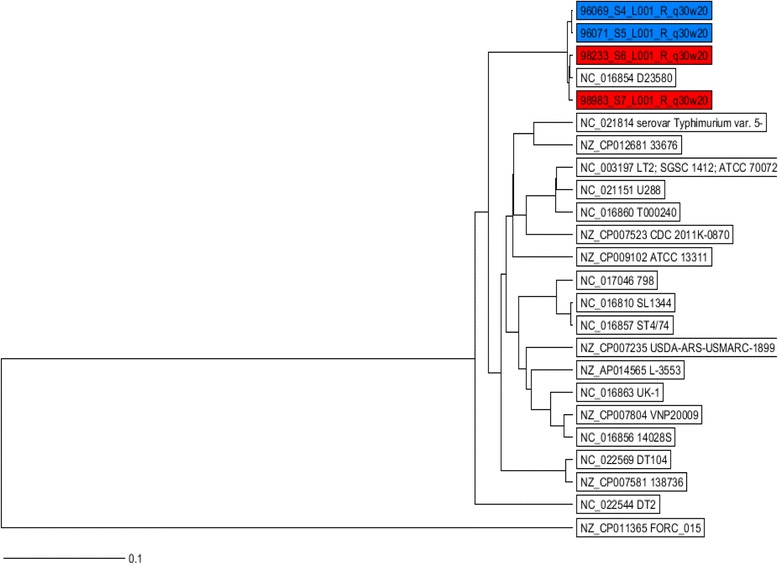
strains were isolated from poultry and patients using standard bacteriological methods described in previous studies. The strains were serotype according to Kaufmann-White scheme and tested for antibiotic susceptibility to 12 different antimicrobial agents using the disk diffusion method. The whole genome of the Typhimurium isolates was analyzed using Illumina technology and compared with 20 isolates of Typhimurium for which the ST has been deposited in a global MLST database.The ResFinder Web server was used to find the antibiotic resistance genes from whole genome sequencing (WGS) data. For comparative genomics, publicly available complete and draft genomes of different Typhimurium laboratory-adapted strains were downloaded from GenBank.
All the tested serotype Typhimurium were multiresistant to five commonly used antibiotics (ampicillin, chloramphenicol, streptomycin, sulfonamide, and trimethoprim). The multilocus sequence type ST313 was detected from all the strains. Our sequences were very similar to Typhimurium ST313 strain D23580 isolated from a patient with invasive non-typhoid (NTS) infection in Malawi, also located in sub-Saharan Africa. The use of ResFinder web server on the whole genome of the strains showed a resistance to aminoglycoside associated with carriage of the following resistances genes: , , and ; resistance to β-lactams associated with carriage of a genes; resistance to phenicol associated with carriage of gene; resistance to sulfonamide associated with carriage of and genes; resistance to tetracycline associated with carriage of gene; and resistance to trimethoprim associated to gene for all the isolates
The poultry and human isolates were genetically similar showing a potential food safety risk for consumers. Our finding of multidrug-resistant Typhimurium ST313 in poultry feces calls for further studies to clarify the potential reservoirs of this emerging pathogen.
多重耐药性是发展中国家发病和死亡的重要原因。本研究的目的是对来自患者和家禽粪便的多重耐药鼠伤寒血清型菌株进行特征分析和比较。
使用先前研究中描述的标准细菌学方法从家禽和患者中分离菌株。根据考夫曼-怀特方案对菌株进行血清分型,并使用纸片扩散法检测其对12种不同抗菌药物的敏感性。使用Illumina技术分析鼠伤寒分离株的全基因组,并与20株鼠伤寒分离株进行比较,这些分离株的序列类型已保存在全球多位点序列分型数据库中。使用ResFinder网络服务器从全基因组测序(WGS)数据中查找抗生素抗性基因。为了进行比较基因组学研究,从GenBank下载了不同实验室适应的鼠伤寒菌株的公开可用完整基因组和草图基因组。
所有测试的鼠伤寒血清型菌株对五种常用抗生素(氨苄青霉素、氯霉素、链霉素、磺胺类药物和甲氧苄啶)均具有多重耐药性。所有菌株均检测到多位点序列类型ST313。我们的序列与从马拉维一名侵袭性非伤寒沙门氏菌(NTS)感染患者中分离出的鼠伤寒ST313菌株D23580非常相似,马拉维也位于撒哈拉以南非洲。在菌株的全基因组上使用ResFinder网络服务器显示,其对氨基糖苷类药物的耐药性与携带以下耐药基因有关:、和;对β-内酰胺类药物的耐药性与携带基因有关;对酚类药物的耐药性与携带基因有关;对磺胺类药物的耐药性与携带和基因有关;对四环素的耐药性与携带基因有关;所有分离株对甲氧苄啶的耐药性与基因有关。
家禽和人类分离株在基因上相似,对消费者显示出潜在的食品安全风险。我们在家禽粪便中发现多重耐药鼠伤寒ST313,这需要进一步研究以阐明这种新兴病原体的潜在储存宿主。