Wang Xuchu, Biswas Silpak, Paudyal Narayan, Pan Hang, Li Xiaoliang, Fang Weihuan, Yue Min
Hangzhou Center for Disease Control and Prevention, Hangzhou, China.
CATG Microbiology and Food Safety Laboratory, Institute of Preventive Veterinary Medicine, College of Animal Sciences, Zhejiang University, Hangzhou, China.
Front Microbiol. 2019 May 7;10:985. doi: 10.3389/fmicb.2019.00985. eCollection 2019.
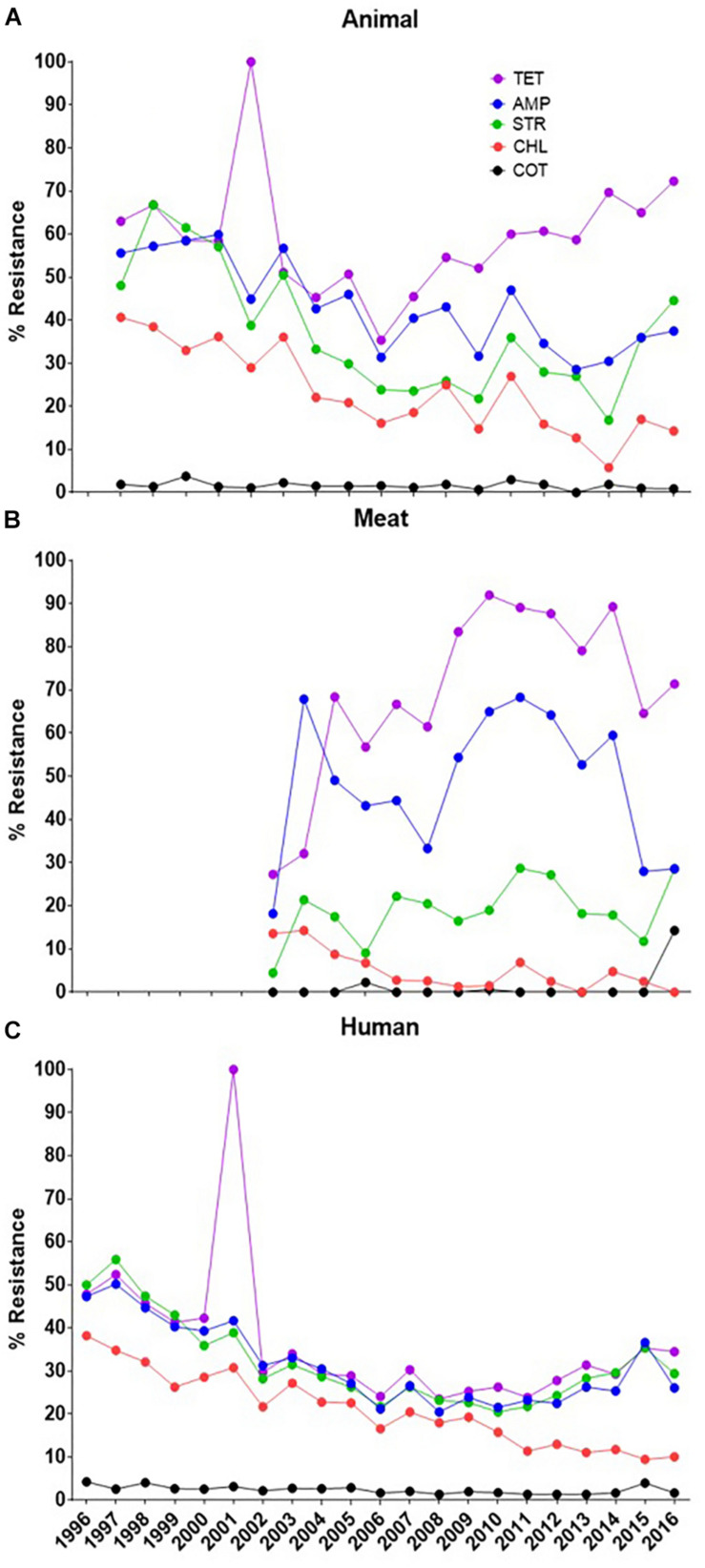
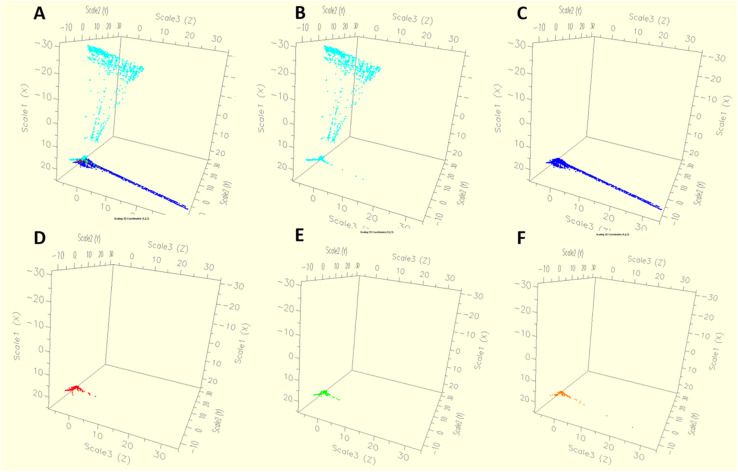
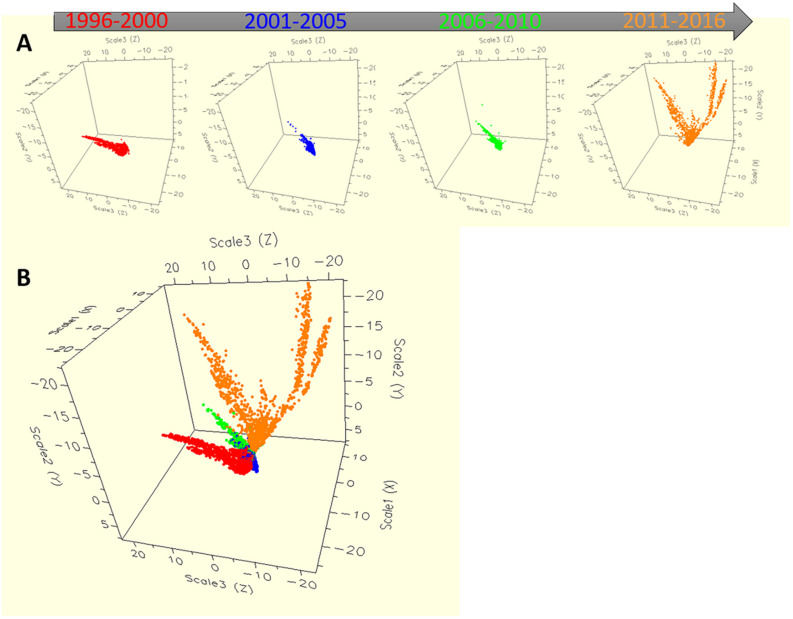
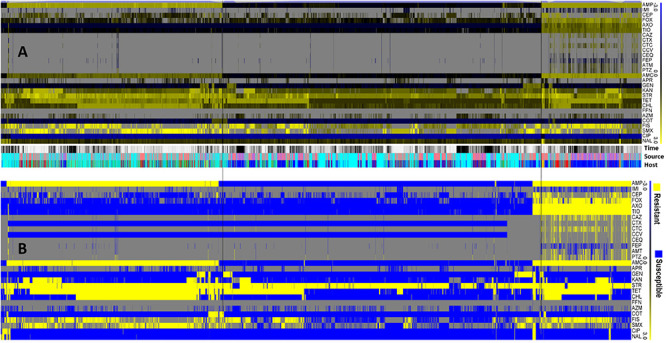
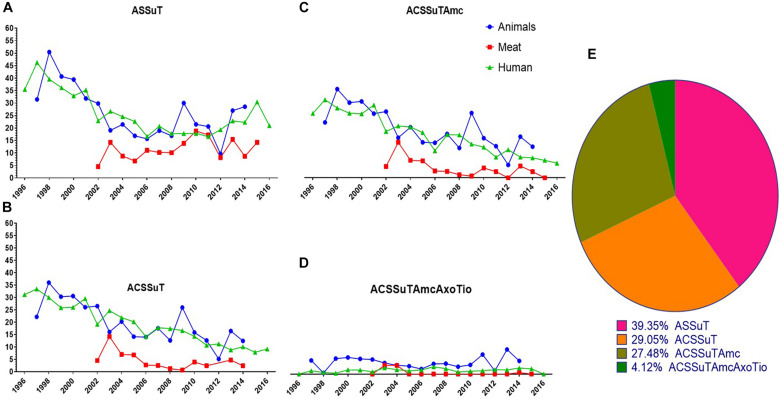
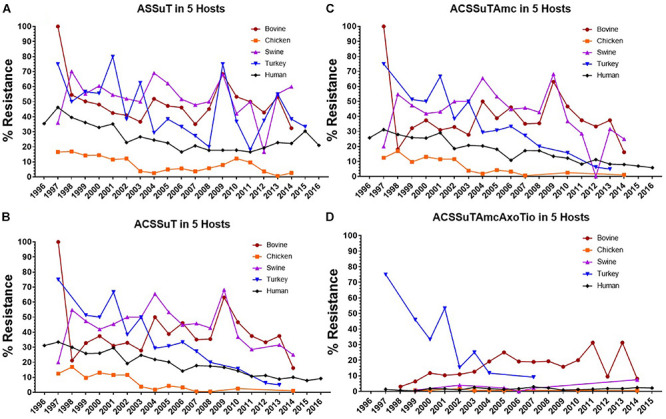
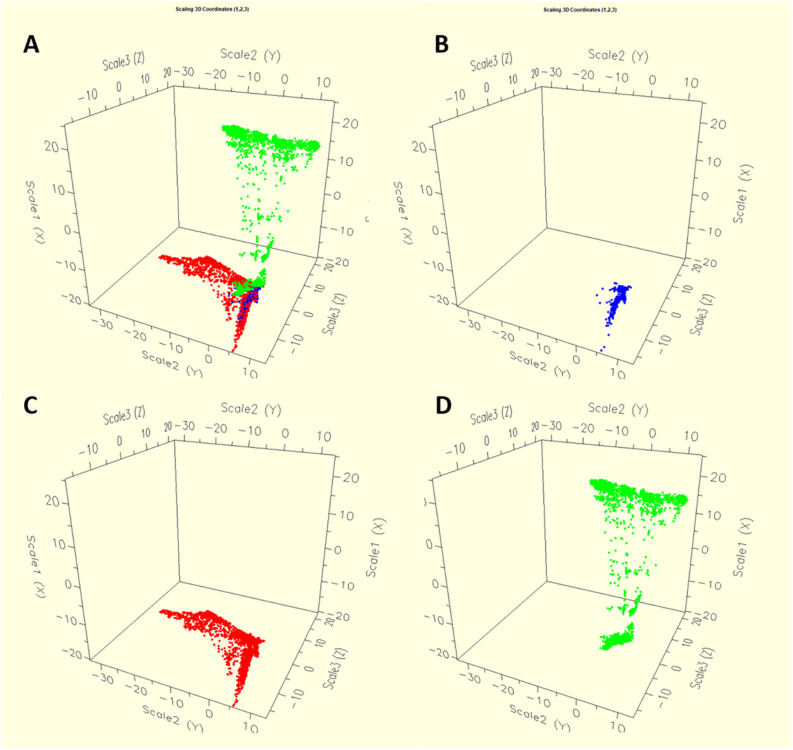
is a major foodborne pathogen which causes widespread contamination and infection worldwide. Typhimurium is one of the leading serovars responsible for human and animal salmonellosis, globally. The increasing rate of antibiotic resistance in Typhimurium poses a significant global concern, and an improved understanding of the distribution of antibiotic resistance patterns in Typhimurium is essential for choosing the suitable antibiotic for the treatment of infections. To evaluate the roles of animal and human in antibiotic resistance dissemination, this study aims to categorize 11,447 . Typhimurium strains obtained across the food-chain, including food animals, retail meats and humans for 21 years in the United States by analyzing minimum inhibitory concentrations (MICs) values for 27 antibiotics. Random Forest Algorithm and Hierarchical Clustering statistics were used to group the strains according to their minimum inhibitory concentration values. Classification and Regression Tree analysis was used to identify the best classifier for human- and animal-populations' isolates. We found the persistent population or multi-drug resistant strains of . Typhimurium across the four time periods (1996∼2000, 2001∼2005, 2006∼2010, 2011∼2016). Importantly, we also detected that there was more diversity in the MIC patterns among . Typhimurium strains isolated between 2011 and 2016, which suggests significant emergence of diversified multi-drug resistant strains. The most frequently observed (43%) antibiotic resistance patterns found in . Typhimurium were tetra-resistant pattern ASSuT (ampicillin, streptomycin, sulfonamides, and tetracycline) and the penta-resistant pattern ACSSuT (ampicillin, chloramphenicol, streptomycin, sulfonamides, and tetracycline). Animals (mainly swine and bovine) are the major source for these two frequently found antibiotic resistance patterns. The occurrence of antibiotic resistant strains from humans and chicken is alarming. Strains were mostly susceptible to fluoroquinolones. Together, this study helped in understanding the expansion of dynamics of antibiotic resistance of . Typhimurium and recommended fluoroquinolones as a possible treatment options against . Typhimurium infection.
是一种主要的食源性病原体,在全球范围内造成广泛的污染和感染。鼠伤寒沙门氏菌是全球导致人类和动物沙门氏菌病的主要血清型之一。鼠伤寒沙门氏菌抗生素耐药性的增加率引起了全球的重大关注,更好地了解鼠伤寒沙门氏菌抗生素耐药模式的分布对于选择合适的抗生素治疗感染至关重要。为了评估动物和人类在抗生素耐药性传播中的作用,本研究旨在通过分析27种抗生素的最低抑菌浓度(MIC)值,对美国21年来在食物链中获得的11447株鼠伤寒沙门氏菌菌株进行分类,这些菌株包括食用动物、零售肉类和人类。使用随机森林算法和层次聚类统计方法根据菌株的最低抑菌浓度值对其进行分组。使用分类与回归树分析来确定人类和动物群体分离株的最佳分类器。我们发现了四个时间段(1996 - 2000年、2001 - 2005年、2006 - 2010年、2011 - 2016年)中鼠伤寒沙门氏菌的持续存在群体或多重耐药菌株。重要的是,我们还检测到2011年至2016年间分离的鼠伤寒沙门氏菌菌株的MIC模式存在更多差异,这表明出现了大量多样化的多重耐药菌株。在鼠伤寒沙门氏菌中最常观察到的(43%)抗生素耐药模式是四重耐药模式ASSuT(氨苄青霉素、链霉素、磺胺类药物和四环素)和五重耐药模式ACSSuT(氨苄青霉素、氯霉素、链霉素、磺胺类药物和四环素)。动物(主要是猪和牛)是这两种常见抗生素耐药模式的主要来源。来自人类和鸡的抗生素耐药菌株的出现令人担忧。菌株大多对氟喹诺酮类药物敏感。总之,本研究有助于了解鼠伤寒沙门氏菌抗生素耐药性动态的扩展,并推荐氟喹诺酮类药物作为治疗鼠伤寒沙门氏菌感染的可能选择。