Laboratoire de Biologie Moléculaire d'Epidémiologie et de Surveillance des Bactéries et Virus Transmis par les Aliments (LaBESTA). Ecole Doctorale Sciences et Technologies, Université Joseph Ki-Zerbo, 03 BP 7021, Ouagadougou, 03, Burkina Faso.
Plateforme de Biologie Moléculaire, Institut Pasteur de Côte d'Ivoire, Abidjan, Côte d'Ivoire.
BMC Microbiol. 2021 Dec 11;21(1):338. doi: 10.1186/s12866-021-02398-6.
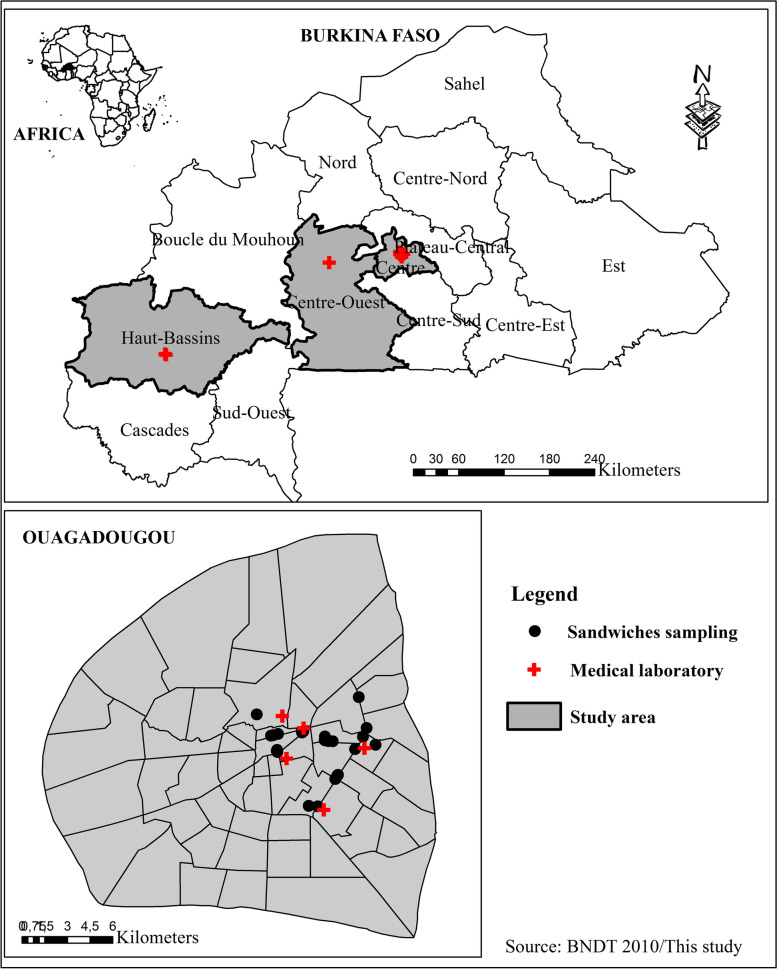
This study was undertaken to identify and functionally characterize virulence genes from Salmonella isolates in street food and stool cultures. From February 2017 to May 2018, clinical and food Salmonella strains were isolated in three regions in Burkina Faso. Salmonella was serotyped according to the White-Kauffmann-Le Minor method, and polymerase chain reaction (PCR) was used to detec invA, spvR, spvC, fimA and stn virulence genes commonly associated with salmonellosis in Sub-Saharan Africa.
A total of 106 Salmonella isolates (77 human stools; 14 sandwiches) was analyzed using a serological identification with an O-group test reagent. The presence of Salmonella was confirmed in 86% (91/106) of the samples were reactive (OMA-positive/OMB-positive). Salmonella serogroup O:4,5 was the most common serogroup detected (40%; 36/91). Salmonella Enteritidis and Typhimurium represented 5.5% (5/91) and 3.3% (3/91), respectively and were identified only from clinical isolates. Furthermore, 14 serotypes of Salmonella (12/91 human strains and 2/15 sandwich strains) were evocative of Kentucky/Bargny serotype. For the genetic profile, 66% (70/106) of the Salmonella had invA and stn genes; 77.4% (82/106) had the fimA gene. The spvR gene was found in 36.8% (39/106) of the isolates while 48.1% (51/106) had the spvC gene. Among the identified Salmonella Enteritidis and Salmonella Typhimurium isolated from stools, the virulence genes detected were invA (3/5) versus (2/3), fimA (4/5) versus (3/3), stn (3/5) versus (2/3), spvR (4/5) versus (2/3) and spvC (3/5) versus (2/3), respectively.
This study reports the prevalence of Salmonella serotypes and virulence genes in clinical isolates and in street foods. It shows that food could be a significant source of Salmonella transmission to humans. Our results could help decision-making by the Burkina Faso health authority in the fight against street food-related diseases, in particular by training restaurateurs in food hygiene.
本研究旨在鉴定和功能表征街头食品和粪便培养物中分离的沙门氏菌分离株的毒力基因。2017 年 2 月至 2018 年 5 月,在布基纳法索的三个地区分离出临床和食品沙门氏菌菌株。根据 White-Kauffmann-Le Minor 方法对沙门氏菌进行血清分型,聚合酶链反应(PCR)用于检测与撒哈拉以南非洲地区沙门氏菌病相关的 invA、spvR、spvC、fimA 和 stn 毒力基因。
使用 O 组测试试剂的血清学鉴定分析了总共 106 株沙门氏菌分离株(77 株人类粪便;14 份三明治)。86%(91/106)的样本呈反应性(OMA-阳性/OMB-阳性),确认存在沙门氏菌。检测到最常见的血清群为 O 群 4,5(40%;36/91)。沙门氏菌肠炎和伤寒分别占 5.5%(5/91)和 3.3%(3/91),仅从临床分离株中鉴定出。此外,沙门氏菌有 14 种血清型(91 株人类菌株中的 12 种和 15 种三明治菌株中的 2 种)与肯塔基州/巴尔尼血清型有关。对于遗传特征,沙门氏菌中有 66%(70/106)含有 invA 和 stn 基因;77.4%(82/106)含有 fimA 基因。spvR 基因在 36.8%(39/106)的分离株中发现,而 48.1%(51/106)的分离株含有 spvC 基因。从粪便中分离出的沙门氏菌肠炎和伤寒分离株中检测到的毒力基因分别为 invA(3/5)与(2/3)、fimA(4/5)与(3/3)、stn(3/5)与(2/3)、spvR(4/5)与(2/3)和 spvC(3/5)与(2/3)。
本研究报告了临床分离株和街头食品中沙门氏菌血清型和毒力基因的流行情况。它表明食物可能是沙门氏菌传播给人类的重要来源。我们的结果可以帮助布基纳法索卫生当局在与街头食品相关的疾病防控方面做出决策,特别是通过培训餐馆老板注意食品卫生。