Lyke Kirsten E, Dabo Abdoulaye, Arama Charles, Diarra Issa, Plowe Christopher V, Doumbo Ogobara K, Sztein Marcelo B
Center for Vaccine Development, Institute for Global Health, School of Medicine, University of Maryland, Baltimore, MD, United States.
Division of Malaria Research, Institute for Global Health, School of Medicine, University of Maryland, Baltimore, MD, United States.
Front Immunol. 2018 Feb 1;8:1995. doi: 10.3389/fimmu.2017.01995. eCollection 2017.
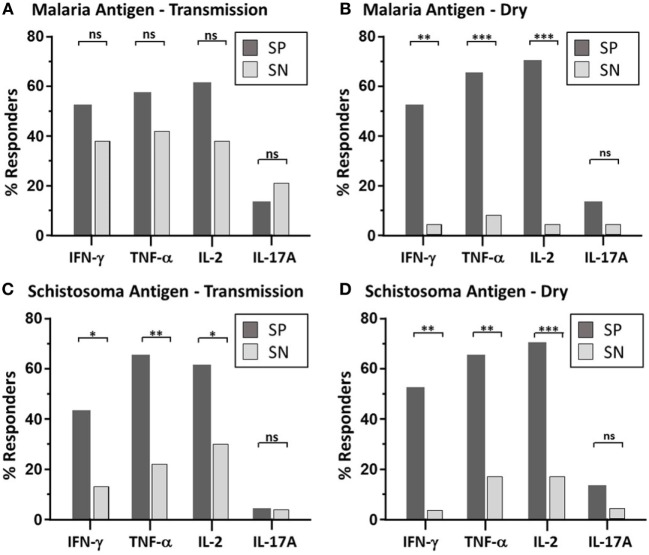
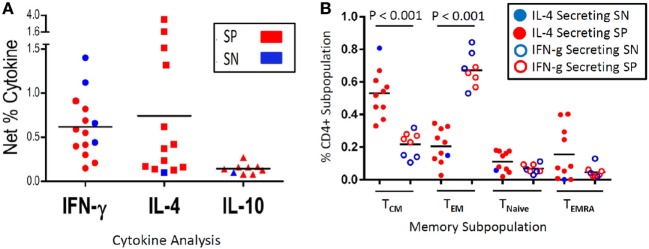
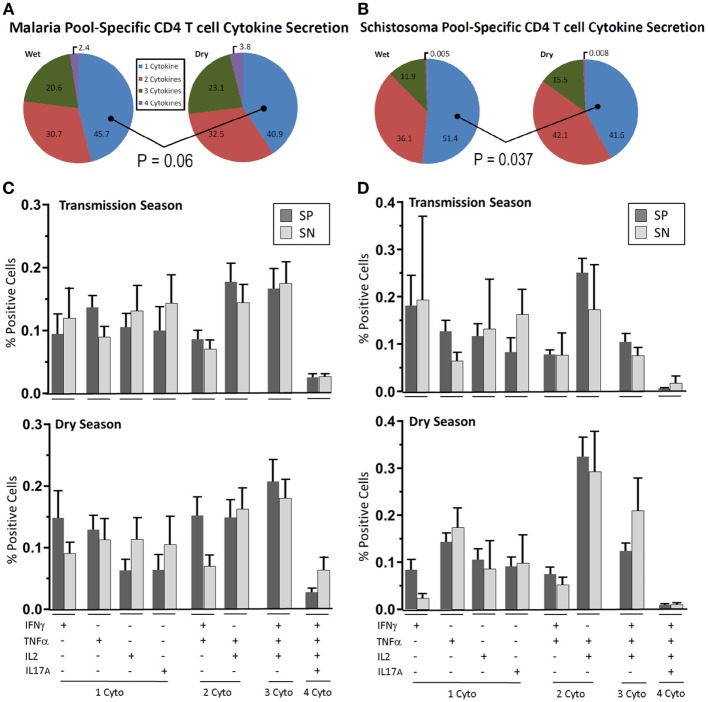
Polyparasitism is common in the developing world. We have previously demonstrated that schistosomiasis-positive (SP) Malian children, aged 4-8 years, are protected from malaria compared to matched schistosomiasis-negative (SN) children. The effect of concomitant schistosomiasis upon acquisition of T cell memory is unknown. We examined antigen-specific T cell frequencies in 48 Malian children aged 4-14 to a pool of malaria blood stage antigens, and a pool of schistosomal antigens, at a time point during a malaria episode and at a convalescent time point ~6 months later, following cessation of malaria transmission. CD4 T cell-derived memory responses, defined as one or more significant cytokine (IFN-γ, TNF-α, IL-2, and/or IL-17) responses, was measured to schistoma antigens in 18/23 SP children at one or both time points, compared to 4/23 SN children ( < 0.0001). At the time of malaria infection, 12/24 SN children and 15/23 SP children ( = 0.29) stimulated with malaria antigens demonstrated memory recall as defined by CD4-derived cytokine production. This compares to 7/23 SN children and 16/23 SP children ( = 0.009) at the convalescent timepoint. 46.2% of cytokine-producing CD4 T cells expressed a single cytokine after stimulation with malaria antigen during the malaria episode. This fell to 40.9% at follow-up with a compensatory rise of multifunctional cytokine secretion over time, a phenomenon consistent with memory maturation. The majority (53.2-59.5%) of responses derived from CD45RACD62L effector memory T cells with little variation in the phenotype depending upon the time point or the study cohort. We conclude that detectable T cell memory responses can be measured against both malaria and schistosoma antigens and that the presence of may be associated with long-term maintenance of T memory to malaria.
多重寄生虫感染在发展中世界很常见。我们之前已经证明,与配对的血吸虫病阴性(SN)儿童相比,4至8岁的血吸虫病阳性(SP)马里儿童对疟疾具有抵抗力。同时感染血吸虫病对T细胞记忆获得的影响尚不清楚。我们在疟疾发作期间的一个时间点以及疟疾传播停止约6个月后的恢复期时间点,检测了48名4至14岁马里儿童针对一组疟疾血期抗原和一组血吸虫抗原的抗原特异性T细胞频率。在一个或两个时间点,18/23名SP儿童对血吸虫抗原产生了CD4 T细胞衍生的记忆反应,定义为一种或多种显著的细胞因子(IFN-γ、TNF-α、IL-2和/或IL-17)反应,相比之下,4/23名SN儿童有此反应(<0.0001)。在疟疾感染时,12/24名SN儿童和15/23名SP儿童(P = 0.29)在用疟疾抗原刺激后表现出由CD4衍生的细胞因子产生所定义的记忆回忆。相比之下,在恢复期时间点,7/23名SN儿童和16/23名SP儿童(P = 0.009)有此表现。在疟疾发作期间,46.2%的产生细胞因子的CD4 T细胞在用疟疾抗原刺激后表达单一细胞因子。在随访时,这一比例降至40.9%,同时多功能细胞因子分泌随时间代偿性增加,这一现象与记忆成熟一致。大多数(53.2 - 59.5%)反应源自CD45RA⁻CD62L⁻效应记忆T细胞,其表型根据时间点或研究队列的不同变化不大。我们得出结论,针对疟疾和血吸虫抗原均可检测到T细胞记忆反应,并且血吸虫病的存在可能与对疟疾T记忆的长期维持有关。