Kilickesmez Kadriye, Dall'Ara Gianni, Rama-Merchan Juan Carlos, Ghione Matteo, Mattesini Alessio, Vinues Carlos Moreno, Konstantinidis Nikolaos, Pighi Michele, Estevez-Loureiro Rodrigo, Zivelonghi Carlo, Lindsay Alistair C, Secco Gioel G, Foin Nicolas, De Silva Ranil, Di Mario Carlo
NIHR Biomedical Research Unit, Royal Brompton Hospital & Harefield NHS Foundation Trust, London, UK.
Department of Clinical and Experimental Medicine, University of Eastern Piedmont, Novara, Italy.
Int J Cardiol Heart Vessel. 2014 Mar 19;3:68-74. doi: 10.1016/j.ijchv.2014.03.003. eCollection 2014 Jun.
Characterization of neointimal tissue is essential to understand the pathophysiology of in-stent restenosis (ISR) after drug eluting stent (DES) implantation. Using optical coherence tomography (OCT), we compared the morphologic characteristics of ISR between first and second generation DES.
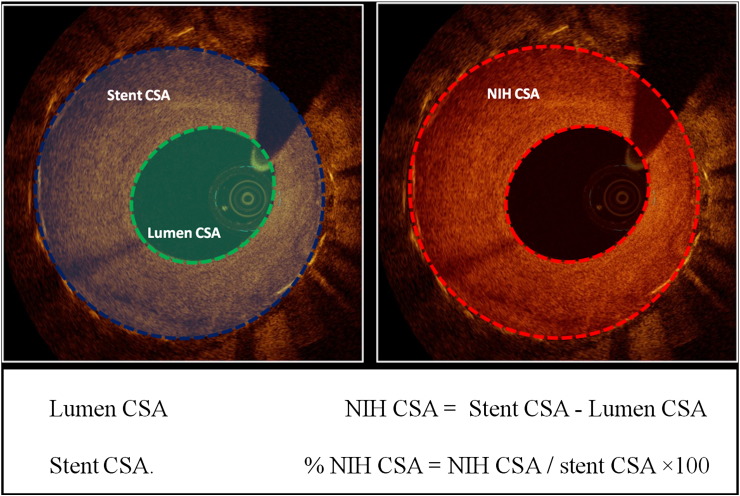
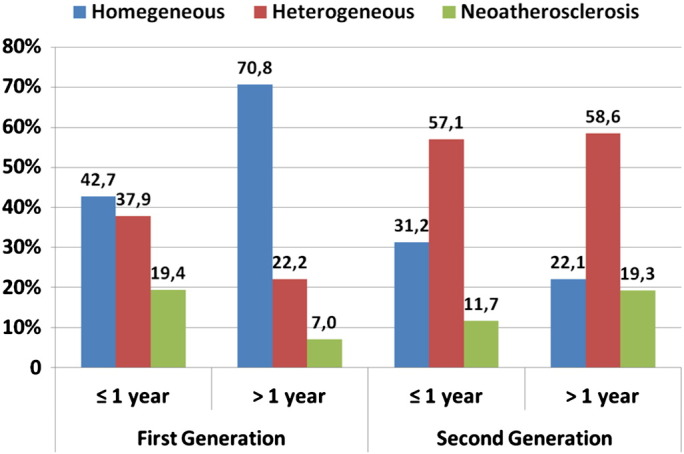
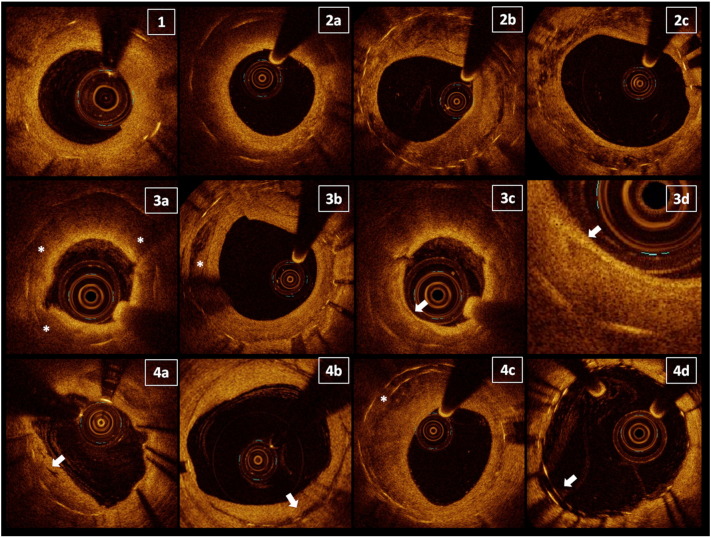
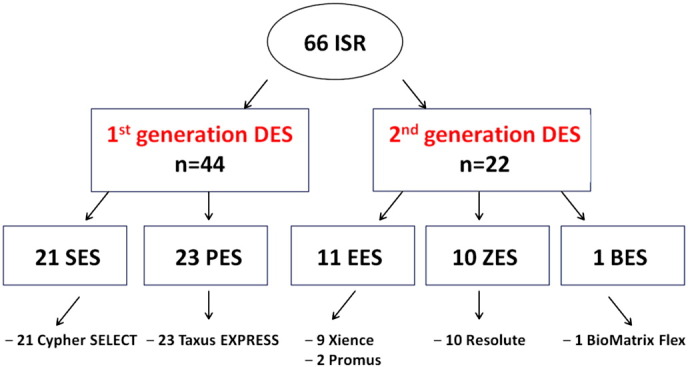
OCT was performed in 66 DES-ISR, defined as > 50% angiographic diameter stenosis within the stented segment. Patients with ISR of first generation sirolimus-eluting stents (SES), paclitaxel eluting stents (PES) and second generation zotarolimus-eluting stents (ZES), everolimus-eluting stents (EES) and biolimus-eluting stents (BES) were enrolled. Quantitative and qualitative ISR tissue analysis was performed at 1-mm intervals along the entire stent, and categorised as homogeneous, heterogeneous and neo-atherosclerosis. The presence of microvessels and peri-strut low intensity area (PSLIA) was determined in all ISR. Neoatherosclerosis was identified by lipid, calcium and thin-cap fibro-atheroma (TCFA) like lesions. We compared the two DES generations at both early (< 1 year) and late (> 1 year) follow-ups.In second generation DES a heterogeneous pattern was prevalent both before and after 1 year (57.1% and 58.6% respectively). Neo-atherosclerosis was more common in the early period in first generation DES (19.4% vs 11.7%, p < 0.01), but after one year was more prevalent in second generation DES (7.0% vs 19.3%, p < 0.01). Similar prevalence of TCFAs was observed in both groups in all comparisons.
When ISR restenosis occurs in second generation DES, the current data suggest a different time course and different morphological characteristics from first generation. Future prospective studies should evaluate the relationship between ISR morphology, time course and clinical events.
对新生内膜组织进行特征分析对于理解药物洗脱支架(DES)植入后支架内再狭窄(ISR)的病理生理学至关重要。我们使用光学相干断层扫描(OCT)比较了第一代和第二代DES之间ISR的形态学特征。
对66例DES-ISR患者进行了OCT检查,DES-ISR定义为支架段内血管造影直径狭窄>50%。纳入第一代西罗莫司洗脱支架(SES)、紫杉醇洗脱支架(PES)以及第二代佐他莫司洗脱支架(ZES)、依维莫司洗脱支架(EES)和生物可吸收涂层依维莫司洗脱支架(BES)的ISR患者。沿着整个支架以1毫米的间隔进行ISR组织的定量和定性分析,并分类为均匀型、异质型和新动脉粥样硬化型。在所有ISR中确定微血管和支架周围低强度区域(PSLIA)的存在。通过脂质、钙和薄帽纤维粥样瘤(TCFA)样病变识别新动脉粥样硬化。我们在早期(<1年)和晚期(>1年)随访中比较了两代DES。在第二代DES中,异质型在1年前后均很普遍(分别为57.1%和58.6%)。新动脉粥样硬化在第一代DES的早期更常见(19.4%对11.7%,p<0.01),但1年后在第二代DES中更普遍(7.0%对19.3%,p<0.01)。在所有比较中,两组中TCFAs的发生率相似。
当第二代DES发生ISR再狭窄时,目前的数据表明其时间进程和形态学特征与第一代不同。未来的前瞻性研究应评估ISR形态、时间进程与临床事件之间的关系。