Garcia Armando L, Udeh Adanna, Kalahasty Karthik, Hackam Abigail S
Bascom Palmer Eye Institute, University of Miami Miller School of Medicine, Miami, FL, USA.
Neural Regen Res. 2018 Jan;13(1):43-52. doi: 10.4103/1673-5374.224359.
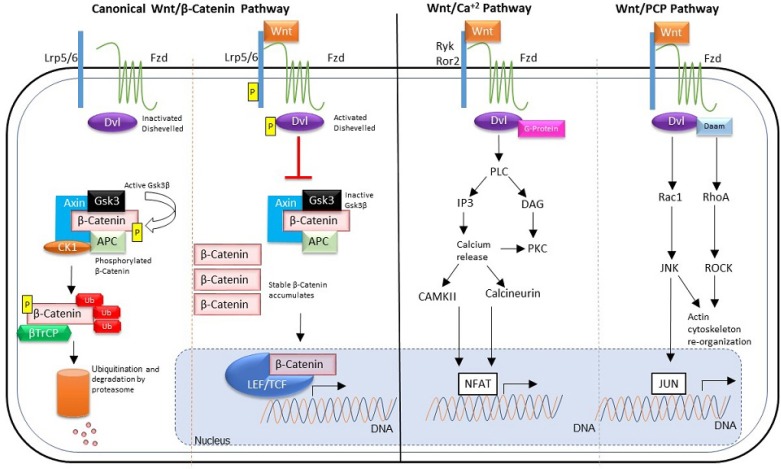
The canonical Wnt/β-catenin pathway is a highly conserved signaling cascade that plays critical roles during embryogenesis. Wnt ligands regulate axonal extension, growth cone guidance and synaptogenesis throughout the developing central nervous system (CNS). Recently, studies in mammalian and fish model systems have demonstrated that Wnt/β-catenin signaling also promotes axonal regeneration in the adult optic nerve and spinal cord after injury, raising the possibility that Wnt could be developed as a therapeutic strategy. In this review, we summarize experimental evidence that reveals novel roles for Wnt signaling in the injured CNS, and discuss possible mechanisms by which Wnt ligands could overcome molecular barriers inhibiting axonal growth to promote regeneration. A central challenge in the neuroscience field is developing therapeutic strategies that induce robust axonal regeneration. Although adult axons have the capacity to respond to axonal guidance molecules after injury, there are several major obstacles for axonal growth, including extensive neuronal death, glial scars at the injury site, and lack of axonal guidance signals. Research in rodents demonstrated that activation of Wnt/β-catenin signaling in retinal neurons and radial glia induced neuronal survival and axonal growth, but that activation within reactive glia at the injury site promoted proliferation and glial scar formation. Studies in zebrafish spinal cord injury models confirm an axonal regenerative role for Wnt/β-catenin signaling and identified the cell types responsible. Additionally, in vitro and in vivo studies demonstrated that Wnt induces axonal and neurite growth through transcription-dependent effects of its central mediator β-catenin, potentially by inducing regeneration-promoting genes. Canonical Wnt signaling may also function through transcription-independent interactions of β-catenin with cytoskeletal elements, which could stabilize growing axons and control growth cone movement. Therefore, these studies suggest that Wnt-induced pathways responsible for regulating axonal growth during embryogenesis could be repurposed to promote axonal growth after injury.
经典的Wnt/β-连环蛋白信号通路是一种高度保守的信号级联反应,在胚胎发育过程中发挥着关键作用。Wnt配体在整个发育中的中枢神经系统(CNS)中调节轴突延伸、生长锥导向和突触形成。最近,在哺乳动物和鱼类模型系统中的研究表明,Wnt/β-连环蛋白信号传导还能促进成年视神经和脊髓损伤后的轴突再生,这增加了将Wnt开发为一种治疗策略的可能性。在这篇综述中,我们总结了揭示Wnt信号在受损中枢神经系统中发挥新作用的实验证据,并讨论了Wnt配体克服抑制轴突生长的分子障碍以促进再生的可能机制。神经科学领域的一个核心挑战是开发能够诱导强大轴突再生的治疗策略。虽然成年轴突在损伤后有能力对轴突导向分子做出反应,但轴突生长存在几个主要障碍,包括广泛的神经元死亡、损伤部位的胶质瘢痕以及缺乏轴突导向信号。对啮齿动物的研究表明,视网膜神经元和放射状胶质细胞中Wnt/β-连环蛋白信号的激活诱导了神经元存活和轴突生长,但损伤部位反应性胶质细胞内的激活促进了增殖和胶质瘢痕形成。斑马鱼脊髓损伤模型的研究证实了Wnt/β-连环蛋白信号传导的轴突再生作用,并确定了相关的细胞类型。此外,体外和体内研究表明,Wnt通过其中心介质β-连环蛋白的转录依赖性作用诱导轴突和神经突生长,可能是通过诱导促进再生的基因。经典的Wnt信号传导也可能通过β-连环蛋白与细胞骨架成分的非转录依赖性相互作用发挥作用,这可以稳定生长中的轴突并控制生长锥运动。因此,这些研究表明,在胚胎发育过程中负责调节轴突生长的Wnt诱导途径可以重新用于促进损伤后的轴突生长。