CORTECS team, University of Grenoble-Alpes, Paris, France.
ThEMAS team, TIMC-IMAG laboratory, UMR CNRS-UGA, 5525, Grenoble, France.
BMC Complement Altern Med. 2018 Feb 17;18(1):65. doi: 10.1186/s12906-018-2098-8.
In 2010, the World Health Organization published benchmarks for training in osteopathy in which osteopathic visceral techniques are included. The purpose of this study was to identify and critically appraise the scientific literature concerning the reliability of diagnosis and the clinical efficacy of techniques used in visceral osteopathy.
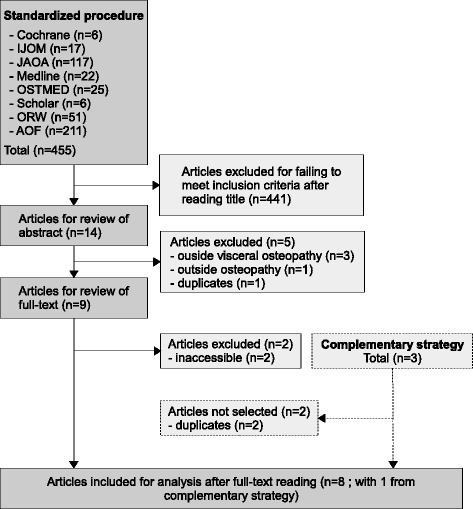
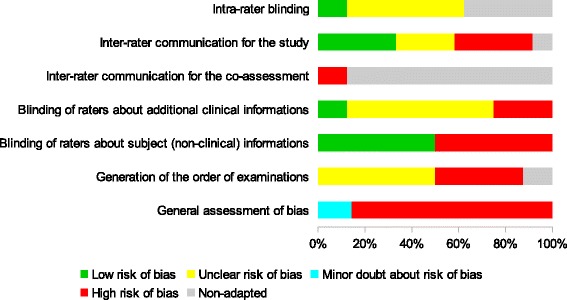
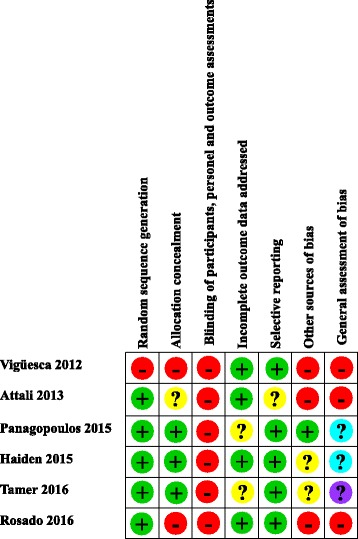
Databases MEDLINE, OSTMED.DR, the Cochrane Library, Osteopathic Research Web, Google Scholar, Journal of American Osteopathic Association (JAOA) website, International Journal of Osteopathic Medicine (IJOM) website, and the catalog of Académie d'ostéopathie de France website were searched through December 2017. Only inter-rater reliability studies including at least two raters or the intra-rater reliability studies including at least two assessments by the same rater were included. For efficacy studies, only randomized-controlled-trials (RCT) or crossover studies on unhealthy subjects (any condition, duration and outcome) were included. Risk of bias was determined using a modified version of the quality appraisal tool for studies of diagnostic reliability (QAREL) in reliability studies. For the efficacy studies, the Cochrane risk of bias tool was used to assess their methodological design. Two authors performed data extraction and analysis.
Eight reliability studies and six efficacy studies were included. The analysis of reliability studies shows that the diagnostic techniques used in visceral osteopathy are unreliable. Regarding efficacy studies, the least biased study shows no significant difference for the main outcome. The main risks of bias found in the included studies were due to the absence of blinding of the examiners, an unsuitable statistical method or an absence of primary study outcome.
The results of the systematic review lead us to conclude that well-conducted and sound evidence on the reliability and the efficacy of techniques in visceral osteopathy is absent.
The review is registered PROSPERO 12th of December 2016. Registration number is CRD4201605286 .
2010 年,世界卫生组织发布了骨科学培训基准,其中包括骨科学内脏技术。本研究的目的是确定和批判性地评价有关内脏骨科学诊断可靠性和临床疗效技术的科学文献。
通过 2017 年 12 月检索 MEDLINE、OSTMED.DR、Cochrane 图书馆、骨科学研究网络、Google Scholar、美国骨科学会杂志(JAOA)网站、国际骨科学杂志(IJOM)网站和法国骨科学学院网站,仅纳入至少有两名评估者的观察者间可靠性研究或至少有两名评估者进行的同评估者内部可靠性研究。对于疗效研究,仅纳入非健康受试者(任何条件、持续时间和结局)的随机对照试验(RCT)或交叉研究。使用改良的诊断可靠性研究质量评估工具(QAREL)对可靠性研究中的偏倚风险进行评估。对于疗效研究,使用 Cochrane 偏倚风险工具评估其方法学设计。两名作者进行了数据提取和分析。
纳入了 8 项可靠性研究和 6 项疗效研究。可靠性研究的分析表明,内脏骨科学中使用的诊断技术不可靠。关于疗效研究,受最少偏倚影响的研究显示主要结局无显著差异。纳入研究中的主要偏倚风险归因于评估者未设盲、不合适的统计方法或缺乏主要研究结局。
系统评价的结果使我们得出结论,缺乏关于内脏骨科学技术可靠性和疗效的高质量证据。
该综述于 2016 年 12 月 12 日在 PROSPERO 上注册,注册号为 CRD4201605286。