Sturgiss Elizabeth A, Elmitt Nicholas, Haesler Emily, van Weel Chris, Douglas Kirsty A
Academic Unit of General Practice, Australian Nation University Medical School, Canberra, Australia.
School of Nursing, Midwifery and Paramedicine, Curtin University, Perth, Western Australia, Australia.
BMJ Open. 2018 Feb 16;8(2):e019367. doi: 10.1136/bmjopen-2017-019367.
Obesity management is an important issue for the international primary care community. This scoping review examines the literature describing the role of the family doctor in managing adults with obesity. The methods were prospectively published and followed Joanna Briggs Institute methodology.
Primary care. Adult patients.
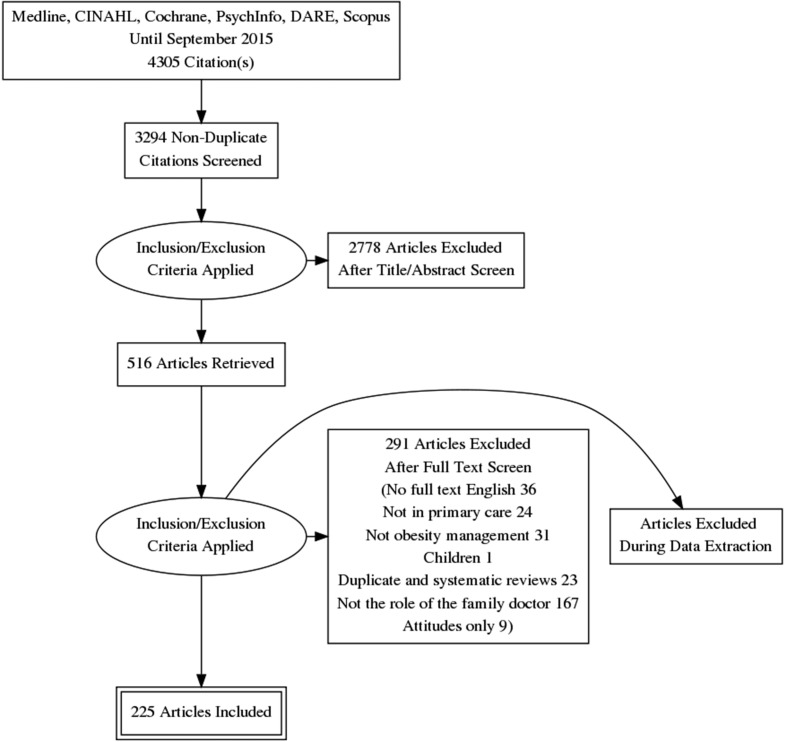
Peer-reviewed and grey literature with the keywords obesity, primary care and family doctors. All literature published up to September 2015. 3294 non-duplicate papers were identified and 225 articles included after full-text review.
Data were extracted on the family doctors' involvement in different aspects of management, and whether whole person and person-centred care were explicitly mentioned.
110 papers described interventions in primary care and family doctors were always involved in diagnosing obesity and often in recruitment of participants. A clear description of the provider involved in an intervention was often lacking. It was difficult to determine if interventions took account of whole person and person-centredness. Most opinion papers and clinical overviews described an extensive role for the family doctor in management; in contrast, research on current practices depicted obesity as undermanaged by family doctors. International guidelines varied in their description of the role of the family doctor with a more extensive role suggested by guidelines from family medicine organisations.
There is a disconnect between how family doctors are involved in primary care interventions, the message in clinical overviews and opinion papers, and observed current practice of family doctors. The role of family doctors in international guidelines for obesity may reflect the strength of primary care in the originating health system. Reporting of primary care interventions could be improved by enhanced descriptions of the providers involved and explanation of how the pillars of primary care are used in intervention development.
肥胖管理是国际初级保健领域的一个重要问题。本范围综述审视了描述家庭医生在管理成年肥胖患者中作用的文献。研究方法已预先发表,并遵循了乔安娜·布里格斯研究所的方法。
初级保健。成年患者。
经同行评审的文献及灰色文献,关键词为肥胖、初级保健和家庭医生。截至2015年9月发表的所有文献。共识别出3294篇非重复文献,经全文评审后纳入225篇文章。
提取有关家庭医生在管理不同方面的参与情况的数据,以及是否明确提及全人护理和以患者为中心的护理。
110篇文献描述了初级保健中的干预措施,家庭医生始终参与肥胖的诊断,且经常参与招募参与者。干预措施中涉及的提供者往往缺乏清晰描述。难以确定干预措施是否考虑了全人护理和以患者为中心。大多数观点论文和临床综述描述了家庭医生在管理中的广泛作用;相比之下,当前实践研究表明家庭医生对肥胖管理不足。国际指南对家庭医生作用的描述各不相同,家庭医学组织的指南建议其作用更为广泛。
家庭医生参与初级保健干预的方式、临床综述和观点论文中的信息与观察到的家庭医生当前实践之间存在脱节。家庭医生在国际肥胖指南中的作用可能反映了其所在卫生系统中初级保健的实力。通过加强对所涉提供者的描述以及解释初级保健支柱如何用于干预措施开发,可改进初级保健干预措施的报告。