Pfadenhauer Lisa M, Gerhardus Ansgar, Mozygemba Kati, Lysdahl Kristin Bakke, Booth Andrew, Hofmann Bjørn, Wahlster Philip, Polus Stephanie, Burns Jacob, Brereton Louise, Rehfuess Eva
Institute for Medical Informatics, Biometry and Epidemiology, LMU Munich, Munich, Germany.
Institute of Public Health and Nursing Research, University of Bremen, Bremen, Germany.
Implement Sci. 2017 Feb 15;12(1):21. doi: 10.1186/s13012-017-0552-5.
The effectiveness of complex interventions, as well as their success in reaching relevant populations, is critically influenced by their implementation in a given context. Current conceptual frameworks often fail to address context and implementation in an integrated way and, where addressed, they tend to focus on organisational context and are mostly concerned with specific health fields. Our objective was to develop a framework to facilitate the structured and comprehensive conceptualisation and assessment of context and implementation of complex interventions.
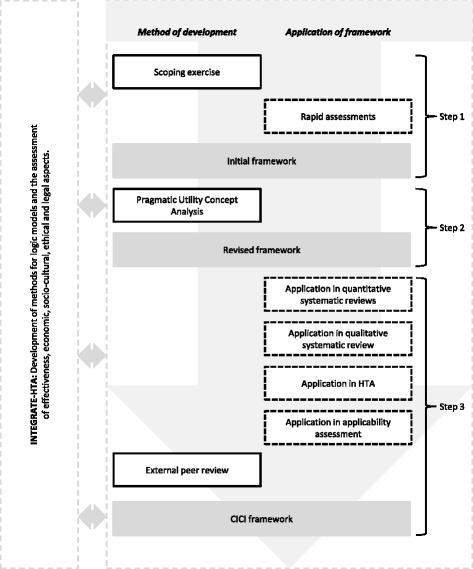
The Context and Implementation of Complex Interventions (CICI) framework was developed in an iterative manner and underwent extensive application. An initial framework based on a scoping review was tested in rapid assessments, revealing inconsistencies with respect to the underlying concepts. Thus, pragmatic utility concept analysis was undertaken to advance the concepts of context and implementation. Based on these findings, the framework was revised and applied in several systematic reviews, one health technology assessment (HTA) and one applicability assessment of very different complex interventions. Lessons learnt from these applications and from peer review were incorporated, resulting in the CICI framework.
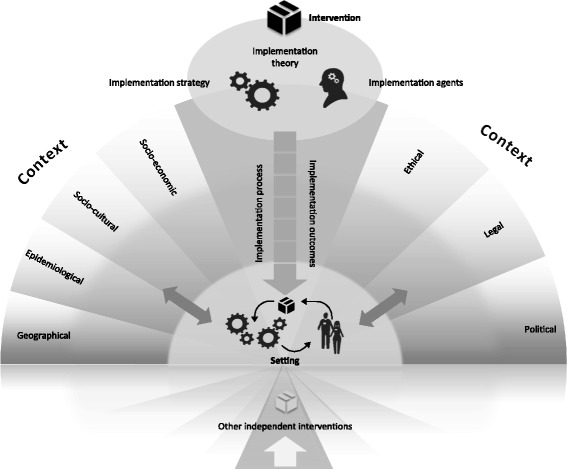
The CICI framework comprises three dimensions-context, implementation and setting-which interact with one another and with the intervention dimension. Context comprises seven domains (i.e., geographical, epidemiological, socio-cultural, socio-economic, ethical, legal, political); implementation consists of five domains (i.e., implementation theory, process, strategies, agents and outcomes); setting refers to the specific physical location, in which the intervention is put into practise. The intervention and the way it is implemented in a given setting and context can occur on a micro, meso and macro level. Tools to operationalise the framework comprise a checklist, data extraction tools for qualitative and quantitative reviews and a consultation guide for applicability assessments.
The CICI framework addresses and graphically presents context, implementation and setting in an integrated way. It aims at simplifying and structuring complexity in order to advance our understanding of whether and how interventions work. The framework can be applied in systematic reviews and HTA as well as primary research and facilitate communication among teams of researchers and with various stakeholders.
复杂干预措施的有效性及其在覆盖相关人群方面的成功程度,在很大程度上受到其在特定环境中实施情况的影响。当前的概念框架往往未能以综合的方式处理环境和实施问题,即便有所涉及,也往往侧重于组织环境,且大多关注特定的健康领域。我们的目标是开发一个框架,以促进对复杂干预措施的环境和实施进行结构化和全面的概念化及评估。
复杂干预措施的环境与实施(CICI)框架是以迭代方式开发的,并经过了广泛应用。基于范围审查的初始框架在快速评估中进行了测试,结果发现其在基本概念方面存在不一致之处。因此,开展了实用效用概念分析,以推进环境和实施的概念。基于这些发现,对框架进行了修订,并应用于多项系统评价、一项卫生技术评估(HTA)以及一项对截然不同的复杂干预措施的适用性评估。从这些应用以及同行评审中吸取的经验教训被纳入其中,从而形成了CICI框架。
CICI框架包含三个维度——环境、实施和背景——它们相互作用,并与干预维度相互影响。环境包括七个领域(即地理、流行病学、社会文化、社会经济、伦理、法律、政治);实施由五个领域组成(即实施理论、过程、策略、实施者和结果);背景是指干预措施实际实施的具体物理场所。干预措施及其在给定背景和环境中的实施方式可以在微观、中观和宏观层面上发生。使该框架可操作化的工具包括一份清单、用于定性和定量评价的数据提取工具以及一份适用性评估的咨询指南。
CICI框架以综合的方式处理并以图表形式呈现环境、实施和背景。它旨在简化和构建复杂性,以增进我们对干预措施是否有效以及如何有效的理解。该框架可应用于系统评价和HTA以及初级研究,并有助于研究团队之间以及与各利益相关者的沟通。