Faculty of Medicine, Department of Clinical Sciences, Psychiatry, Lund University, Lund, Sweden.
Department of Psychiatry, University of California San Francisco (UCSF) School of Medicine, San Francisco, CA, USA.
Neuropsychopharmacology. 2018 Jun;43(7):1557-1564. doi: 10.1038/s41386-017-0001-9. Epub 2018 Jan 30.
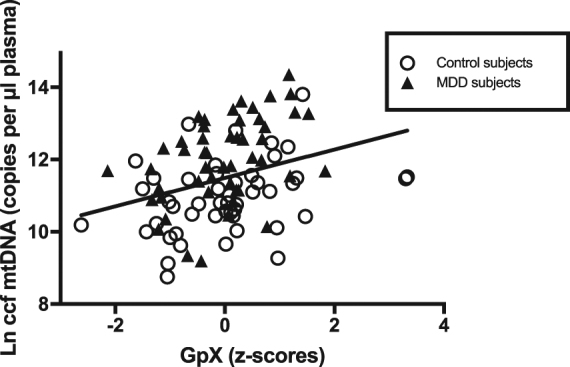
Major depressive disorder (MDD) has been linked to mitochondrial defects, which could manifest in mitochondrial DNA (mtDNA) polymorphisms or mutations. Additionally, copy number of mtDNA (mtDNA-cn) can be quantified in peripheral blood mononuclear cells (PBMC)s, indirectly reflecting cellular energetics, or in the circulating cell-free mtDNA (ccf-mtDNA) levels, which may reflect a fraction of the mitochondrial genome released during cellular stress. Few studies have examined ccf-mtDNA in MDD, and no studies have tested its relationship with intracellular mtDNA-cn or with antidepressant treatment response. Here, mtDNA levels were quantified in parallel from: (i) PBMCs and (ii) cell-free plasma of 50 unmedicated MDD subjects and 55 controls, in parallel with PBMC telomere length (TL) and antioxidant enzyme glutathione peroxidase (GpX) activity. MtDNA measures were repeated in 19 MDD subjects after 8 weeks of open-label SSRI treatment. In analyses adjusted for age, sex, BMI, and smoking, MDD subjects had significantly elevated levels of ccf-mtDNA (F = 20.6, p = 0.00002). PBMC mtDNA-cn did not differ between groups (p > 0.4). In preliminary analyses, we found that changes in ccf-mtDNA with SSRI treatment differed between SSRI responders and non-responders (F = 6.47, p = 0.02), with the non-responders showing an increase in ccf-mtDNA and responders not changing. Baseline ccf-mtDNA was positively correlated with GpX (r = 0.32, p = 0.001), and PBMC mtDNA correlated positively with PBMC TL (r = 0.38, p = 0.0001). These data suggest that plasma ccf-mtDNA and PBMC mtDNA-cn reflect different cellular processes and that the former may be more reflective of certain aspects of MDD pathophysiology and of the response to SSRI antidepressants.
重度抑郁症(MDD)与线粒体缺陷有关,这些缺陷可能表现为线粒体 DNA(mtDNA)多态性或突变。此外,外周血单核细胞(PBMC)中的 mtDNA 拷贝数(mtDNA-cn)可以被定量,间接反映细胞能量代谢,或者外周血循环无细胞 mtDNA(ccf-mtDNA)水平,这可能反映了细胞应激期间释放的一部分线粒体基因组。很少有研究检测 MDD 中的 ccf-mtDNA,也没有研究检测其与细胞内 mtDNA-cn 或与抗抑郁药治疗反应的关系。在这里,我们同时从以下方面定量了 mtDNA 水平:(i)PBMCs 和(ii)未经治疗的 50 名 MDD 患者和 55 名对照者的无细胞血浆,并与 PBMC 端粒长度(TL)和抗氧化酶谷胱甘肽过氧化物酶(GpX)活性平行。在 19 名 MDD 患者接受 8 周开放性 SSRI 治疗后,重复了 mtDNA 测量。在调整年龄、性别、BMI 和吸烟的分析中,MDD 患者的 ccf-mtDNA 水平显著升高(F=20.6,p=0.00002)。两组之间 PBMC mtDNA-cn 没有差异(p>0.4)。在初步分析中,我们发现 SSRI 治疗后 ccf-mtDNA 的变化在 SSRI 反应者和非反应者之间存在差异(F=6.47,p=0.02),非反应者的 ccf-mtDNA 增加,而反应者则没有变化。基线 ccf-mtDNA 与 GpX 呈正相关(r=0.32,p=0.001),PBMC mtDNA 与 PBMC TL 呈正相关(r=0.38,p=0.0001)。这些数据表明,血浆 ccf-mtDNA 和 PBMC mtDNA-cn 反映了不同的细胞过程,前者可能更能反映 MDD 病理生理学的某些方面以及 SSRI 抗抑郁药的反应。