Chen R, McIntosh S, Hemby S E, Sun H, Sexton T, Martin T J, Childers S R
Department of Physiology & Pharmacology, Wake Forest School of Medicine, Winston Salem, NC 27157, United States; Center for the Neurobiology of Addiction Treatment, Wake Forest School of Medicine, Winston Salem, NC 27157, United States; Center for Molecular Signaling, Wake Forest University, Winston Salem, NC 27109, United States.
Department of Physiology & Pharmacology, Wake Forest School of Medicine, Winston Salem, NC 27157, United States.
Neurosci Lett. 2018 Apr 3;671:133-139. doi: 10.1016/j.neulet.2018.02.026. Epub 2018 Feb 14.
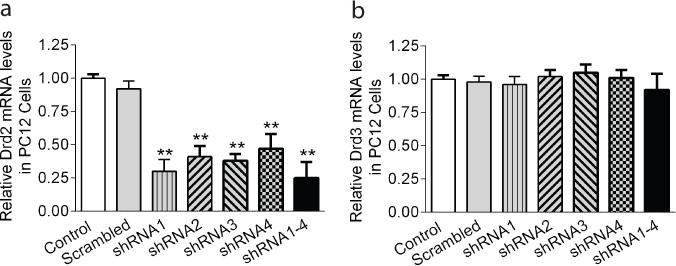
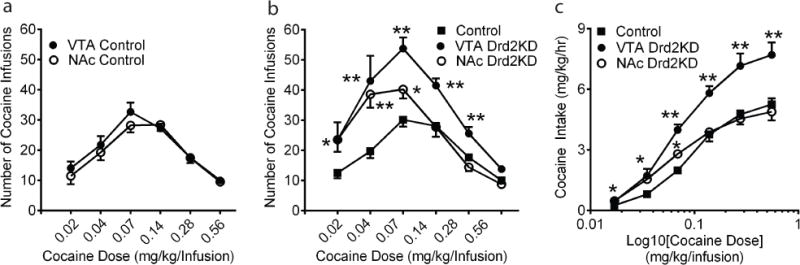
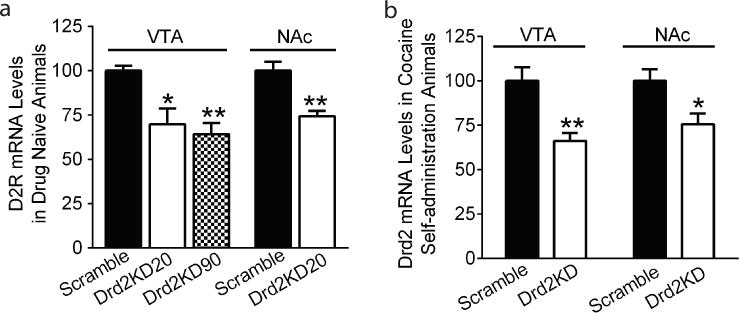
Dopamine D2 receptors (D2Rs) in the ventral tegmental area (VTA) and the nucleus accumbens (NAc) are associated with vulnerability to addiction; however, whether D2Rs in these two brain regions play differential roles in regulation of drug intake is unknown. Here, we compared the effect of decreased mRNA level of Drd2 in each region on cocaine self-administration in a dose-response function. Drd2 mRNA levels in rat VTA or NAc were knocked down by bilateral microinjection of lentivirus coding shRNAs against rat Drd2 or scrambled shRNA. Drd2 knockdown was persistent and stable between 20 and 90 days after lentiviral infection. Animals were trained to self-administer cocaine 20 days after Drd2 shRNA treatment. Compared to scrambled shRNA treated rats, Drd2 knockdown in the VTA increased cocaine self-administration at all tested doses (0.02-0.56 mg/kg/infusion) producing an upward shift (both the ascending and descending limb) in the dose-response curve of cocaine self-administration. In contrast, intra-NAc knockdown increased cocaine self-administration only on the ascending limb of the dose-response curve (0.02-0.07 mg/kg/infusion). These data suggest that D2Rs in the VTA, not in the NAc, regulate high-dose cocaine intake. The present study not only demonstrates that low levels of D2Rs in either region increase low doses of cocaine intake, but also reveals for the first time their dissociable roles in limiting high doses of cocaine self-administration.
腹侧被盖区(VTA)和伏隔核(NAc)中的多巴胺D2受体(D2Rs)与成瘾易感性相关;然而,这两个脑区中的D2Rs在药物摄入调节中是否发挥不同作用尚不清楚。在此,我们在剂量反应函数中比较了每个区域中Drd2 mRNA水平降低对可卡因自我给药的影响。通过双侧微量注射编码针对大鼠Drd2的短发夹RNA(shRNA)或 scrambled shRNA的慢病毒,敲低大鼠VTA或NAc中的Drd2 mRNA水平。慢病毒感染后20至90天,Drd2的敲低持续且稳定。在Drd2 shRNA治疗20天后,训练动物自我给药可卡因。与 scrambled shRNA处理的大鼠相比,VTA中Drd2的敲低在所有测试剂量(0.02 - 0.56 mg/kg/注射)下均增加了可卡因自我给药,使可卡因自我给药的剂量反应曲线向上移动(上升和下降支)。相比之下,NAc内敲低仅在剂量反应曲线的上升支(0.02 - 0.07 mg/kg/注射)增加了可卡因自我给药。这些数据表明,VTA而非NAc中的D2Rs调节高剂量可卡因摄入。本研究不仅表明任一区域中低水平的D2Rs会增加低剂量可卡因摄入,还首次揭示了它们在限制高剂量可卡因自我给药中的可分离作用。