Gluskin B S, Mickey B J
Department of Psychiatry, University of Michigan Medical School, Ann Arbor, MI, USA.
School of Kinesiology, University of Michigan, Ann Arbor, MI, USA.
Transl Psychiatry. 2016 Mar 1;6(3):e747. doi: 10.1038/tp.2016.22.
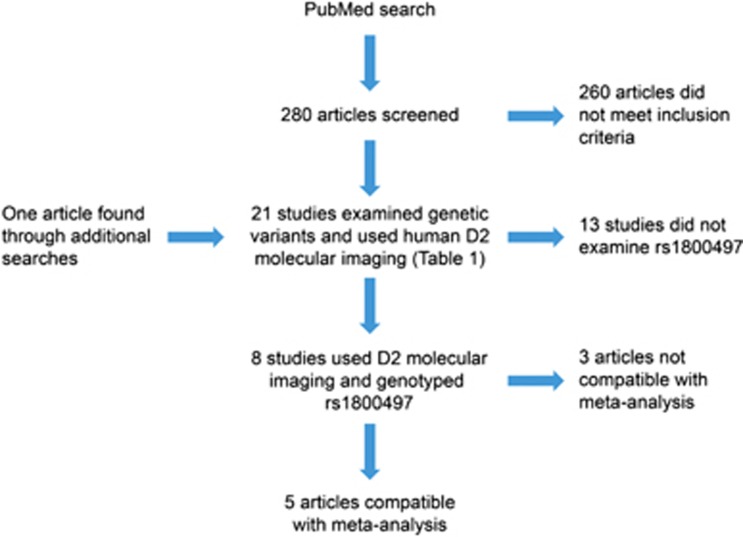
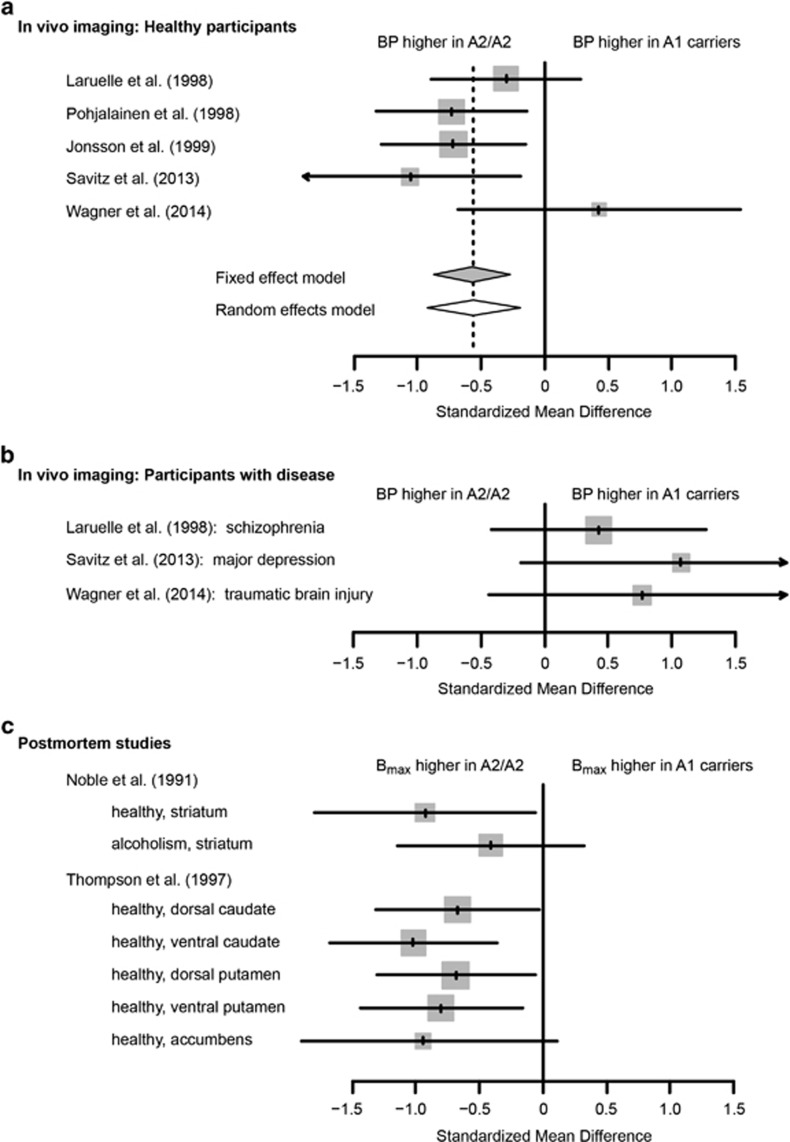
The D2 dopamine receptor mediates neuropsychiatric symptoms and is a target of pharmacotherapy. Inter-individual variation of D2 receptor density is thought to influence disease risk and pharmacological response. Numerous molecular imaging studies have tested whether common genetic variants influence D2 receptor binding potential (BP) in humans, but demonstration of robust effects has been limited by small sample sizes. We performed a systematic search of published human in vivo molecular imaging studies to estimate effect sizes of common genetic variants on striatal D2 receptor BP. We identified 21 studies examining 19 variants in 11 genes. The most commonly studied variant was a single-nucleotide polymorphism in ANKK1 (rs1800497, Glu713Lys, also called 'Taq1A'). Fixed- and random-effects meta-analyses of this variant (5 studies, 194 subjects total) revealed that striatal BP was significantly and robustly lower among carriers of the minor allele (Lys713) relative to major allele homozygotes. The weighted standardized mean difference was -0.57 under the fixed-effect model (95% confidence interval=(-0.87, -0.27), P=0.0002). The normal relationship between rs1800497 and BP was not apparent among subjects with neuropsychiatric diseases. Significant associations with baseline striatal D2 receptor BP have been reported for four DRD2 variants (rs1079597, rs1076560, rs6277 and rs1799732) and a PER2 repeat polymorphism, but none have yet been tested in more than two independent samples. Our findings resolve apparent discrepancies in the literature and establish that rs1800497 robustly influences striatal D2 receptor availability. This genetic variant is likely to contribute to important individual differences in human striatal function, neuropsychiatric disease risk and pharmacological response.
D2多巴胺受体介导神经精神症状,是药物治疗的靶点。D2受体密度的个体差异被认为会影响疾病风险和药理反应。众多分子影像学研究已检测常见基因变异是否会影响人类D2受体结合潜能(BP),但由于样本量较小,尚未有力证明其显著影响。我们对已发表的人体活体分子影像学研究进行了系统检索,以估计常见基因变异对纹状体D2受体BP的效应大小。我们确定了21项研究,这些研究检测了11个基因中的19种变异。研究最频繁的变异是ANKK1中的单核苷酸多态性(rs1800497,Glu713Lys,也称为“Taq1A”)。对该变异进行的固定效应和随机效应荟萃分析(5项研究,共194名受试者)显示,与主要等位基因纯合子相比,次要等位基因(Lys713)携带者的纹状体BP显著且明显更低。在固定效应模型下,加权标准化均数差为-0.57(95%置信区间=(-0.87,-0.27),P=0.0002)。在患有神经精神疾病的受试者中,rs1800497与BP之间的正常关系并不明显。已报道4种DRD2变异(rs1079597、rs1076560、rs6277和rs1799732)以及一种PER2重复多态性与基线纹状体D2受体BP存在显著关联,但尚未在超过两个独立样本中进行检测。我们的研究结果解决了文献中明显的差异,并确定rs1800497对纹状体D2受体可用性有显著影响。这种基因变异可能导致人类纹状体功能、神经精神疾病风险和药理反应方面的重要个体差异。