Graduated School, Tianjin University of Chinese Medicine, Tianjin, 300193, China.
Department of Chinese Medicine, Nankai Hospital, No. 6 Changjiang Road, Nankai District, Tianjin, 300100, China.
BMC Complement Altern Med. 2018 Feb 17;18(1):66. doi: 10.1186/s12906-018-2130-z.
Depression is a common mental disorder. Chai Hu Shu Gan San, a traditional Chinese medicine, is used to treat depression empirically. We present a systematic review and meta-analysis of the therapeutic efficacy and safety of Chai Hu Shu Gan San in treating depression.
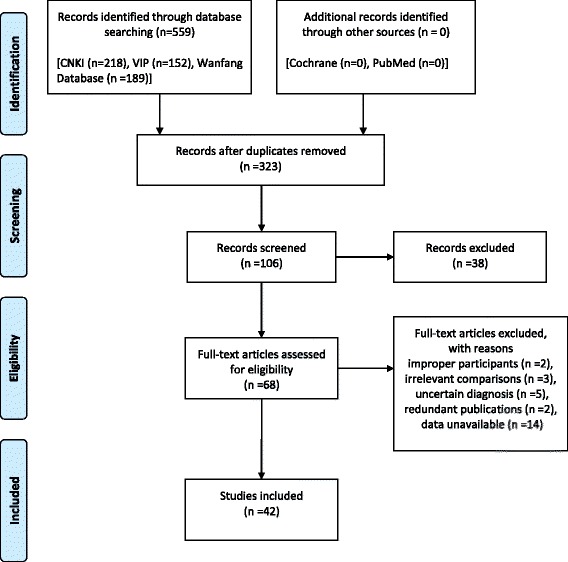
Several databases, including PubMed, China National Knowledge Internet, Wanfang, Chongqing VIP, and the Cochrane library, were systematically searched from their date of foundation to January 1, 2017. In this review, wehave included randomized control trials that compared Chai Hu Shu Gan San (or its combination with a regular Western medicine) with a regular Western medicine alone for the treatment of depression. Two investigators independently extracted and analyzed the data using RevMan 5.2.0 software. Mean difference (with a 95% confidence interval) was used as efficacy indices for outcomes.
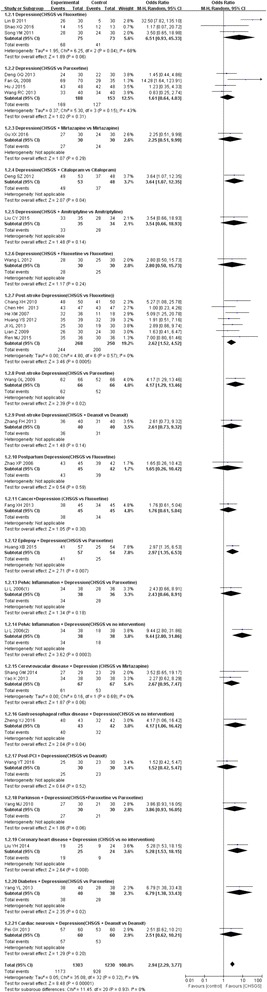
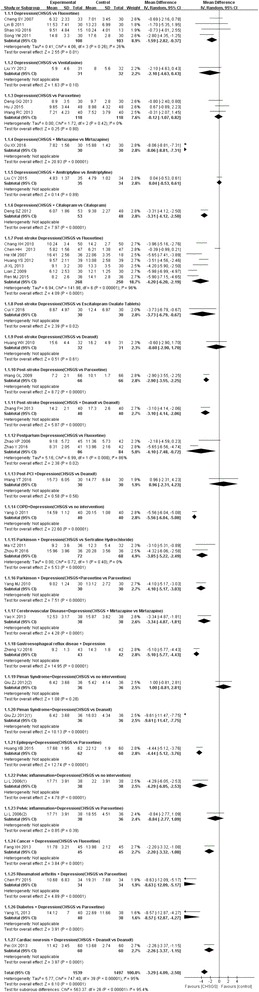
We included 42 studies involving 3234 patients with depression in 15 different types of diseases. Meta analyses showed better effect of Chai Hu Shu Gan San than fluoxetine for pure depression (MD = - 1.59, from - 2.82 to - 0.37, 4 trials, I = 26%), for post-stroke depression (MD = - 4.20, from - 6.20 to - 2.19, 7 trials, I = 96%), and for postpartum depression (MD = - 4.10, from - 7.48 to - 0.72 7 trials, I = 86%). None of the articles reported severe adverse events of oral administration of Chai Hu Shu Gan San. Furthermore, any adverse effects of using Chai Hu Shu Gan San alone were fewer than those of regular Western medicines.
This review found that Chai Hu Shu Gan San has some advantages in treating depression, especially post-stroke depression and post-partum depression. A meticulously designed and conducted randomized control trial is needed for further evaluation.
抑郁症是一种常见的精神障碍。柴胡疏肝散是一种中药,被用于治疗抑郁症。我们进行了一项系统评价和 meta 分析,以评估柴胡疏肝散治疗抑郁症的疗效和安全性。
我们系统性地检索了包括 PubMed、中国知网、万方、维普、Cochrane 图书馆在内的多个数据库,检索时间从建库起至 2017 年 1 月 1 日。本综述纳入了比较柴胡疏肝散(或其与常规西药联合使用)与单纯常规西药治疗抑郁症的随机对照试验。两名研究者独立提取和分析数据,使用 RevMan 5.2.0 软件。采用均数差(95%置信区间)作为结局的疗效指标。
我们纳入了 42 项研究,共 3234 例不同疾病类型的抑郁症患者。meta 分析显示,柴胡疏肝散治疗单纯性抑郁症(MD=-1.59,95%CI-2.82 至-0.37,4 项研究,I²=26%)、脑卒中后抑郁症(MD=-4.20,95%CI-6.20 至-2.19,7 项研究,I²=96%)和产后抑郁症(MD=-4.10,95%CI-7.48 至-0.72,7 项研究,I²=86%)的疗效均优于氟西汀。没有文章报告柴胡疏肝散口服的严重不良事件。此外,单独使用柴胡疏肝散的不良反应少于常规西药。
本综述发现,柴胡疏肝散在治疗抑郁症方面具有一定优势,特别是脑卒中后抑郁症和产后抑郁症。需要进一步设计和开展精心设计和实施的随机对照试验来评估其疗效。