Institute for General Practice, Hannover Medical School, Carl-Neuberg-Str. 1, 30625, Hannover, Germany.
Paracelsus Medical University Salzburg, Strubergasse 21, 5020, Salzburg, Austria.
BMC Palliat Care. 2018 Feb 17;17(1):27. doi: 10.1186/s12904-018-0283-7.
The Supportive and Palliative Care Indicators tool (SPICT) supports the identification of patients with potential palliative care (PC) needs. An Austrian-German expert group translated SPICT into German (SPICT-DE) in 2014. The aim of this study was the systematic development, refinement, and testing of SPICT-DE for its application in primary care (general practice).
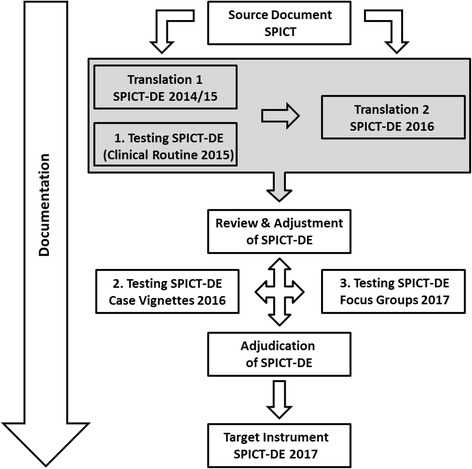
SPICT-DE was developed by a multiprofessional research team according to the TRAPD model: translation, review, adjudication, pretesting and documentation. In a pretest, five general practitioners (GPs) rated four case vignettes of patients with different PC needs. GPs were asked to assess whether each patient might benefit from PC or not (I) based on their subjective appraisal ("usual practice") and (II) by using SPICT-DE. After further refinement, two focus groups with 28 GPs (68% with a further qualification in PC) were conducted to test SPICT-DE. Again, participants rated two selected case vignettes (I) based on their subjective appraisal and (II) by using SPICT-DE. Afterwards, participants reflected the suitability of SPICT-DE for use in their daily practice routine within the German primary care system. Quantitative data were analysed with descriptive statistics and non-parametric tests for small samples. Qualitative data were analysed by conventional content analysis. Focus group discussion was analysed combining formal and conventional content analysis.
Compared to the spontaneous rating of the case vignettes based on subjective appraisal, participants in both the pretest and the focus groups considered PC more often as being beneficial for the patients described in the case vignettes when using SPICT-DE. Participants in the focus groups agreed that SPICT-DE includes all relevant indicators necessary for an adequate clinical identification of patients who might benefit from PC.
SPICT-DE supports the identification of patients who might benefit from PC and seems suitable for routine application in general practice in Germany. The systematic development, refinement, and testing of SPICT-DE in this study was successfully completed by using a multiprofessional and participatory approach.
支持性和姑息治疗指标工具(SPICT)支持识别有潜在姑息治疗(PC)需求的患者。一个奥地利-德国专家组于 2014 年将 SPICT 翻译为德文(SPICT-DE)。本研究的目的是系统地开发、完善和测试 SPICT-DE,以便在初级保健(全科医学)中应用。
SPICT-DE 由多专业研究团队根据 TRAPD 模型开发:翻译、审查、裁决、预测试和文件记录。在预测试中,五名全科医生(GP)对四种不同 PC 需求的患者案例进行了评分。要求 GP 基于主观评估(“常规做法”)和(II)使用 SPICT-DE,评估每位患者是否可能受益于 PC。经过进一步完善,对 28 名全科医生(68%有进一步的 PC 资格)进行了两次焦点小组测试,以测试 SPICT-DE。同样,参与者根据主观评估(I)和(II)使用 SPICT-DE 对两个选定的案例进行了评分。之后,参与者反思了 SPICT-DE 在德国初级保健系统常规实践中的适用性。定量数据采用描述性统计和小样本非参数检验进行分析。定性数据采用常规内容分析法进行分析。焦点小组讨论分析结合了形式和常规内容分析。
与基于主观评估的案例评分相比,预测试和焦点小组的参与者在使用 SPICT-DE 时,更多地认为案例中描述的患者接受 PC 治疗更有益。焦点小组的参与者一致认为,SPICT-DE 包含了所有必要的指标,用于充分识别可能受益于 PC 的患者。
SPICT-DE 支持识别可能受益于 PC 的患者,似乎适合在德国的常规实践中应用。本研究采用多专业和参与式方法成功完成了 SPICT-DE 的系统开发、完善和测试。