Department of Family and Preventive Medicine, Prince of Songkla University, Faculty of Medicine, Hat Yai, Songkhla, 90110, Thailand.
Research Center for Cancer Control, Prince of Songkla University, Hat Yai, Songkhla, 90110, Thailand.
BMC Palliat Care. 2021 Feb 19;20(1):35. doi: 10.1186/s12904-021-00729-y.
Identification of patients who might benefit from palliative care among countries with different socioeconomic and medical contexts is challenging. The Supportive and Palliative Care Indicators Tool for a Low-income Setting (SPICT-LIS) was designed to help physicians identify patients in low-income setting who might benefit from palliative care. We aimed to systematically adapt and refine the SPICT-LIS for Thai general palliative care providers.
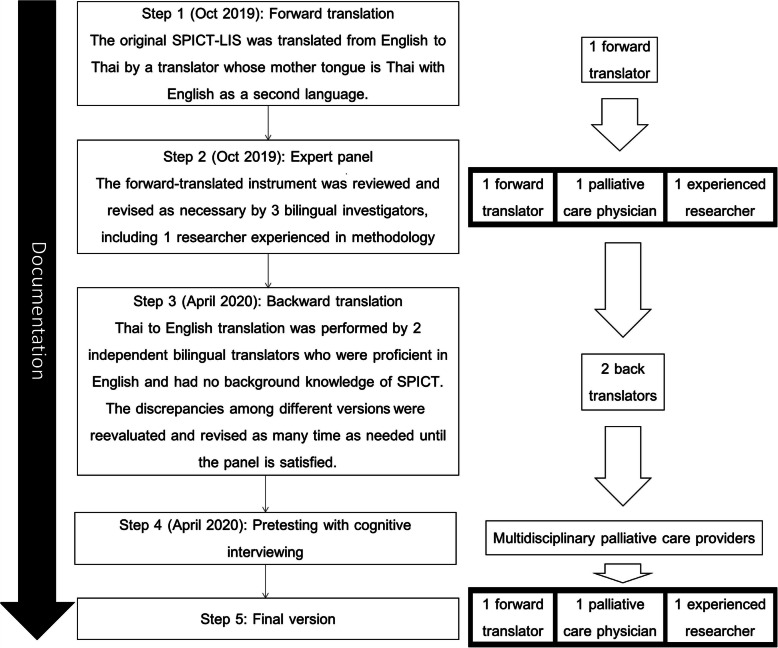
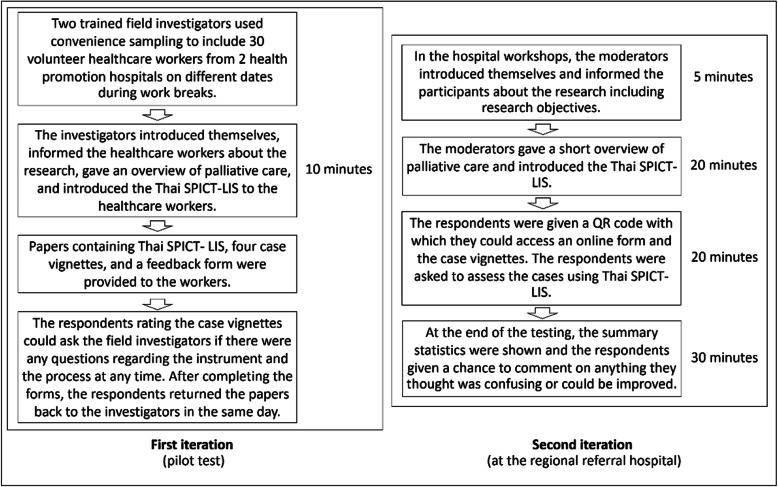
We followed the WHO guidelines for translation, cross-cultural adaptation and validation of an instrument for the SPICT-LIS. Three expert panel members did the initial adaptation using forward and backward translations with pretested data. Two iterations of pretesting were conducted to test for applicability and reliability. The case vignettes which were used in the pretesting were modified hospital medical records. The pretesting was done with 30 respondents from various specialties in a community health center and 34 general palliative care providers from a regional referral hospital in the first and second iterations, respectively. To examine instrument reliability, interrater reliability and internal consistency were evaluated. Cognitive interviewing was conducted using semi-structured interviews with general practitioners (GPs) using the "think aloud strategy" and "probing questions".
The adapted Thai SPICT-LIS had a total of 34 indicators which included 6 general and 28 clinical indicators. The assessment of the adapted Thai SPICT-LIS found that it provided consistent responses with good agreement among the GPs, with a Fleiss kappa coefficient of 0.93 (0.76-1.00). The administration time was 2.3-4.3 min per case. Most respondents were female. The 8 interviewed GPs said they felt that the SPICT-LIS was appropriate for use in a general setting in Thailand.
The study found that the Thai SPICT-LIS could be an applicable, acceptable, and reliable tool for general palliative care providers in Thailand to identify patients who might benefit from palliative care.
在社会经济和医疗环境不同的国家中,确定哪些患者可能从姑息治疗中获益具有挑战性。支持和姑息治疗低资源环境指标工具(SPICT-LIS)旨在帮助医生识别可能从姑息治疗中获益的低资源环境中的患者。我们旨在为泰国的一般姑息治疗提供者系统地改编和完善 SPICT-LIS。
我们遵循世界卫生组织(WHO)的指南,对 SPICT-LIS 进行翻译、跨文化适应和验证。三位专家组成员使用预测试数据进行了初步的改编,即正向和逆向翻译。进行了两轮预测试,以测试适用性和可靠性。预测试中使用的病例示例是修改后的医院病历。第一轮预测试在社区卫生中心的 30 名来自不同专业的人员和第二轮预测试在区域转诊医院的 34 名一般姑息治疗提供者中进行。为了检查仪器的可靠性,评估了评分者间信度和内部一致性。使用一般从业者(GP)的半结构化访谈进行认知访谈,使用“大声思考策略”和“探究问题”。
改编后的泰国 SPICT-LIS 共有 34 个指标,包括 6 个一般指标和 28 个临床指标。对改编后的泰国 SPICT-LIS 的评估发现,它提供了一致的反应,GP 之间的一致性很好,Fleiss kappa 系数为 0.93(0.76-1.00)。每个病例的管理时间为 2.3-4.3 分钟。大多数受访者为女性。接受访谈的 8 名 GP 表示,他们认为 SPICT-LIS 适合在泰国的一般环境中使用。
研究发现,泰国 SPICT-LIS 可能是泰国一般姑息治疗提供者识别可能从姑息治疗中获益的患者的一种适用、可接受和可靠的工具。