Zafar Azra, Alabdali Majed, Shahid Rizwana, Aljaafari Danah, Al-Khamis Fahd A, Albakr Aishah I, Nazish Saima, Al-Sulaiman Abdulla A, Abraham Alon
Department of Neurology, College of Medicine, Imam Abdulrahman Bin Faisal University, Dammam, Kingdom of Saudi Arabia. E-mail:
Neurosciences (Riyadh). 2018 Jan;23(1):13-17. doi: 10.17712/nsj.2018.1.20170207.
To assess the burden and describe the pattern of neurological disorders requiring admissions in a teaching hospital of Al Khobar.
This is a retrospective, cross sectional study, carried out in the Neurology Department of King Fahd Hospital of the University from January 2009 to December 2016. Neurological disorders were grouped as ischemic stroke, intracerebral hemorrhage, transient ischemic attack, cerebral venous sinus thrombosis, seizure disorders, central nervous system infection, multiple sclerosis, neuropathies, myopathies, headache, dementia and miscellaneous group. Data was entered and analyzed by Statistical Package for the Social Science (SPSS) version 22.0 (IBM Corp., Armonk, NY, USA).
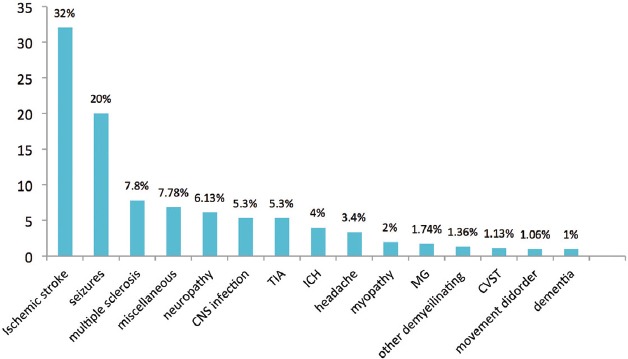
The records of 1,317 patients admitted under Neurology Service were analyzed. Out of that, 740 (56.2%) were male and 577 (43.8%) were female. Mean age was 46.9+-24 years (mean+-standard deviation). Ischemic stroke was the most common diagnosis (32%) followed by seizures (20%). Multiple sclerosis accounted for around 8% and central nervous system infections 5% of neurological admission.
Ischemic stroke was found to be the most common etiology for hospitalization in our study. The results of our study are similar to previous literature. An urgent need to control major risk factors such as diabetes and hypertension is warranted to minimize the burden of stroke.
评估沙特胡拜尔市一家教学医院中需要住院治疗的神经系统疾病的负担,并描述其模式。
这是一项回顾性横断面研究,于2009年1月至2016年12月在法赫德国王大学医院神经科进行。神经系统疾病分为缺血性卒中、脑出血、短暂性脑缺血发作、脑静脉窦血栓形成、癫痫、中枢神经系统感染、多发性硬化、神经病变、肌病、头痛、痴呆及其他类别。数据录入并采用社会科学统计软件包(SPSS)22.0版(美国纽约州阿蒙克市IBM公司)进行分析。
分析了1317例在神经科接受治疗的患者记录。其中,男性740例(56.2%),女性577例(43.8%)。平均年龄为46.9±24岁(均值±标准差)。缺血性卒中是最常见的诊断(32%),其次是癫痫(20%)。多发性硬化约占神经科住院患者的8%,中枢神经系统感染占5%。
在我们的研究中,缺血性卒中是住院治疗最常见的病因。我们的研究结果与先前文献相似。迫切需要控制糖尿病和高血压等主要危险因素,以减轻卒中负担。