Salinas-Santander Mauricio, Trevino Víctor, De la Rosa-Moreno Eduardo, Verduzco-Garza Bárbara, Sánchez-Domínguez Celia N, Cantú-Salinas Cristina, Ocampo-Garza Jorge, Lagos-Rodríguez Armando, Ocampo-Candiani Jorge, Ortiz-López Rocio
Departamento de Bioquímica y Medicina Molecular, Universidad Autónoma de Nuevo León, Facultad de Medicina, Monterrey, Nuevo León 64460, México.
Departamento de Investigación, Facultad de Medicina Unidad Saltillo, Universidad Autónoma de Coahuila, Saltillo, Coahuila 25000, México.
Exp Ther Med. 2018 Mar;15(3):2804-2811. doi: 10.3892/etm.2018.5764. Epub 2018 Jan 17.
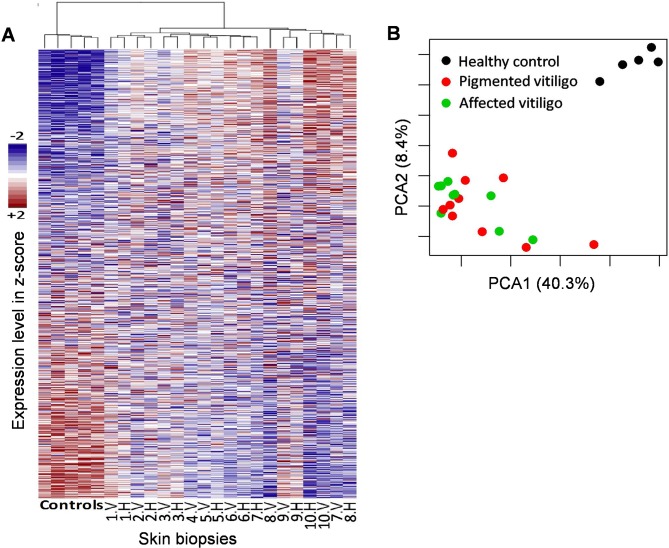
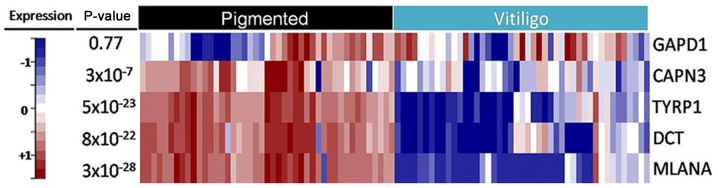
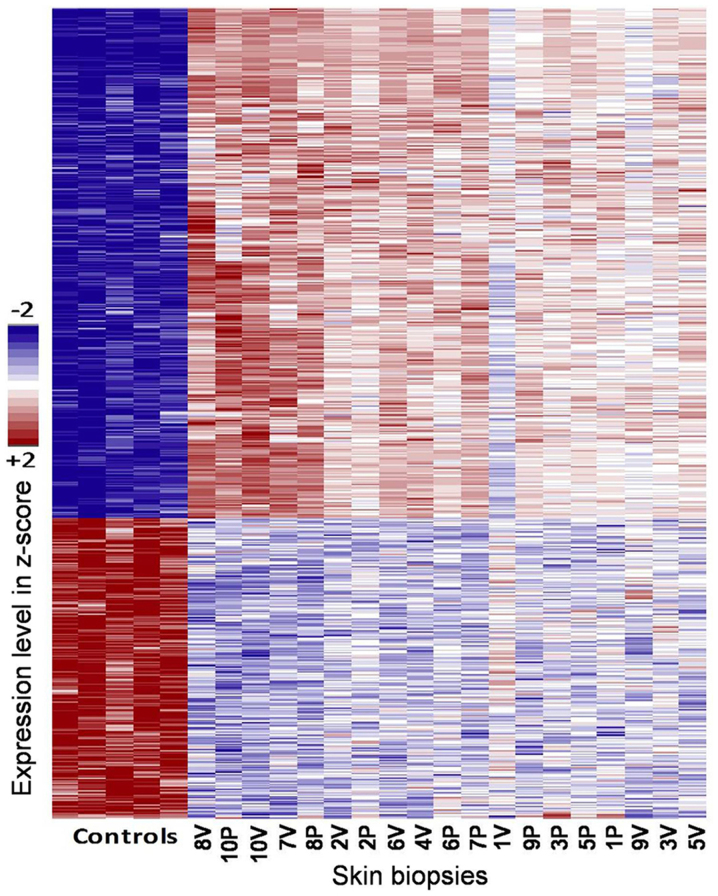
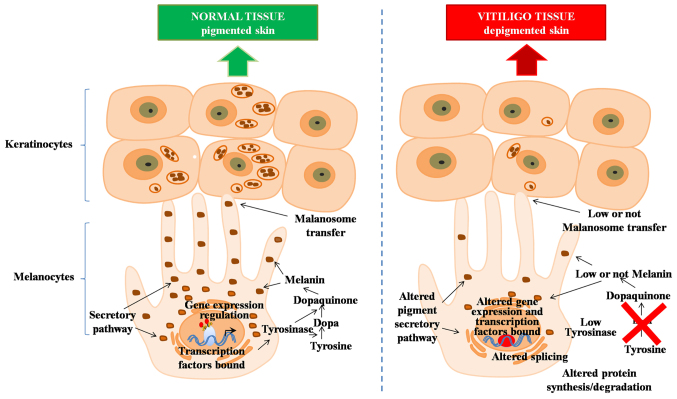
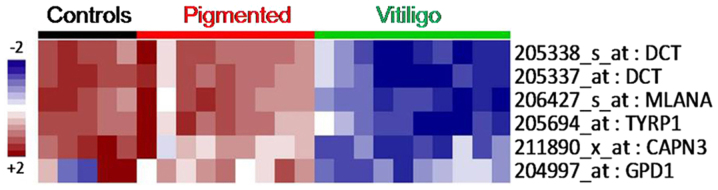
Vitiligo is a disorder causing skin depigmentation, in which several factors have been proposed for its pathogenesis: Environmental, genetic and biological aspects of melanocytes, even those of the surrounding keratinocytes. However, the lack of understanding of the mechanisms has complicated the task of predicting the development and progression. The present study used microarray analysis to characterize the transcriptional profile of skin from Vitiligo Vulgaris (VV) patients and the identified transcripts were validated using targeted high-throughput RNA sequencing in a broader set of patients. For microarrays, mRNA was taken from 20 skin biopsies of 10 patients with VV (pigmented and depigmented skin biopsy of each), and 5 biopsies of healthy subjects matched for age and sex were used as a control. A signature was identified that contains the expression pattern of 722 genes between depigmented vitiligo skin vs. healthy control, 1,108 between the pigmented skin of vitiligo vs. healthy controls and 1,927 between pigmented skin, depigmented vitiligo and healthy controls (P<0.05; false discovery rate, <0.1). When comparing the pigmented and depigmented skin of patients with vitiligo, which reflects the real difference between both skin types, 5 differentially expressed genes were identified and further validated in 45 additional VV patients by RNA sequencing. This analysis showed significantly higher RNA levels of calpain-3, dopachrome tautomerase, melan-A and tyrosinase-related protein-1 genes. The data revealed that the pigmented skin of vitiligo is already affected at the level of gene expression and that the main differences between pigmented and non-pigmented skin are explained by the expression of genes associated with pigment metabolism.
白癜风是一种导致皮肤色素脱失的疾病,其发病机制涉及多个因素:包括环境、黑素细胞的遗传和生物学方面,甚至周围角质形成细胞的相关因素。然而,对其发病机制的认识不足使得预测疾病的发展和进展变得复杂。本研究使用微阵列分析来表征寻常型白癜风(VV)患者皮肤的转录谱,并在更广泛的患者群体中使用靶向高通量RNA测序对鉴定出的转录本进行验证。对于微阵列分析,从10例VV患者的20份皮肤活检样本(每位患者的色素沉着和色素脱失皮肤活检样本)中提取mRNA,并将5份年龄和性别匹配的健康受试者的活检样本用作对照。确定了一个特征图谱,其中包括色素脱失的白癜风皮肤与健康对照之间722个基因的表达模式、白癜风色素沉着皮肤与健康对照之间1108个基因的表达模式,以及色素沉着皮肤、色素脱失的白癜风皮肤与健康对照之间1927个基因的表达模式(P<0.05;错误发现率<0.1)。在比较白癜风患者的色素沉着和色素脱失皮肤时(这反映了两种皮肤类型之间的实际差异),鉴定出5个差异表达基因,并通过RNA测序在另外45例VV患者中进一步验证。该分析显示钙蛋白酶-3、多巴色素互变酶、黑素-A和酪氨酸酶相关蛋白-1基因的RNA水平显著更高。数据表明,白癜风的色素沉着皮肤在基因表达水平上已经受到影响,色素沉着和非色素沉着皮肤之间的主要差异可由与色素代谢相关基因的表达来解释。