Said-Fernandez Salvador Luis, Sanchez-Domínguez Celia Nohemi, Salinas-Santander Mauricio Andres, Martinez-Rodriguez Herminia Guadalupe, Kubelis-Lopez David Emmanuel, Zapata-Salazar Natalia Aranza, Vazquez-Martinez Osvaldo Tomas, Wollina Uwe, Lotti Torello, Ocampo-Candiani Jorge
Department of Biochemistry and Molecular Medicine, Jose Eleuterio Gonzalez Medicine School and University Hospital, Autonomous University of Nuevo León, Monterrey, Nuevo León 64460, Mexico.
Research Department, Autonomous University of Coahuila, Faculty of Medicine Saltillo Unit, Saltillo, Coahuila 25000, Mexico.
Exp Ther Med. 2021 Apr;21(4):312. doi: 10.3892/etm.2021.9743. Epub 2021 Feb 1.
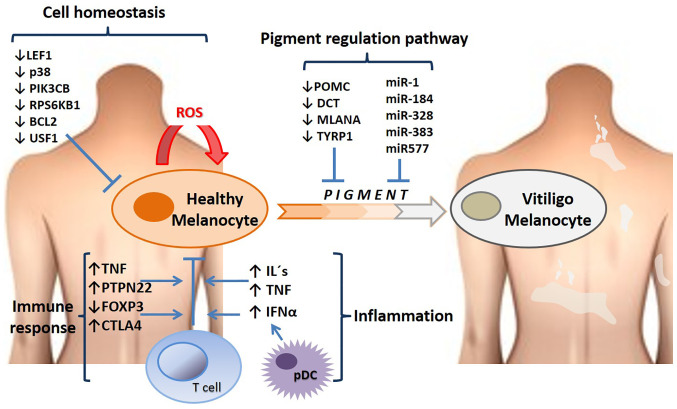
Vitiligo is a skin disorder characterized by depigmentation of the skin due to a lack of melanin. This condition affects men and woman of all ages and its incidence is not restricted by ethnicity or region. Vitiligo is a multifactorial disease, in which melanocytes, which serve important functions in skin pigmentation and immune processes, are impaired. There is sufficient evidence that immunological and genetic factors are primarily responsible for the destruction and dysfunction of melanocytes. Therefore, genetic DNA sequence variants that participate in skin homeostasis, pigmentation and immune response regulation, as well as altered expression patterns, may contribute to the risk of developing vitiligo. The current review presented an overview of the mechanism of pigmentation and of currently known factors involved in depigmentation, as well as the classification, epidemiology, associated comorbidities, risk factors, immunopathogenesis and several genetic and molecular changes associated with vitiligo.
白癜风是一种皮肤疾病,其特征是由于缺乏黑色素而导致皮肤色素脱失。这种疾病影响所有年龄段的男性和女性,其发病率不受种族或地区限制。白癜风是一种多因素疾病,其中在皮肤色素沉着和免疫过程中起重要作用的黑素细胞受到损害。有充分证据表明,免疫和遗传因素是黑素细胞破坏和功能障碍的主要原因。因此,参与皮肤稳态、色素沉着和免疫反应调节的遗传DNA序列变异以及表达模式的改变,可能会增加患白癜风的风险。本综述概述了色素沉着的机制、目前已知的色素脱失相关因素,以及白癜风的分类、流行病学、相关合并症、危险因素、免疫发病机制和一些与白癜风相关的遗传和分子变化。