Hung Ming-Szu, Fang Yu-Hung, Lin Yu-Ching, Lung Jr-Hau, Hsieh Meng-Jer, Tsai Ying-Huang
Division of Thoracic Oncology, Department of Pulmonary and Critical Care Medicine, Chang Gung Memorial Hospital, Chiayi Branch, Chiayi 61363, Taiwan, R.O.C.
Department of Medicine, College of Medicine, Chang Gung University, Taoyuan 33302, Taiwan, R.O.C.
Mol Clin Oncol. 2018 Mar;8(3):421-428. doi: 10.3892/mco.2018.1550. Epub 2018 Jan 10.
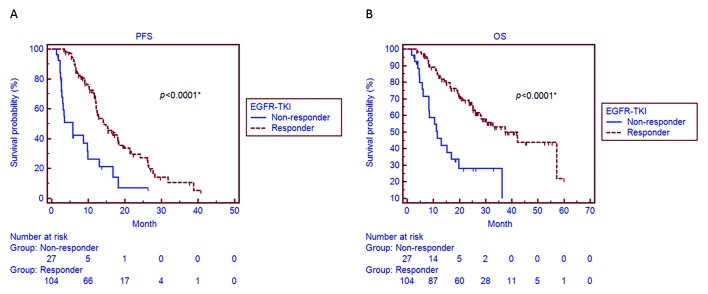
The aim of the present retrospective cohort study was to elucidate the clinical presentation of epidermal growth factor receptor (EGFR)-tyrosine kinase inhibitor (TKI) responders and non-responders in lung adenocarcinoma patients with common mutations. The cohort included 131 lung adenocarcinoma patients with common exon 19 or exon 21 mutations, who were receiving first-line EGFR-TKI therapy. The patient characteristics, treatment regimen and outcomes were recorded and analyzed. Of the 131 patients, 104 (79.3%) responded to treatment, while 27 (20.7%) did not. A significantly longer median progression-free survival (PFS) [14.3, 95% confidence interval (CI): 12.2-18.4 vs. 5.7, 95% CI: 2.7-9.9 months; P<0.001] and overall survival (OS) (42.2, 95% CI: 28.1-58.1 vs. 11.5, 95% CI: 8.3-19.7 months; P<0.001) were observed in responders compared with non-responders. In responders, bone [hazard ratio (HR)=1.87, 95% CI: 1.11-3.20, P=0.021] and pleural (HR=2.40, 95% CI: 1.37-4.22, P=0.002) metastasis were independent factors of PFS. Exon 19 mutations (HR=0.38, 95% CI: 0.19-0.76, P=0.006), Eastern Cooperative Oncology Group performance status score ≥2 (HR=3.53, 95% CI: 1.42-8.75, P=0.007) and bone metastasis (HR=2.01, 95% CI: 1.05-3.85, P=0.034), were independent factors of OS. In non-responders, smoking (HR=3.97, 95% CI: 1.13-13.91, P=0.031) was an independent factor of PFS. Different survival-associated factors were observed between EGFR-TKI responders and non-responders. The development of new treatment strategies should be advocated in EGFR-TKI non-responders.
本回顾性队列研究的目的是阐明表皮生长因子受体(EGFR)-酪氨酸激酶抑制剂(TKI)治疗有常见突变的肺腺癌患者时,治疗有反应者和无反应者的临床表现。该队列包括131例有常见外显子19或外显子21突变且正在接受一线EGFR-TKI治疗的肺腺癌患者。记录并分析了患者的特征、治疗方案和结局。131例患者中,104例(79.3%)对治疗有反应,27例(20.7%)无反应。有反应者的中位无进展生存期(PFS)[14.3,95%置信区间(CI):12.2 - 18.4对5.7,95%CI:2.7 - 9.9个月;P<0.001]和总生存期(OS)(42.2,95%CI:28.1 - 58.1对11.5,95%CI:8.3 - 19.7个月;P<0.001)显著长于无反应者。在有反应者中,骨转移[风险比(HR)=1.87,95%CI:1.11 - 3.20,P = 0.021]和胸膜转移(HR = 2.40,95%CI:1.37 - 4.22,P = 0.002)是PFS的独立影响因素。外显子19突变(HR = 0.38,95%CI:0.19 - 0.76,P = 0.006)、东部肿瘤协作组体能状态评分≥2(HR = 3.53,95%CI:1.42 - 8.75,P = 0.007)和骨转移(HR = 2.01,95%CI:1.05 - 3.85,P = 0.034)是OS的独立影响因素。在无反应者中,吸烟(HR = 3.97,95%CI:1.13 - 13.91,P = 0.031)是PFS的独立影响因素。EGFR-TKI治疗有反应者和无反应者之间观察到不同的生存相关因素。应提倡为EGFR-TKI治疗无反应者制定新的治疗策略。