Institute for Advanced Biosciences (IAB), INSERM U1209, CNRS UMR 5309, Université Grenoble Alpes, 38000, Grenoble, France.
Assistance Publique-Hôpitaux de Paris, Robert Debré Hospital, Child and Adolescent Psychiatry Department, Paris, France.
Environ Health. 2018 Feb 20;17(1):17. doi: 10.1186/s12940-018-0359-0.
There are concerns that developmental exposure to endocrine disrupting chemicals such as phenolic compounds and phthalates could affect child cognitive function. Epidemiological studies tackling this question have mainly focused on phthalate metabolites and bisphenol A, but not on the other phenolic compounds. Our study aimed to assess the relationship between in-utero exposure to phthalates, bisphenol A and other phenolic compounds (parabens, triclosan, dichlorophenols and benzophenone-3) and the Intelligence Quotient (IQ) of boys at 5-6 years.
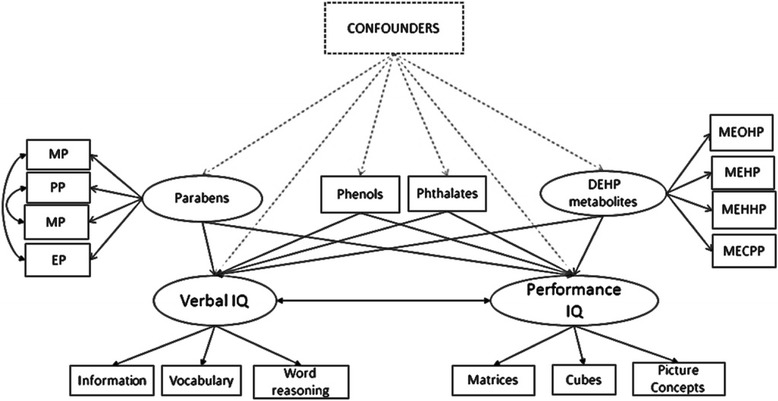
In 452 mother-son dyads from the French EDEN cohort, we measured 11 phthalate metabolites and 9 phenolic compounds (4 parabens, benzophenone-3, bisphenol A, 2 dichlorophenols and triclosan) in spot urine samples collected between 22 and 29 gestational weeks. Verbal and performance IQ of children were assessed at 5-6 years by a psychologist using the Wechsler Preschool and Primary Scale of Intelligence (WPPSI). We used adjusted Structural Equation Models (SEM) combined with Benjamini and Hochberg false discovery rate correction to assess the associations between maternal urine phenol and phthalate metabolite concentrations considered simultaneously and the boys' IQ.
No phenol or phthalate metabolite concentration was negatively associated with the boys' verbal or performance IQ (uncorrected p-values ≥0.09). Mono(3-carboxypropyl) phthalate tended to be associated with increased verbal IQ (β = 0.136, 95% confidence interval, 0.01; 0.27). This association disappeared after correction for multiple comparison (corrected p-value, 0.71).
Our results did not provide evidence of an inverse association between in-utero exposure to phenols or phthalates and verbal and performance IQ among boys. Since phenols and phthalates may have sex-specific effects, these null findings cannot be generalized to girls. Limitations included use of a single spot urine sample to assess exposures and lack of consideration of postnatal exposures.
人们担心发育过程中接触到的内分泌干扰化学物质,如酚类化合物和邻苯二甲酸酯,可能会影响儿童的认知功能。针对这一问题的流行病学研究主要集中在邻苯二甲酸酯代谢物和双酚 A 上,但没有涉及其他酚类化合物。我们的研究旨在评估宫内暴露于邻苯二甲酸酯、双酚 A 和其他酚类化合物(对羟基苯甲酸酯、三氯生、二氯酚和二苯甲酮-3)与 5-6 岁男孩智商之间的关系。
在法国 EDEN 队列的 452 对母子中,我们在妊娠 22 至 29 周期间收集了尿液样本,测量了 11 种邻苯二甲酸酯代谢物和 9 种酚类化合物(4 种对羟基苯甲酸酯、二苯甲酮-3、双酚 A、2 种二氯酚和三氯生)。心理学家使用韦氏学前和小学智力量表(WPPSI)在 5-6 岁时评估了儿童的言语和操作智商。我们使用结合了 Benjamini 和 Hochberg 错误发现率校正的调整结构方程模型(SEM)来评估同时考虑母体尿液中酚和邻苯二甲酸酯代谢物浓度与男孩智商之间的关联。
没有一种酚或邻苯二甲酸酯代谢物浓度与男孩的言语或操作智商呈负相关(未校正 p 值≥0.09)。单(3-羧基丙基)邻苯二甲酸酯与言语智商升高呈正相关(β=0.136,95%置信区间,0.01;0.27)。在进行多次比较校正后,这种关联消失(校正 p 值,0.71)。
我们的结果没有提供证据表明胎儿暴露于酚类化合物或邻苯二甲酸酯与男孩的言语和操作智商之间存在反比关系。由于酚类化合物和邻苯二甲酸酯可能具有性别特异性的影响,因此这些阴性结果不能推广到女孩。研究的局限性包括使用单一的尿液样本来评估暴露情况以及缺乏对产后暴露情况的考虑。