Centre for GeoGenetics, Natural History Museum of Denmark, University of Copenhagen, Copenhagen, Denmark.
State Key Laboratory of Genetic Resources and Evolution, Kunming Institute of Zoology, Chinese Academy of Sciences, Kunming, China.
Nat Ecol Evol. 2018 Apr;2(4):659-668. doi: 10.1038/s41559-018-0476-8. Epub 2018 Feb 19.
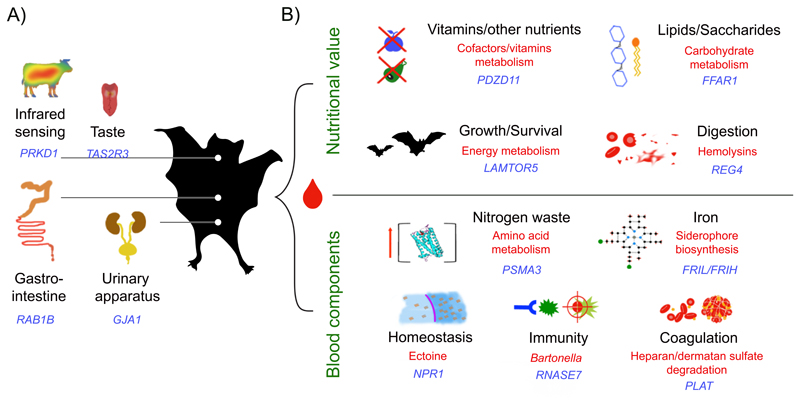
Adaptation to specialized diets often requires modifications at both genomic and microbiome levels. We applied a hologenomic approach to the common vampire bat (Desmodus rotundus), one of the only three obligate blood-feeding (sanguivorous) mammals, to study the evolution of its complex dietary adaptation. Specifically, we assembled its high-quality reference genome (scaffold N50 = 26.9 Mb, contig N50 = 36.6 kb) and gut metagenome, and compared them against those of insectivorous, frugivorous and carnivorous bats. Our analyses showed a particular common vampire bat genomic landscape regarding integrated viral elements, a dietary and phylogenetic influence on gut microbiome taxonomic and functional profiles, and that both genetic elements harbour key traits related to the nutritional (for example, vitamin and lipid shortage) and non-nutritional (for example, nitrogen waste and osmotic homeostasis) challenges of sanguivory. These findings highlight the value of a holistic study of both the host and its microbiota when attempting to decipher adaptations underlying radical dietary lifestyles.
适应专门的饮食通常需要在基因组和微生物组水平上进行修改。我们应用全基因组学方法研究了普通吸血蝙蝠(Desmodus rotundus),这是仅有的三种必需血液(吸血)哺乳动物之一,以研究其复杂饮食适应的进化。具体来说,我们组装了高质量的参考基因组(支架 N50=26.9 Mb,连续 N50=36.6 kb)和肠道宏基因组,并将其与食虫、食果和食肉蝙蝠进行了比较。我们的分析显示,普通吸血蝙蝠的基因组景观具有特别的特点,包括整合的病毒元件、饮食和系统发育对肠道微生物组分类和功能特征的影响,以及这些遗传元素都具有与吸血的营养(例如,维生素和脂质缺乏)和非营养(例如,氮废物和渗透平衡)挑战相关的关键特征。这些发现强调了在试图破译激进饮食生活方式背后的适应时,对宿主及其微生物组进行整体研究的价值。