Department of Chemical Sciences and Technologies, University of Rome, Tor Vergata, Via della Ricerca Scientifica, 00133, Rome, Italy.
Department of Systems Medicine, Hypertension and Nephrology Unit, University of Rome, Tor Vergata, Viale Oxford 81, 00133, Rome, Italy.
Cell Death Dis. 2018 Feb 19;9(3):288. doi: 10.1038/s41419-018-0289-3.
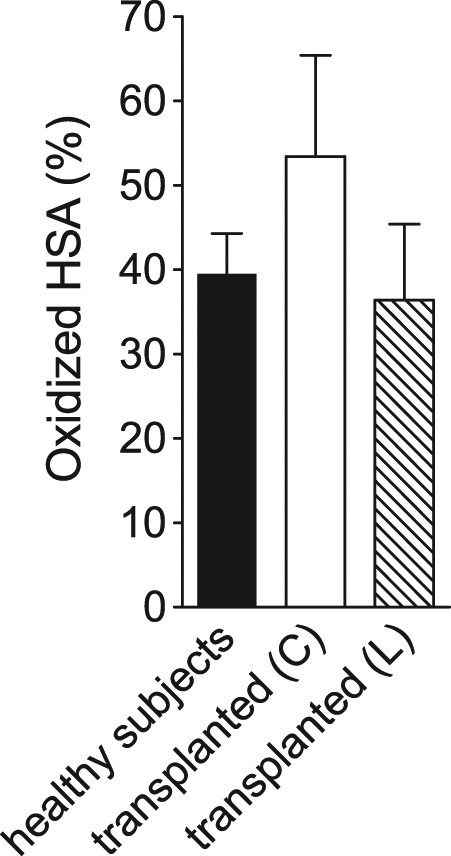
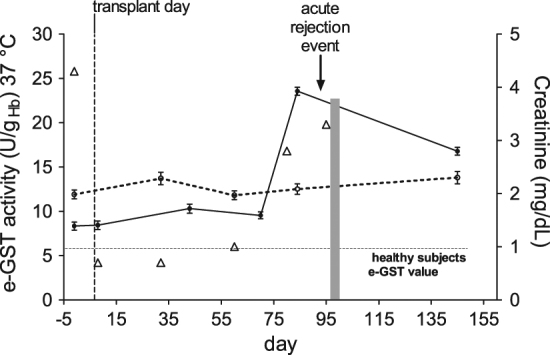
Erythrocyte glutathione transferase (e-GST) is overexpressed in case of increased blood toxicity and its level correlates with the kidney disease progression. Thus, it represents a probe of kidney efficiency against circulating toxins. We measured the activity of e-GST in patients with transplant kidney from living and cadaver donors, correlated its level to biochemical parameters of kidney function, and measured the level of oxidized albumin as a probe of oxidative stress using a new simple procedure. Interestingly, the activity of e-GST in transplant patients from cadaver donors (N = 153) is very high (11.7 U/g) compared to healthy subjects (N = 80) ( 5.6 U/g). Lower values were observed in transplant patients with kidney from living donors (N = 16) (9.8 U/g). Except for steroids, no correlation has been found with the immunosuppressive therapies and routine clinical and laboratory parameters. Also serum oxidized albumin, which reveals oxidative stress, is significantly higher in transplant patients from cadaver donors (53%) compared to that from living donors (36%). Overall, these data indicate that most of transplant kidneys from cadavers lost part of the detoxifying power against circulating toxins and suffer a relevant oxidative stress compared to those coming from living donors. A case report suggests that e-GST could represent a very early marker of incipient graft rejection. In conclusion, e-GST may be used to check the decline or maintenance of the kidney detoxification competence during post-transplantation course.
红细胞谷胱甘肽转移酶(e-GST)在血液毒性增加时过度表达,其水平与肾病进展相关。因此,它代表了对抗循环毒素的肾脏效率的探针。我们测量了来自活体和尸体供体的移植肾患者的 e-GST 活性,将其水平与肾功能的生化参数相关联,并使用新的简单程序测量氧化白蛋白水平作为氧化应激的探针。有趣的是,来自尸体供体的移植患者(N=153)的 e-GST 活性非常高(11.7 U/g),与健康受试者(N=80)相比(5.6 U/g)。来自活体供体的移植患者(N=16)的 e-GST 活性较低(9.8 U/g)。除了类固醇,与免疫抑制治疗和常规临床及实验室参数均无相关性。来自尸体供体的移植患者的血清氧化白蛋白(揭示氧化应激的指标)也明显高于来自活体供体的移植患者(53%对 36%)。总的来说,这些数据表明,与来自活体供体的移植肾相比,大多数来自尸体的移植肾失去了部分对抗循环毒素的解毒能力,并遭受了相关的氧化应激。一份病例报告表明,e-GST 可能是早期移植排斥反应的标志物。总之,e-GST 可用于检查移植后期间肾脏解毒能力的下降或维持情况。