Geffroy Benjamin, Sadoul Bastien, Bouchareb Amine, Prigent Sylvain, Bourdineaud Jean-Paul, Gonzalez-Rey Maria, Morais Rosana N, Mela Maritana, Nobre Carvalho Lucélia, Bessa Eduardo
Center of Study of the Meridional Amazon, Federal University of Mato Grosso, Sinop, Brazil.
Institute of Biological, Human and Social Sciences, Federal University of Mato Grosso UFMT, Sinop, Brazil.
Front Physiol. 2018 Feb 5;9:13. doi: 10.3389/fphys.2018.00013. eCollection 2018.
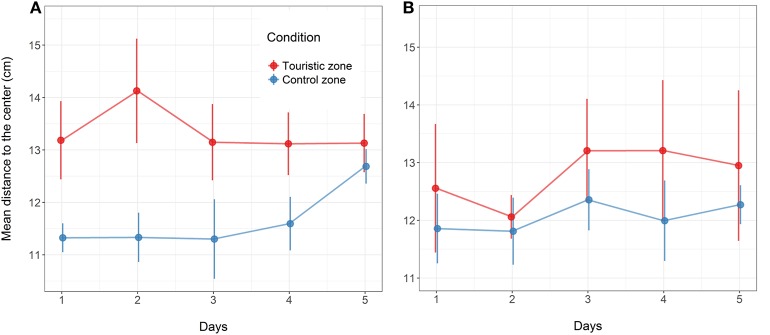
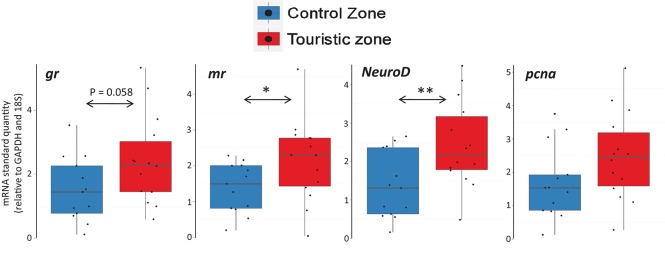
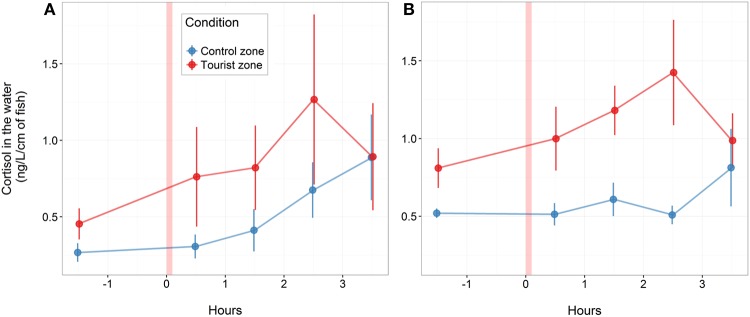
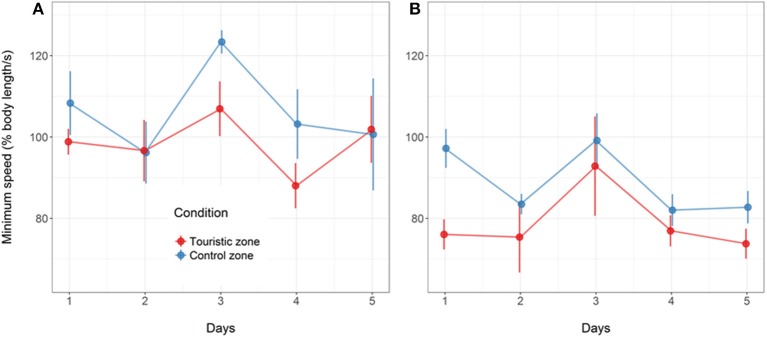
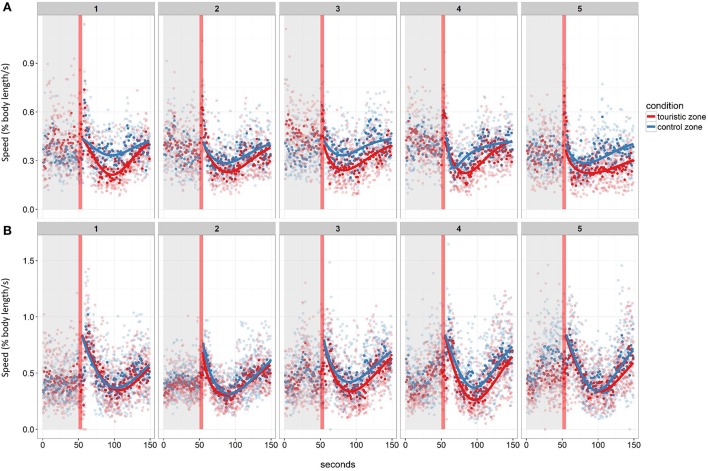
Nature-based tourism is gaining extensive popularity, increasing the intensity and frequency of human-wildlife contacts. As a consequence, behavioral and physiological alterations were observed in most exposed animals. However, while the majority of these studies investigated the effects of punctual exposure to tourists, the consequences of constant exposition to humans in the wild remains overlooked. This is an important gap considering the exponential interest for recreational outdoor activities. To infer long-term effects of intensive tourism, we capitalized on , a short-lived sedentary Tetra fish who spends its life close to humans, on which it feeds on dead skin. Hence, those fish are constantly exposed to tourists throughout their lifecycle. Here we provide an integrated picture of the whole phenomenon by investigating, for the first time, the expression of genes involved in stress response and neurogenesis, as well as behavioral and hormonal responses of animals consistently exposed to tourists. Gene expression of the mineralocorticoid (and cortisol) receptor () and the neurogenic differentiation factor () were significantly higher in fish sampled in the touristic zone compared to those sampled in the control zone. Additionally, after a simulated stress in artificial and controlled conditions, those fish previously exposed to visitors produced more cortisol and presented increased behavioral signs of stress compared to their non-exposed conspecifics. Overall, nature-based tourism appeared to shift selection pressures, favoring a sensitive phenotype that does not thrive under natural conditions. The ecological implications of this change in coping style remain, nevertheless, an open question.
基于自然的旅游业越来越受欢迎,这增加了人类与野生动物接触的强度和频率。因此,在大多数接触游客的动物身上观察到了行为和生理变化。然而,虽然这些研究大多调查了偶尔接触游客的影响,但野生动物持续接触人类的后果仍然被忽视。考虑到人们对户外休闲活动的兴趣呈指数级增长,这是一个重要的空白。为了推断密集旅游的长期影响,我们利用了一种寿命较短的定居性四间鱼,这种鱼一生都生活在靠近人类的地方,以死皮为食。因此,这些鱼在其整个生命周期中都持续接触游客。在这里,我们首次通过研究参与应激反应和神经发生的基因表达,以及持续接触游客的动物的行为和激素反应,提供了这一整个现象的综合情况。与在对照区采样的鱼相比,在旅游区采样的鱼中盐皮质激素(和皮质醇)受体()和神经源性分化因子()的基因表达显著更高。此外,在人工控制条件下进行模拟应激后,与未接触游客的同种鱼相比,那些先前接触过游客的鱼产生了更多的皮质醇,并表现出更多的应激行为迹象。总体而言,基于自然的旅游业似乎改变了选择压力,有利于一种在自然条件下无法茁壮成长的敏感表型。然而,这种应对方式变化的生态影响仍然是一个悬而未决的问题。