National Center for Global Health, Istituto Superiore di Sanità, Rome, Italy.
Department of Infectious Diseases, Istituto Superiore di Sanità, Rome, Italy.
Front Immunol. 2018 Feb 5;9:171. doi: 10.3389/fimmu.2018.00171. eCollection 2018.
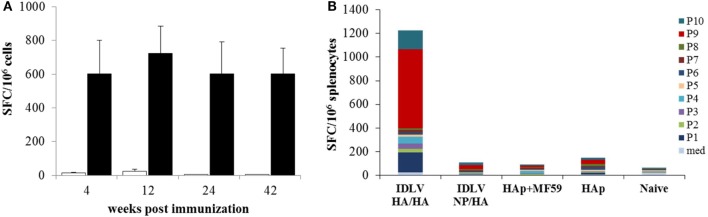
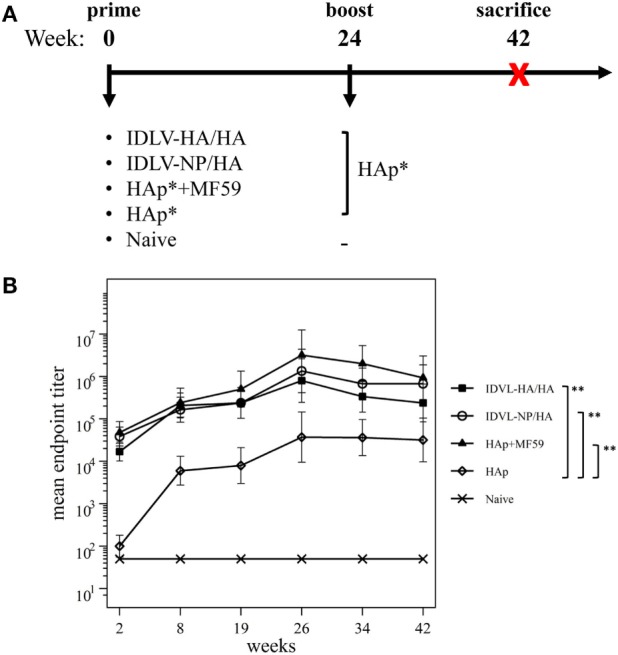
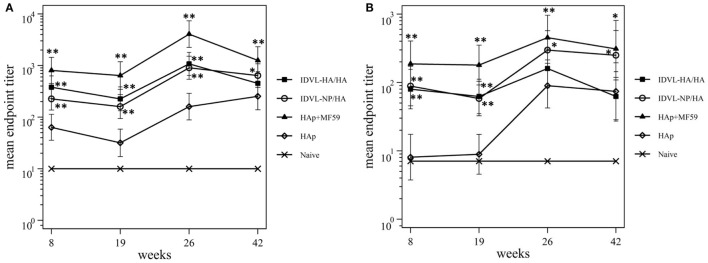
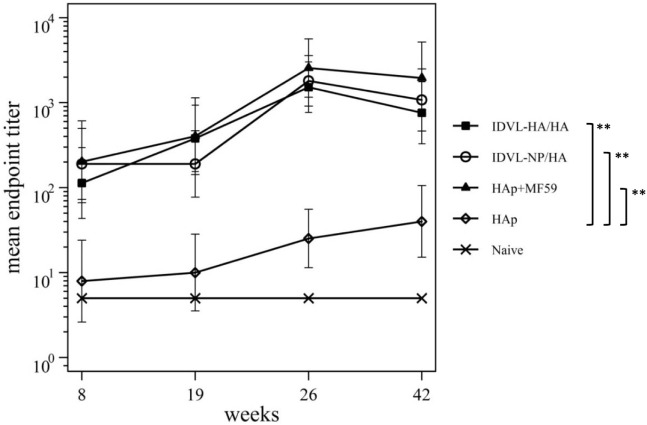
Viral vectors represent an attractive technology for vaccine delivery. We exploited the integrase defective lentiviral vector (IDLV) as a platform for delivering relevant antigens within the context of the ADITEC collaborative research program. In particular, Influenza virus hemagglutinin (HA) and nucleoprotein (NP) were delivered by IDLVs while H1N1 A/California/7/2009 subunit vaccine (HAp) with or without adjuvant was used to compare the immune response in a murine model of immunization. In order to maximize the antibody response against HA, both IDLVs were also pseudotyped with HA (IDLV-HA/HA and IDLV-NP/HA, respectively). Groups of CB6F1 mice were immunized intramuscularly with a single dose of IDLV-NP/HA, IDLV-HA/HA, HAp alone, or with HAp together with the systemic adjuvant MF59. Six months after the vaccine prime all groups were boosted with HAp alone. Cellular and antibody responses to influenza antigens were measured at different time points after the immunizations. Mice immunized with HA-pseudotyped IDLVs showed similar levels of anti-H1N1 IgG over time, evaluated by ELISA, which were comparable to those induced by HAp + MF59 vaccination, but significantly higher than those induced by HAp alone. The boost with HAp alone induced an increase of antibodies in all groups, and the responses were maintained at higher levels up to 18 weeks post-boost. The antibody response was functional and persistent overtime, capable of neutralizing virus infectivity, as evaluated by hemagglutination inhibition and microneutralization assays. Moreover, since neuraminidase (NA)-expressing plasmid was included during IDLV preparation, immunization with IDLV-NP/HA and IDLV-HA/HA also induced functional anti-NA antibodies, evaluated by enzyme-linked lectin assay. IFNγ-ELISPOT showed evidence of HA-specific response in IDLV-HA/HA immunized animals and persistent NP-specific CD8+ T cell response in IDLV-NP/HA immunized mice. Taken together our results indicate that IDLV can be harnessed for producing a vaccine able to induce a comprehensive immune response, including functional antibodies directed toward HA and NA proteins present on the vector particles in addition to a functional T cell response directed to the protein transcribed from the vector.
病毒载体是一种有吸引力的疫苗传递技术。我们利用整合酶缺陷型慢病毒载体(IDLV)作为平台,在 ADITEC 合作研究计划的框架内传递相关抗原。特别是,流感病毒血凝素(HA)和核蛋白(NP)通过 IDLV 传递,而 H1N1 A/加利福尼亚/2009 亚单位疫苗(HAp)有或没有佐剂被用于比较免疫接种小鼠模型中的免疫反应。为了最大限度地提高针对 HA 的抗体反应,两种 IDLV 都用 HA 假型化(分别为 IDLV-HA/HA 和 IDLV-NP/HA)。CB6F1 小鼠分组肌肉注射单次剂量的 IDLV-NP/HA、IDLV-HA/HA、HAp 或 HAp 加全身性佐剂 MF59。疫苗接种后 6 个月,所有组均用 HAp 单独加强免疫。在免疫后不同时间点测量针对流感抗原的细胞和抗体反应。通过 ELISA 评估,用 HA 假型化 IDLV 免疫的小鼠在一段时间内显示出相似水平的抗 H1N1 IgG,这与 HAp+MF59 疫苗接种诱导的水平相当,但明显高于 HAp 单独诱导的水平。用 HAp 单独加强免疫可在所有组中诱导抗体增加,并且在加强后 18 周内,反应保持在较高水平。抗体反应是功能持久的,能够中和病毒感染力,如通过血凝抑制和微量中和测定评估。此外,由于在 IDLV 制备过程中包含神经氨酸酶(NA)表达质粒,因此用 IDLV-NP/HA 和 IDLV-HA/HA 免疫还诱导了功能性抗 NA 抗体,如通过酶联凝集素测定评估。IFNγ-ELISPOT 显示了 IDLV-HA/HA 免疫动物中 HA 特异性反应的证据,并在 IDLV-NP/HA 免疫小鼠中持续存在 NP 特异性 CD8+T 细胞反应。综上所述,我们的结果表明,IDLV 可用于生产能够诱导全面免疫反应的疫苗,包括针对载体颗粒上存在的 HA 和 NA 蛋白的功能性抗体以及针对载体转录的蛋白的功能性 T 细胞反应。