Kuntová Barbora, Stopková Romana, Stopka Pavel
BIOCEV Group, Department of Zoology, Faculty of Science, Charles University, Prague, Czechia.
Front Genet. 2018 Feb 5;9:26. doi: 10.3389/fgene.2018.00026. eCollection 2018.
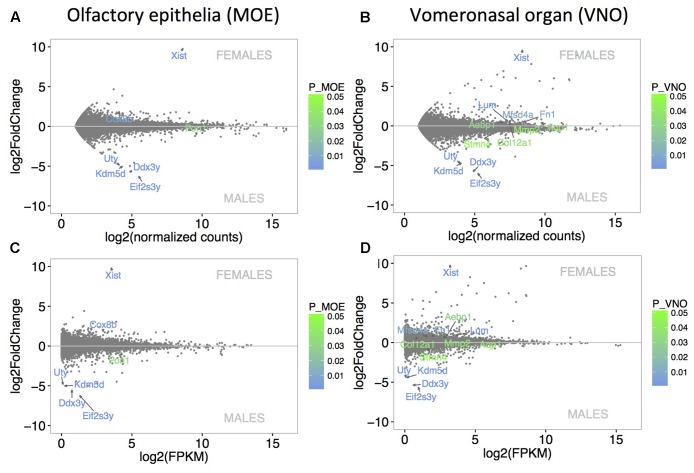
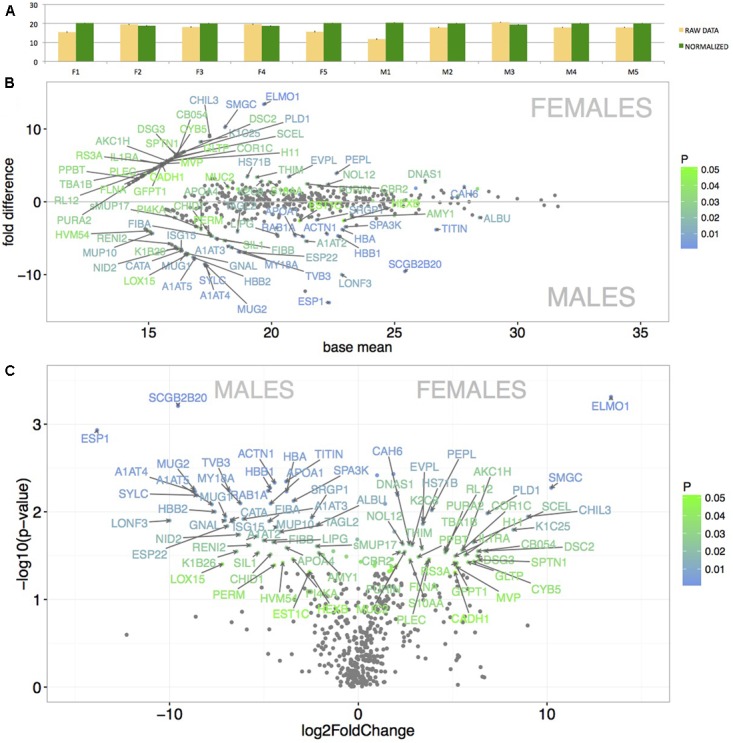
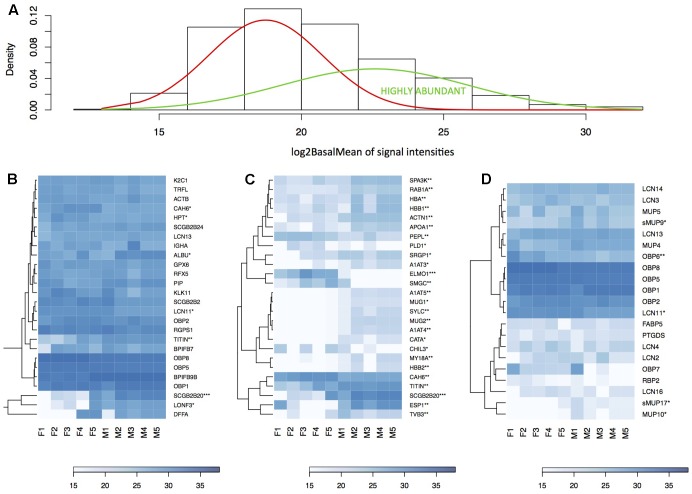
Mammalian olfaction depends on chemosensory neurons of the main olfactory epithelia (MOE), and/or of the accessory olfactory epithelia in the vomeronasal organ (VNO). Thus, we have generated the VNO and MOE transcriptomes and the nasal cavity proteome of the house mouse, . Both transcriptomes had low levels of sexual dimorphisms, while the soluble proteome of the nasal cavity revealed high levels of sexual dimorphism similar to that previously reported in tears and saliva. Due to low levels of sexual dimorphism in the olfactory receptors in MOE and VNO, the sex-specific sensing seems less likely to be dependent on receptor repertoires. However, olfaction may also depend on a continuous removal of background compounds from the sites of detection. Odorant binding proteins (OBPs) are thought to be involved in this process and in our study transcripts were most expressed along other lipocalins (e.g., , ) and antimicrobial proteins. At the level of proteome, OBPs were highly abundant with only few being sexually dimorphic. We have, however, detected the major urinary proteins MUP4 and MUP5 in males and females and the male-biased central/group-B MUPs that were thought to be abundant mainly in the urine. The exocrine gland-secreted peptides ESP1 and ESP22 were male-biased but not male-specific in the nose. For the first time, we demonstrate that the expression of nasal lipocalins correlates with antimicrobial proteins thus suggesting that their individual variation may be linked to evolvable mechanisms that regulate natural microbiota and pathogens that regularly enter the body along the 'eyes-nose-oral cavity' axis.
哺乳动物的嗅觉依赖于主嗅觉上皮(MOE)的化学感应神经元,和/或犁鼻器(VNO)中的副嗅觉上皮的化学感应神经元。因此,我们已经生成了家鼠的犁鼻器和主嗅觉上皮转录组以及鼻腔蛋白质组。两个转录组的性别二态性水平都很低,而鼻腔的可溶性蛋白质组显示出高水平的性别二态性,类似于先前在眼泪和唾液中报道的情况。由于主嗅觉上皮和犁鼻器中的嗅觉受体的性别二态性水平较低,性别特异性感知似乎不太可能依赖于受体库。然而,嗅觉也可能依赖于从检测部位持续清除背景化合物。气味结合蛋白(OBP)被认为参与了这个过程,在我们的研究中,转录本与其他脂质运载蛋白(如, )和抗菌蛋白一起表达最为丰富。在蛋白质组水平上,气味结合蛋白含量很高,只有少数具有性别二态性。然而,我们在雄性和雌性中都检测到了主要尿蛋白MUP4和MUP5,以及被认为主要在尿液中大量存在的雄性偏向的中枢/ B组主要尿蛋白。外分泌腺分泌的肽ESP1和ESP22在鼻子中是雄性偏向的,但不是雄性特有的。我们首次证明鼻腔脂质运载蛋白的表达与抗菌蛋白相关,因此表明它们的个体差异可能与调节自然微生物群和经常沿“眼-鼻-口腔”轴进入身体的病原体的可进化机制有关。