Boye Kristina S, Botros Fady T, Haupt Axel, Woodward Brad, Lage Maureen J
Global Patient Outcomes and Real World Evidence, Eli Lilly and Company, Lilly Corporate Center, Indianapolis, IN, 46285, USA.
Diabetes, Eli Lilly and Company, Lilly Corporate Center, Indianapolis, IN, 46285, USA.
Diabetes Ther. 2018 Apr;9(2):637-650. doi: 10.1007/s13300-018-0377-5. Epub 2018 Feb 19.
The study characterizes the use of glucagon-like peptide-1 receptor agonists (GLP-1 RAs) in patients with type 2 diabetes (T2D) with and without renal impairment and examines the effects of such use on the clinical outcomes of estimated glomerular filtration rate (eGFR) and glycated hemoglobin (A1c).
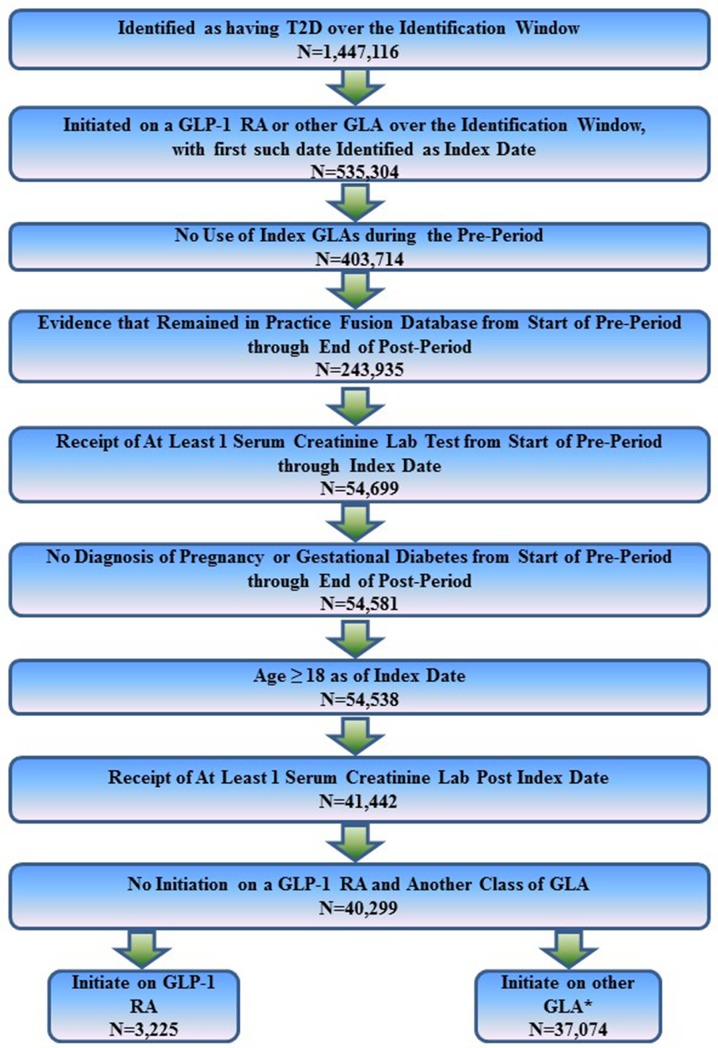
Data from the Practice Fusion electronic health records database from 1 January 2012 through 30 April 2015 were used. Adults with T2D who received serum creatinine laboratory tests and initiated therapy with a GLP-1 RA (N = 3225) or other glucose-lowering agent (GLA) (N = 37,074) were included in the analysis. The GLP-1 RA cohort was matched to cohorts initiating therapy any other GLA, and multivariable analyses examined the association between GLP-1 RA use and changes in eGFR or A1c at 1 year after therapy initiation.
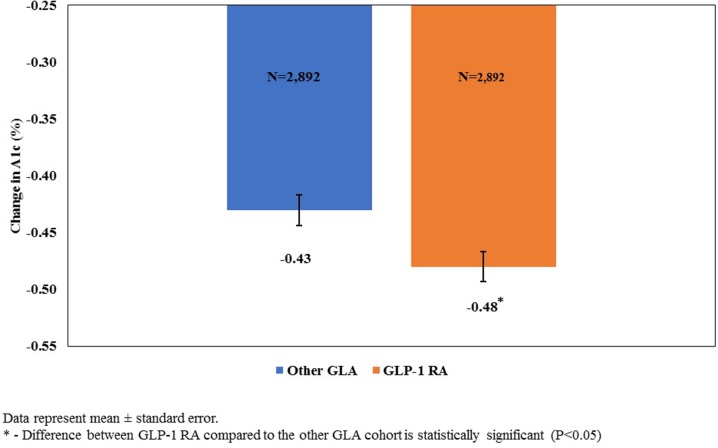
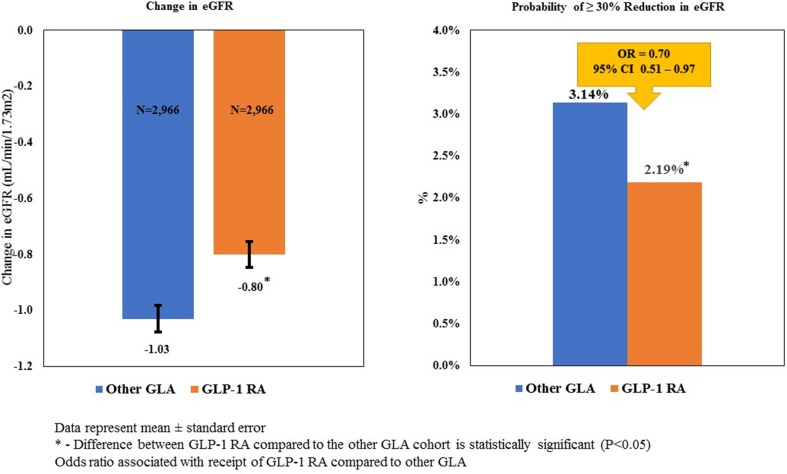
In this study, only 5.7% of patients with an eGFR of < 30 and ≥ 15 mL/min/1.73 m and 3.6% of patients with an eGFR of < 15 mL/min/1.73 m initiated therapy with a GLP-1 RA. Compared to other GLAs, at 1-year after initiation of therapy the use of a GLP-1 RA was associated with a significantly smaller decline in eGFR (- 0.80 vs. - 1.03 mL/min/1.73 m; P = 0.0005), a significantly smaller likelihood of having a ≥ 30% reduction in eGFR (2.19 vs. 3.14%; P < 0.0001), and a significantly larger reduction in A1c (- 0.48 vs. - 0.43; P = 0.0064).
In clinical practice, the use of GLP-1 RAs in patients with a higher degree of renal impairment disease was limited. Compared to other GLAs, the use of GLP-1 RAs was associated with a significantly smaller decline in eGFR and a larger reduction in A1c over the 1 year following therapy initiation.
Eli Lilly and Company.
本研究描述了胰高血糖素样肽-1受体激动剂(GLP-1 RA)在有和没有肾功能损害的2型糖尿病(T2D)患者中的使用情况,并研究了这种使用对估计肾小球滤过率(eGFR)和糖化血红蛋白(A1c)临床结局的影响。
使用来自Practice Fusion电子健康记录数据库2012年1月1日至2015年4月30日的数据。分析纳入了接受血清肌酐实验室检查并开始使用GLP-1 RA(N = 3225)或其他降糖药物(GLA)(N = 37,074)治疗的T2D成人患者。将GLP-1 RA队列与开始使用任何其他GLA治疗的队列进行匹配,并进行多变量分析以研究开始治疗1年后GLP-1 RA的使用与eGFR或A1c变化之间的关联。
在本研究中,eGFR < 30且≥15 mL/min/1.73 m²的患者中只有5.7%以及eGFR < 15 mL/min/1.73 m²的患者中只有3.6%开始使用GLP-1 RA治疗。与其他GLA相比,开始治疗1年后,使用GLP-1 RA与eGFR的显著较小下降相关(-0.80 vs. -1.03 mL/min/1.73 m²;P = 0.0005),eGFR降低≥30%的可能性显著较小(2.19% vs. 3.14%;P < 0.0001),以及A1c的显著更大降低(-0.48 vs. -0.43;P = 0.0064)。
在临床实践中,肾功能损害程度较高的患者中GLP-1 RA的使用有限。与其他GLA相比,开始治疗后的1年中,GLP-1 RA的使用与eGFR的显著较小下降和A1c的更大降低相关。
礼来公司。