Department of Cardiovascular Medicine, Fukushima Medical University, Fukushima, Japan.
ESC Heart Fail. 2018 Jun;5(3):284-291. doi: 10.1002/ehf2.12273. Epub 2018 Feb 20.
Sleep-disordered breathing (SDB) is associated with arterial stiffness, which may be one of the factors that lead to heart failure (HF). We examined the relationship between pulse wave velocity (PWV) and SDB in patients who have HF with reduced ejection fraction (HFrEF) and HF with preserved ejection fraction (HFpEF).
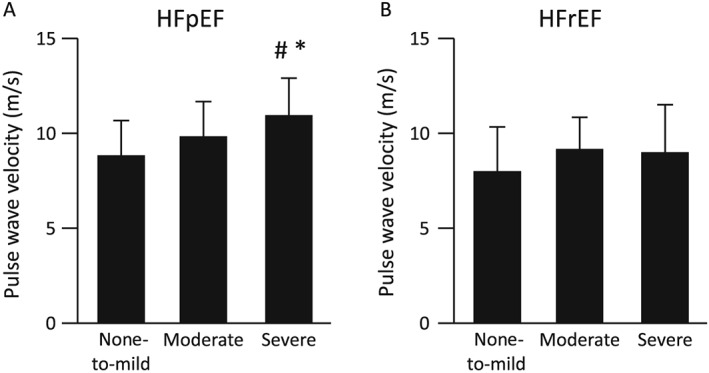
We measured the apnoea-hypopnoea index (AHI) by polysomnography, echocardiographic parameters, and PWV in 221 HF patients. Age, blood pressure, and PWV were higher in HFpEF (ejection fraction > 50%, n = 70) patients than in HFrEF (ejection fraction < 50%, n = 151) patients. All HF patients were divided into three groups according to AHI: none-to-mild SDB group (AHI < 15 times/h, n = 77), moderate SDB group (15 < AHI < 30 times/h, n = 59), and severe SDB group (AHI > 30 times/h, n = 85). Although blood pressure and echocardiographic parameters did not differ among the three groups, PWV was significantly higher in the severe SDB group than in the none-to-mild and moderate SDB groups (P = 0.002). When the HFrEF and HFpEF patients were analysed separately, PWV was significantly higher in the severe SDB group than in the none-to-mild and moderate SDB groups in patients with HFpEF (P = 0.002), but not in those with HFrEF (P = 0.068). In the multiple regression analysis to determine PWV, the presence of severe SDB was found to be an independent predictor of high PWV in HFpEF (β = 0.234, P = 0.005), but not in HFrEF patients.
Severe SDB is associated with elevated arterial stiffness and may be related to the pathophysiology of HF, especially in HFpEF patients.
睡眠呼吸障碍(SDB)与动脉僵硬度有关,而动脉僵硬度可能是导致心力衰竭(HF)的因素之一。我们研究了在射血分数降低的心力衰竭(HFrEF)和射血分数保留的心力衰竭(HFpEF)患者中,脉搏波速度(PWV)与 SDB 之间的关系。
我们通过多导睡眠图测量了 221 例 HF 患者的呼吸暂停-低通气指数(AHI)、超声心动图参数和 PWV。HFpEF(射血分数>50%,n=70)患者的年龄、血压和 PWV 均高于 HFrEF(射血分数<50%,n=151)患者。所有 HF 患者均根据 AHI 分为三组:无至轻度 SDB 组(AHI<15 次/小时,n=77)、中度 SDB 组(15<AHI<30 次/小时,n=59)和重度 SDB 组(AHI>30 次/小时,n=85)。尽管三组之间的血压和超声心动图参数没有差异,但重度 SDB 组的 PWV 明显高于无至轻度和中度 SDB 组(P=0.002)。当单独分析 HFrEF 和 HFpEF 患者时,HFpEF 中重度 SDB 组的 PWV 明显高于无至轻度和中度 SDB 组(P=0.002),而在 HFrEF 患者中则无差异(P=0.068)。在确定 PWV 的多元回归分析中,重度 SDB 是 HFpEF 患者 PWV 升高的独立预测因素(β=0.234,P=0.005),但不是 HFrEF 患者。
重度 SDB 与动脉僵硬度升高有关,可能与 HF 的病理生理学有关,尤其是在 HFpEF 患者中。