University of Toronto, Toronto, ON, Canada.
Cleveland Clinic Abu Dhabi, Abu Dhabi, UAE.
Allergy. 2018 Aug;73(8):1724-1734. doi: 10.1111/all.13430.
ASSURE-CSU revealed differences in physician and patient reporting of angioedema. This post hoc analysis was conducted to evaluate the actual rate of angioedema in the study population and explore differences between patients with and without angioedema.
This international observational study assessed 673 patients with inadequately controlled chronic spontaneous urticaria (CSU). Physicians abstracted angioedema data from medical records, which were compared with patient-reported data. Patients in the Yes-angioedema category had angioedema reported in the medical record and a patient-reported source. For those in the No-angioedema category, angioedema was reported in neither the medical record nor a patient-reported source. Those in the Misaligned category had angioedema reported in only one source. Statistical comparisons between Yes-angioedema and No-angioedema categories were conducted for measures of CSU activity, health-related quality of life (HRQoL), productivity and healthcare resource utilization (HCRU). Regression analyses explored the relationship between Dermatology Life Quality Index (DLQI) score and angioedema, adjusting for important covariates.
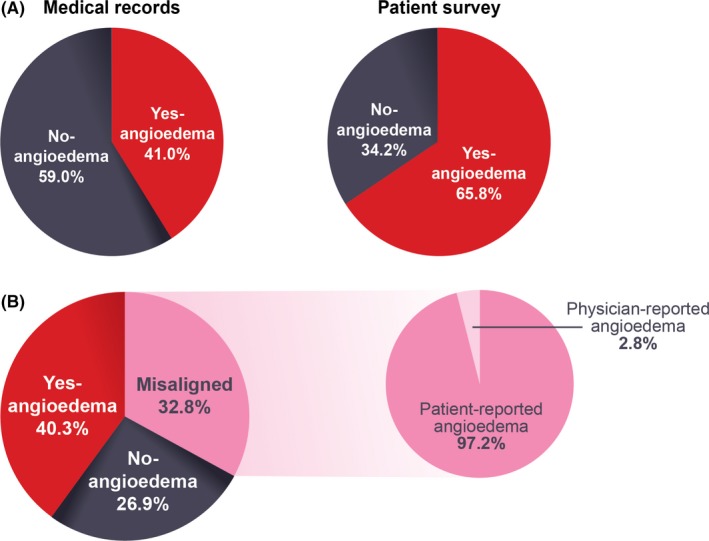
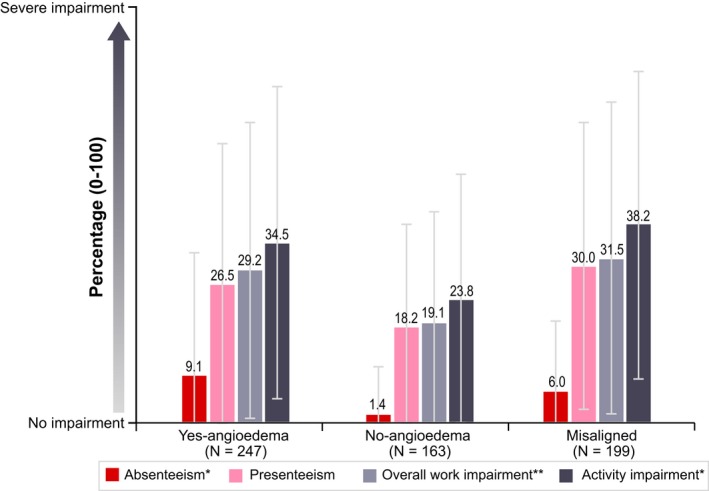
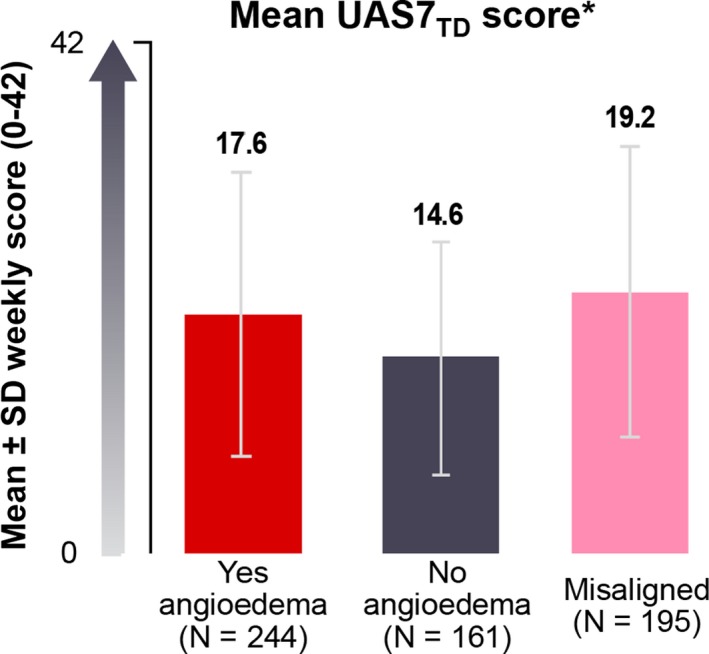
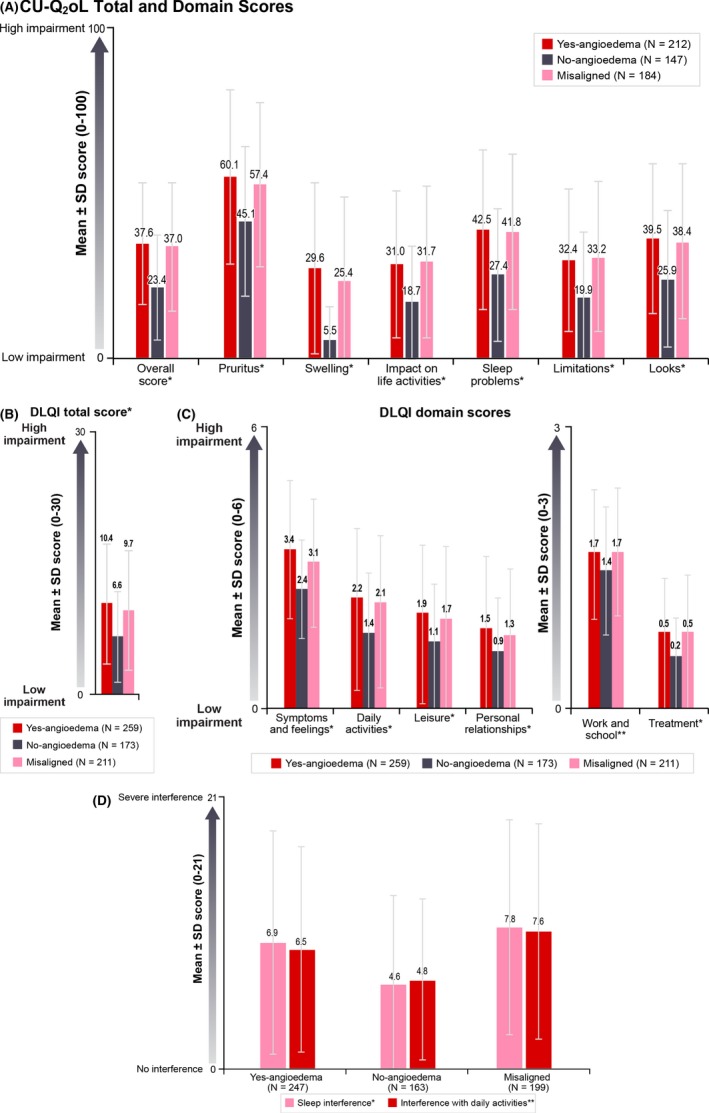
Among evaluable patients, 259 (40.3%), 173 (26.9%) and 211 (32.8%) were in the Yes-angioedema, No-angioedema and Misaligned category, respectively. CSU activity and impact on HRQoL, productivity, and HCRU was greater for Yes-angioedema patients than No-angioedema patients. After covariate adjustment, mean DLQI score was significantly higher (indicating worse HRQoL) for patients with angioedema versus no angioedema (9.88 vs 7.27, P < .001). The Misaligned category had similar results with Yes-angioedema on all outcomes.
Angioedema in CSU seems to be under-reported but has significant negative impacts on HRQoL, daily activities, HCRU and work compared with no angioedema.
ASSURE-CSU 研究揭示了医师报告和患者报告的血管性水肿之间的差异。本事后分析旨在评估研究人群中实际的血管性水肿发生率,并探讨有和无血管性水肿患者之间的差异。
这项国际观察性研究共纳入 673 例未充分控制的慢性自发性荨麻疹(CSU)患者。医师从病历中提取血管性水肿数据,并与患者报告数据进行比较。在“有血管性水肿”类别中,病历和患者报告均报告有血管性水肿;在“无血管性水肿”类别中,病历和患者报告均未报告有血管性水肿;在“不匹配”类别中,仅在一个来源中报告有血管性水肿。对“有血管性水肿”和“无血管性水肿”类别之间的 CSU 活动度、健康相关生活质量(HRQoL)、生产力和医疗保健资源利用(HCRU)进行了统计学比较。回归分析探讨了调整重要协变量后,皮肤病生活质量指数(DLQI)评分与血管性水肿之间的关系。
在可评估的患者中,259 例(40.3%)、173 例(26.9%)和 211 例(32.8%)分别归入“有血管性水肿”、“无血管性水肿”和“不匹配”类别。“有血管性水肿”患者的 CSU 活动度和对 HRQoL、生产力和 HCRU 的影响均大于“无血管性水肿”患者。在调整协变量后,有血管性水肿患者的平均 DLQI 评分显著高于无血管性水肿患者(9.88 分 vs 7.27 分,P<.001)。“不匹配”类别在所有结局上与“有血管性水肿”类别均具有相似的结果。
CSU 中的血管性水肿似乎报告不足,但与无血管性水肿相比,它对 HRQoL、日常活动、HCRU 和工作具有显著的负面影响。