Division of Environmental Health Sciences and Public Health Informatics Program, HumNat Lab, School of Public Health, University of Minnesota, Minneapolis, Minnesota 55455.
Institute on the Environment, University of Minnesota, St. Paul, Minnesota 55455.
Toxicol Sci. 2018 May 1;163(1):293-306. doi: 10.1093/toxsci/kfy035.
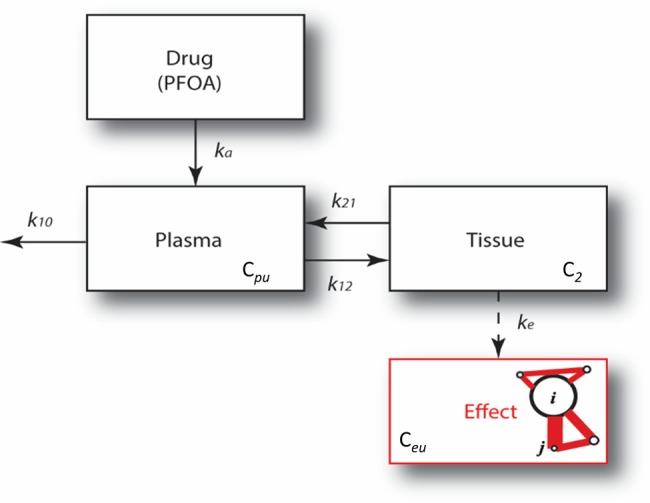
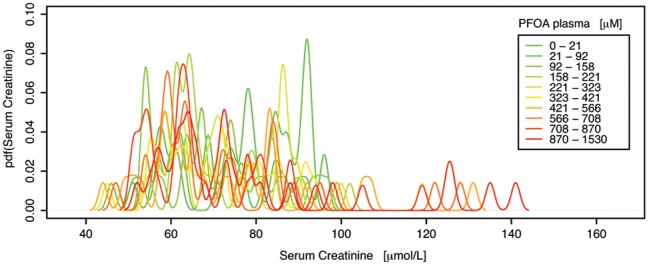
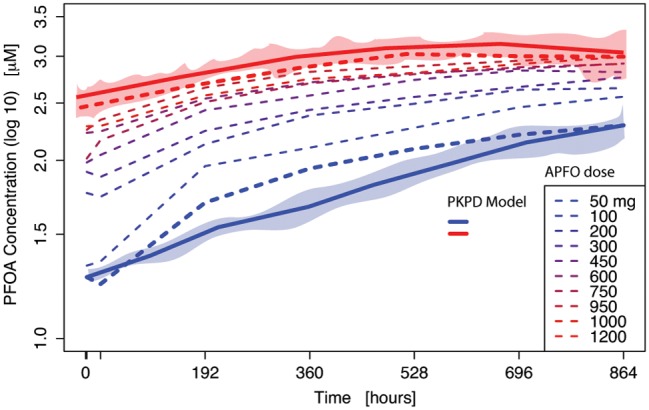
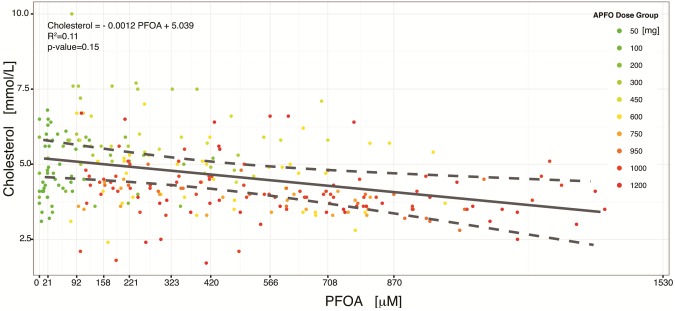
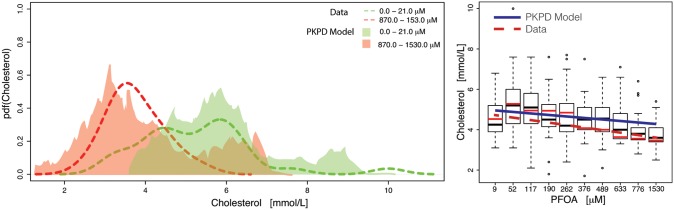
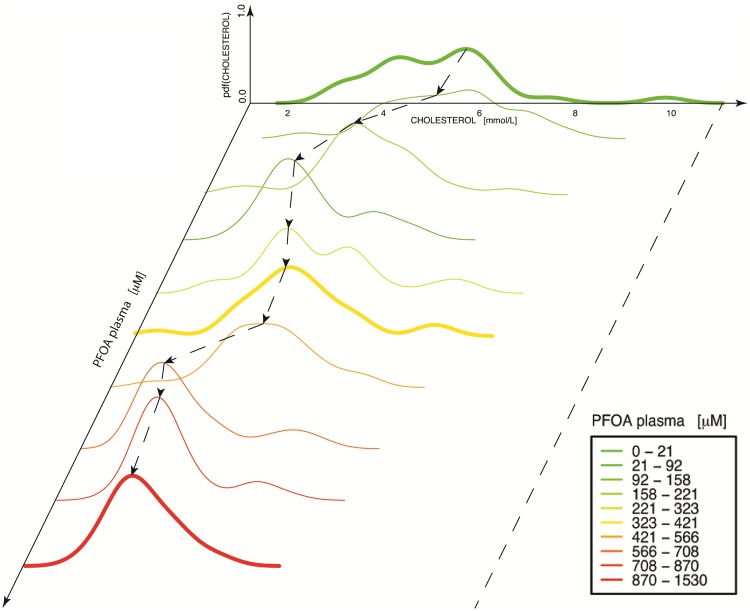
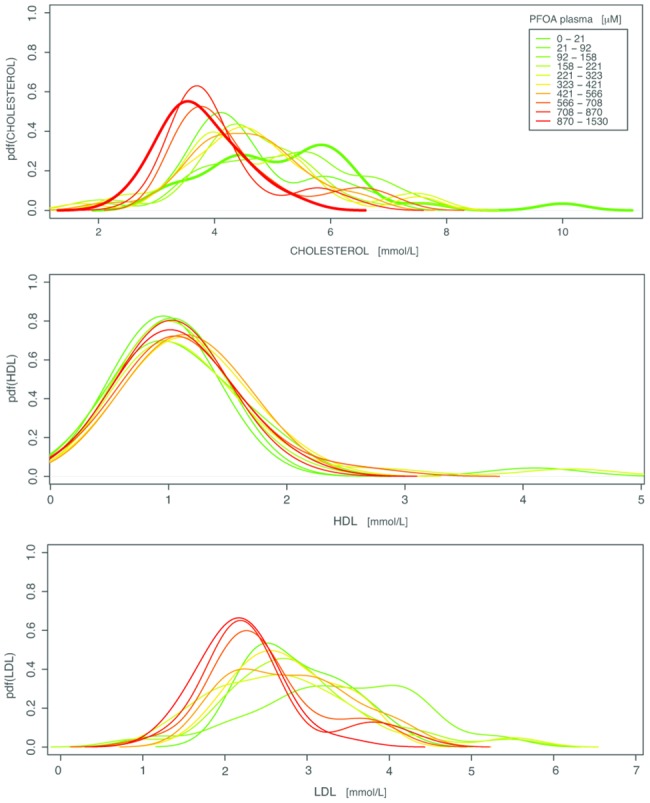
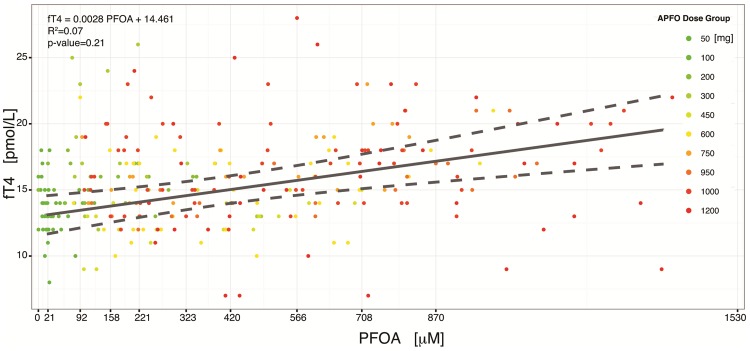
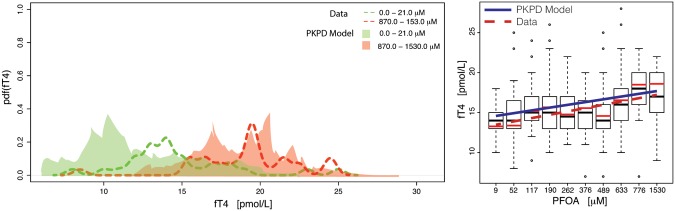
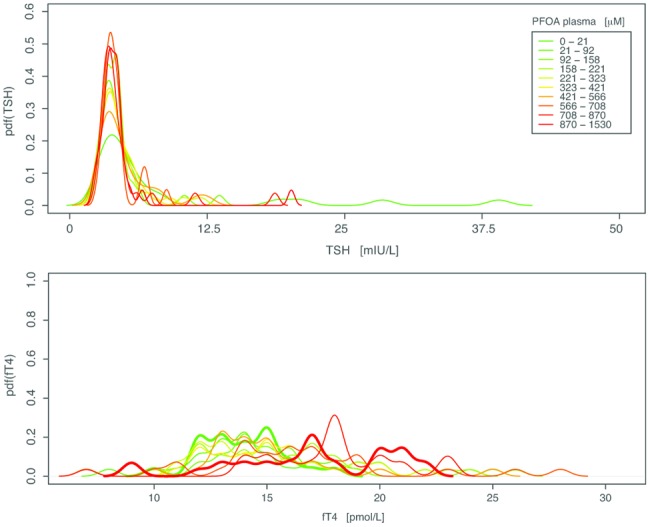
A phase 1 dose-escalation trial assessed the chemotherapeutic potential of ammonium perfluorooctanoate (APFO). Forty-nine primarily solid-tumor cancer patients who failed standard therapy received weekly APFO doses (50-1200 mg) for 6 weeks. Clinical chemistries and plasma PFOA (anionic APFO) were measured predose and weekly thereafter. Several clinical measures including total cholesterol, high-density lipoproteins (HDLs), thyroid stimulating hormone (TSH), and free thyroxine (fT4), relative to PFOA concentrations were examined by: Standard statistical analyses using generalized estimating equations (GEE) and a probabilistic analysis using probability distribution functions (pdf) at various PFOA concentrations; and a 2-compartment pharmacokinetic/pharmacodynamic (PK/PD) model to directly estimate mean changes. Based on the GEE, the average rates of change in total cholesterol and fT4 associated with increasing PFOA were approximately -1.2×10⁻³ mmol/l/μM and 2.8×10⁻³ pmol/l/μM, respectively. The PK/PD model predicted more closely the trends observed in the data as well as the pdfs of biomarkers. A decline in total cholesterol was observed, with a clear transition in shape and range of the pdfs, manifested by the maximum value of the Kullback-Leibler (KL) divergence, that occurred at plasma PFOA between 420 and 565 μM (175 000-230 000 ng/ml). High-density lipoprotein was unchanged. An increase in fT4 was observed at a higher PFOA transition point, albeit TSH was unchanged. Our findings are consistent with some animal models and may motivate re-examination of the epidemiologic studies to PFOA at levels several orders of magnitude lower than this study. These observational studies have reported contrary associations, but currently understood biology does not support the existence of such conflicting effects.
一项评估过氧全氟辛酸铵(APFO)化疗潜力的 1 期剂量递增试验纳入了 49 名经标准治疗失败的实体瘤癌症患者,这些患者每周接受 APFO 剂量(50-1200mg)治疗 6 周。在给药前和每周后测量临床化学和血浆 PFOA(带负电荷的 APFO)。通过以下方式检查几种临床指标与 PFOA 浓度的相关性:使用广义估计方程(GEE)的标准统计分析和在不同 PFOA 浓度下使用概率分布函数(pdf)的概率分析;以及直接估计平均变化的 2 隔室药代动力学/药效学(PK/PD)模型。基于 GEE,与 PFOA 浓度增加相关的总胆固醇和游离甲状腺素(fT4)的平均变化率分别约为-1.2×10⁻³mmol/l/μM 和 2.8×10⁻³pmol/l/μM。PK/PD 模型更准确地预测了数据中的趋势以及生物标志物的 pdf。观察到总胆固醇下降,pdf 的形状和范围发生明显转变,表现为 Kullback-Leibler(KL)散度的最大值,该值发生在血浆 PFOA 浓度为 420 至 565μM(175,000-230,000ng/ml)之间。高密度脂蛋白不变。在更高的 PFOA 转变点观察到 fT4 增加,尽管 TSH 不变。我们的发现与一些动物模型一致,可能促使重新检查低于该研究水平几个数量级的 PFOA 的流行病学研究。这些观察性研究报告了相反的关联,但目前已知的生物学不支持存在这种相互矛盾的影响。