Postgraduate Medical Education, Graduate Diploma and Professional Master in Medical Sciences, School of Medicine, Queen's University, Kingston, ON K7L 3L4, Canada.
Department of Biomedical and Molecular Science, Queen's University, Kingston, ON K7L 3N6, Canada.
Int J Mol Sci. 2018 Feb 17;19(2):575. doi: 10.3390/ijms19020575.
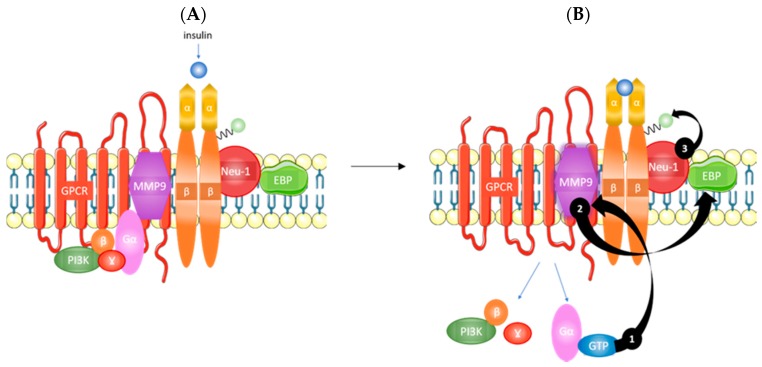
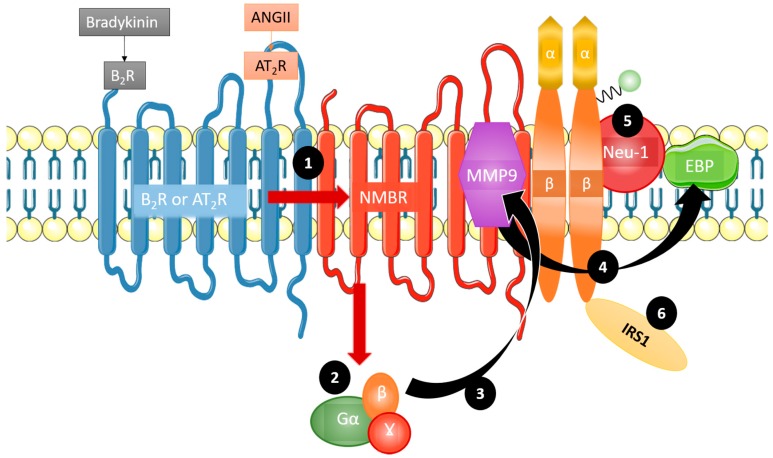
Insulin signaling, as mediated through the insulin receptor (IR), plays a critical role in metabolism. Aberrations in this signaling cascade lead to several pathologies, the majority of which are classified under the umbrella term "metabolic syndrome". Although many of these pathologies are associated with insulin resistance, the exact mechanisms are not well understood. One area of current interest is the possibility of G-protein-coupled receptors (GPCRs) influencing or regulating IR signaling. This concept is particularly significant, because GPCRs have been shown to participate in cross-talk with the IR. More importantly, GPCR signaling has also been shown to preferentially regulate specific downstream signaling targets through GPCR agonist bias. A novel study recently demonstrated that this GPCR-biased agonism influences the activity of the IR without the presence of insulin. Although GPCR-IR cross-talk has previously been established, the notion that GPCRs can regulate the activation of the IR is particularly significant in relation to metabolic syndrome and other pathologies that develop as a result of alterations in IR signaling. As such, we aim to provide an overview of the physiological and pathophysiological roles of the IR within metabolic syndrome and its related pathologies, including cardiovascular health, gut microflora composition, gastrointestinal tract functioning, polycystic ovarian syndrome, pancreatic cancer, and neurodegenerative disorders. Furthermore, we propose that the GPCR-biased agonism may perhaps mediate some of the downstream signaling effects that further exacerbate these diseases for which the mechanisms are currently not well understood.
胰岛素信号转导,通过胰岛素受体(IR)介导,在代谢中起着关键作用。该信号级联的异常导致了几种病理学,其中大多数被归类为“代谢综合征”这一总称。尽管这些病理学中的许多与胰岛素抵抗有关,但确切的机制尚不清楚。目前一个关注的领域是 G 蛋白偶联受体(GPCR)是否可能影响或调节 IR 信号。这个概念特别重要,因为已经表明 GPCR 参与与 IR 的串扰。更重要的是,已经表明 GPCR 信号也可以通过 GPCR 激动剂偏倚优先调节特定的下游信号靶标。最近的一项新研究表明,这种 GPCR 偏向激动作用可以在没有胰岛素的情况下影响 IR 的活性。尽管先前已经建立了 GPCR-IR 串扰,但 GPCR 可以调节 IR 激活的概念在代谢综合征及其相关病理学中尤为重要,这些病理学是由于 IR 信号转导的改变而发展的。因此,我们旨在概述代谢综合征及其相关病理学(包括心血管健康、肠道微生物群落组成、胃肠道功能、多囊卵巢综合征、胰腺癌和神经退行性疾病)中 IR 的生理和病理生理学作用。此外,我们提出 GPCR 偏向激动作用可能介导了一些进一步加剧这些疾病的下游信号效应,而这些疾病的机制目前尚不清楚。