State Key Laboratory of Oncology in South China and Collaborative Innovation Center for Cancer Medicine, Sun Yat-sen University Cancer Center, Guangzhou, Guangdong, China.
Department of Nasopharyngeal Carcinoma, Sun Yat-Sen University Cancer Center, Guangzhou, China.
J Exp Clin Cancer Res. 2018 Feb 20;37(1):34. doi: 10.1186/s13046-018-0692-8.
CLCA2 was reported as a tumor suppressor and disregulated in breast cancer. However, its function in tumor growth and metastasis in NPC has rarely been reported. In this study, we investigated the functional and molecular mechanisms by which CLCA2 influences NPC.
CLCA2 expression in human NPC cell lines and tissues was examined via real-time PCR (RT-PCR), Western blot and IHC. The biological roles of CLCA2 in proliferative, migration and invasion of NPC cell lines was evaluated in 5-8F, S18, S26 and SUNE-1 cells. Cell viability, migration and invasion were assessed in vitro by MTS, colony formation and transwell assay, respectively. CLCA2 in growth and metastasis of NPC were evaluated in vivo through NPC xenograft tumor growth, lung metastatic mice model and popliteal lymph node (LN) metastasis model.
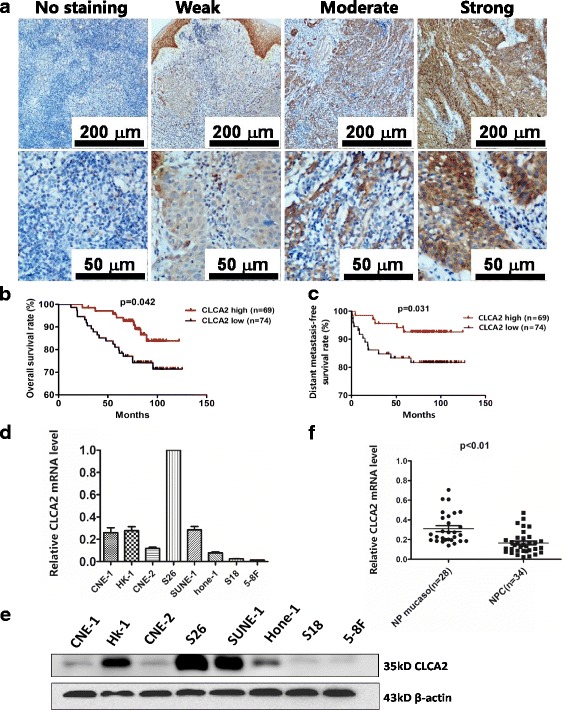
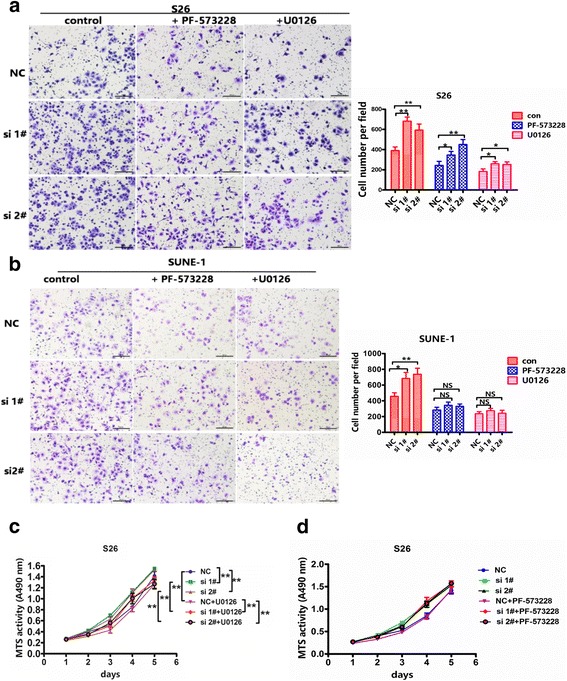
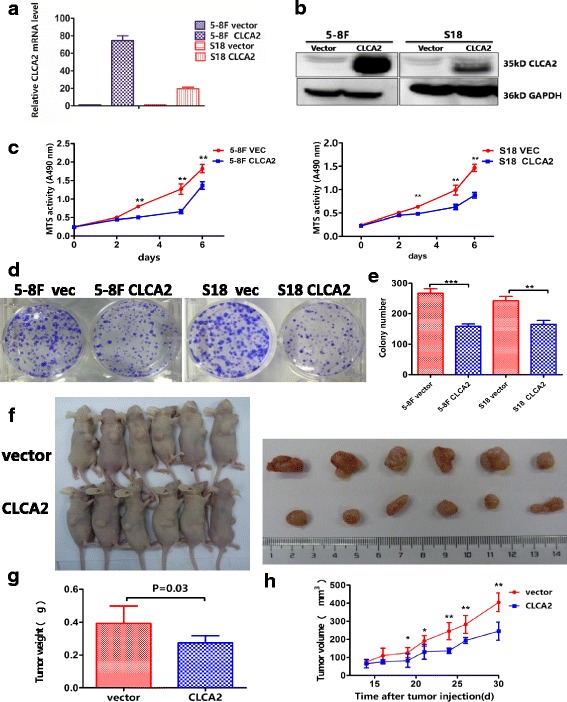
Overexpression of CLCA2 significantly decreased proliferation, migration and invasion of NPC cells. In contrast, knockdown of CLCA2 elicited the opposite effects. CLCA2 overexpression suppressed xenograft tumor growth and lung, popliteal lymph node (LN) metastasis in vivo. CLCA2 inhibited tumor metastasis through suppressing epithelial-Mesenchymal transition (EMT) and in-activating FAK/ERK1/2 signaling pathway in NPC cells. Immunohistochemical staining of 143 NPC samples revealed that CLCA2 expression was an independent, favorable prognostic factor for overall survival and distant metastasis-free survival of patients. In addition, inhibition of FAK and ERK1/2 reversed CLCA2 silencing-induced tumor cell migration. Furthermore, inhibitors against chloride channels suppressed NPC cellular migration which could have been enhanced by the presence of CLCA2.
CLCA2 suppress NPC proliferation, migration, invasion and epithelial-mesenchymal transition through inhibiting FAK/ERK signaling.
CLCA2 被报道为抑癌基因,在乳腺癌中失调。然而,其在 NPC 中对肿瘤生长和转移的功能知之甚少。在这项研究中,我们研究了 CLCA2 影响 NPC 的功能和分子机制。
通过实时 PCR(RT-PCR)、Western blot 和 IHC 检测人 NPC 细胞系和组织中的 CLCA2 表达。在 5-8F、S18、S26 和 SUNE-1 细胞中评估 CLCA2 对 NPC 细胞系增殖、迁移和侵袭的生物学作用。通过 MTS、集落形成和 Transwell 测定分别评估细胞活力、迁移和侵袭。通过 NPC 异种移植肿瘤生长、肺转移小鼠模型和腘淋巴结(LN)转移模型评估 CLCA2 在 NPC 生长和转移中的作用。
CLCA2 的过表达显著降低了 NPC 细胞的增殖、迁移和侵袭。相反,CLCA2 的敲低则产生了相反的效果。CLCA2 的过表达抑制了体内异种移植肿瘤的生长以及肺、腘淋巴结(LN)转移。CLCA2 通过抑制上皮-间充质转化(EMT)和失活 FAK/ERK1/2 信号通路抑制 NPC 细胞中的肿瘤转移。对 143 例 NPC 样本的免疫组织化学染色显示,CLCA2 表达是患者总生存和无远处转移生存的独立有利预后因素。此外,FAK 和 ERK1/2 的抑制逆转了 CLCA2 沉默诱导的肿瘤细胞迁移。此外,氯离子通道抑制剂抑制 NPC 细胞迁移,而 CLCA2 的存在可增强这种抑制作用。
CLCA2 通过抑制 FAK/ERK 信号通路抑制 NPC 增殖、迁移、侵袭和上皮-间充质转化。