Paediatrics & Neonatology Unit, "Guglielmo da Saliceto" City Hospital, Cantone del Cristo, 50, 29121, Piacenza, Italy.
Ital J Pediatr. 2018 Feb 20;44(1):27. doi: 10.1186/s13052-018-0465-1.
Unilateral absence of the pulmonary artery (UAPA) is a rare congenital malformation often associated with other cardiac anomalies; however it may occur as an isolated lesion. Isolated absence of the right pulmonary artery is twice more frequent than that of the left pulmonary artery. Patients with isolated UAPA are usually asymptomatic at birth; thereafter they may develop a progression of symptoms such as exercise intolerance, dyspnea, chest pain, hemoptysis and recurrent pulmonary infections. As patients may remain asymptomatic or have vague symptoms, the diagnosis of isolated UAPA can be difficult to make in infancy. Indeed, most cases described in literature are adults. Due to the rarity of neonatal presentation, there is no consensus regarding the treatment of this malformation.
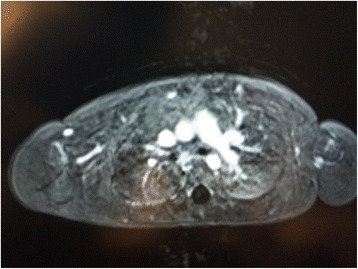
Herein, the case of a two-day-old term female infant, born after uneventful pregnancy, who required a cardiological assessment for a light murmur, is reported; an echocardiogram demonstrated an isolated unilateral absence of the right pulmonary artery, confirmed by means of magnetic resonance imaging (MRI) performed 1 month after child's birth. Besides this finding, MRI showed a slightly increased lumen and size of the main and left pulmonary arteries. The right lung was shown to be perfused by some systemic collateral arteries. In the absence of any other cardiovascular malformation, our patient did not need any treatment. As symptoms may occur later in life, a thorough clinical and cardiological follow up was immediately started. Three years later, she is still asymptomatic, showing adequate growth, without any sign of pulmonary hypertension.
Isolated UAPA is a very rare malformation with a diverse clinical presentation. To the best of our knowledge, this is the second case of neonatal presentation of UAPA reported in literature to date. We believe that our case report supports the opinion that a prompt cardiological evaluation is needed whenever a newborn shows signs and/or symptoms of cardiorespiratory concern. Any missed neonatal diagnosis of UAPA may contribute to the later age at presentation, with resultant higher risk of morbidity and mortality and greater therapeutical difficulties.
单侧肺动脉缺如(UAPA)是一种罕见的先天性畸形,常伴有其他心脏异常;然而,它也可能作为孤立病变出现。孤立性右肺动脉缺如的发生率是左肺动脉的两倍。孤立性 UAPA 患者出生时通常无症状;此后,他们可能会出现进行性症状,如运动不耐受、呼吸困难、胸痛、咯血和反复肺部感染。由于患者可能仍然无症状或有模糊的症状,因此在婴儿期诊断孤立性 UAPA 可能具有挑战性。事实上,文献中描述的大多数病例都是成年人。由于新生儿表现罕见,对于这种畸形的治疗尚无共识。
本文报道了一例 2 天龄足月女婴的病例,该女婴出生于无并发症的妊娠,因心脏杂音需要进行心脏评估;超声心动图显示孤立性右肺动脉单侧缺如,1 个月后经磁共振成像(MRI)证实。除了这一发现,MRI 显示主肺动脉和左肺动脉的管腔和尺寸略有增加。右肺被证明由一些体循环侧支动脉灌注。由于没有其他心血管畸形,我们的患者不需要任何治疗。由于症状可能在以后的生活中出现,因此立即开始进行彻底的临床和心脏随访。3 年后,她仍然无症状,生长良好,没有任何肺动脉高压的迹象。
孤立性 UAPA 是一种非常罕见的畸形,临床表现多样。据我们所知,这是迄今为止文献中报道的第二个新生儿 UAPA 病例。我们认为,我们的病例报告支持这样一种观点,即每当新生儿出现心肺相关症状和/或体征时,都需要进行及时的心脏评估。任何对 UAPA 的新生儿漏诊都可能导致以后的发病年龄更高,从而导致更高的发病率和死亡率以及更大的治疗难度。