Kim Kyung Mok, Chung Ki Wung, Jeong Hyeong Oh, Lee Bonggi, Kim Dae Hyun, Park June Whoun, Kim Seong Min, Yu Byung Pal, Chung Hae Young
Molecular Inflammation Research Center for Aging Intervention (MRCA), College of Pharmacy, Pusan National University, Busan, Republic of Korea.
Korean Medicine (KM)-Application Center, Korea Institute of Oriental Medicine (KIOM), Daegu, Republic of Korea.
Oncotarget. 2017 Dec 24;9(5):5588-5599. doi: 10.18632/oncotarget.23652. eCollection 2018 Jan 19.
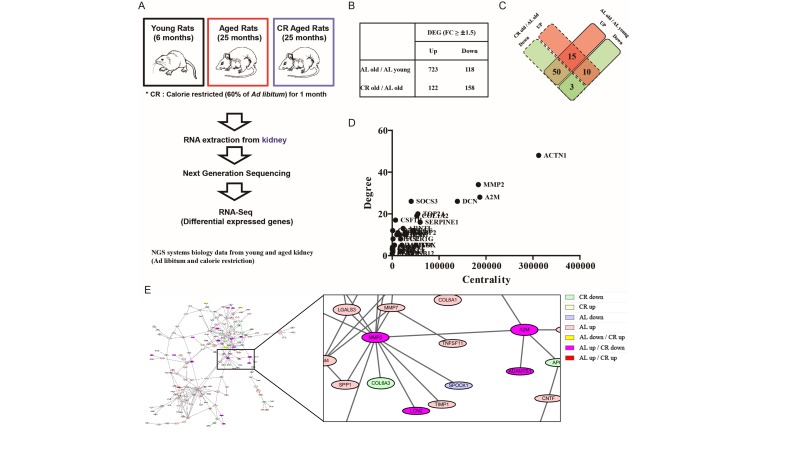
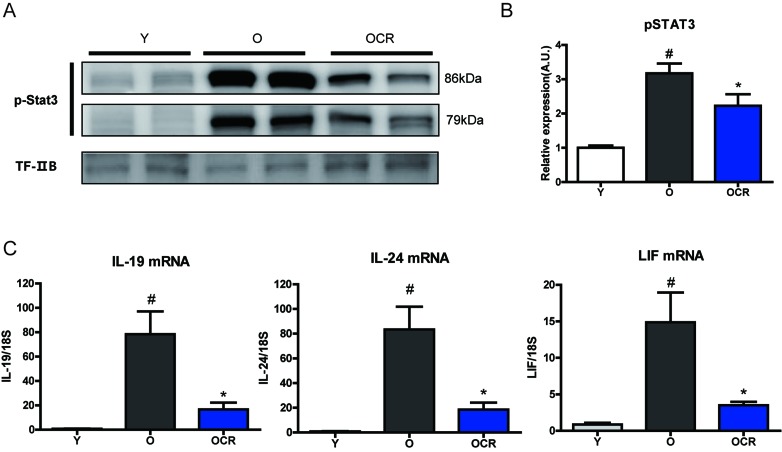
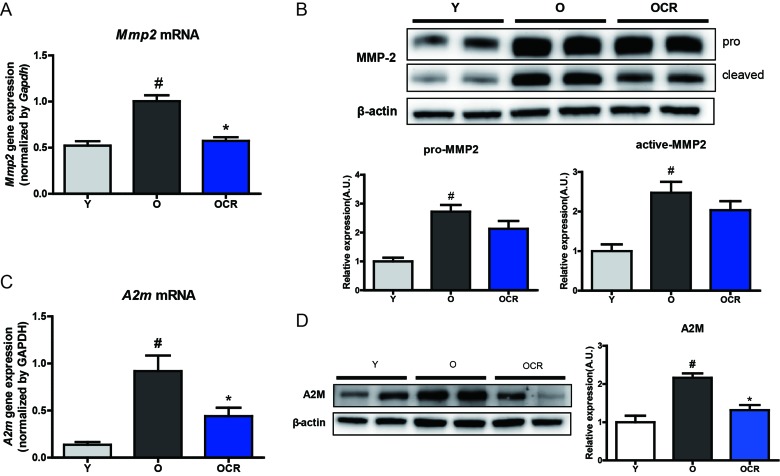
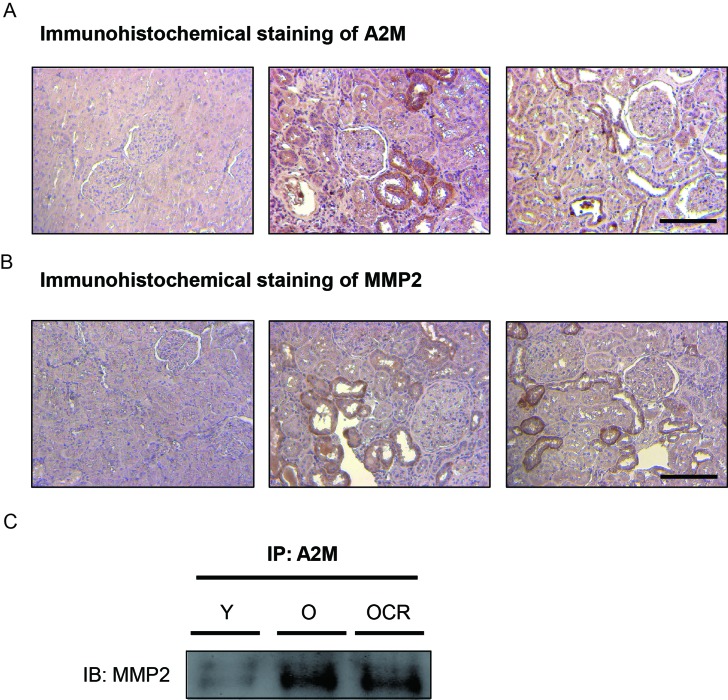
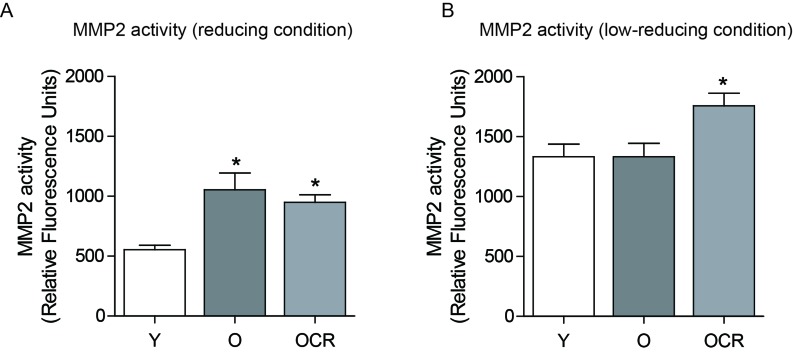
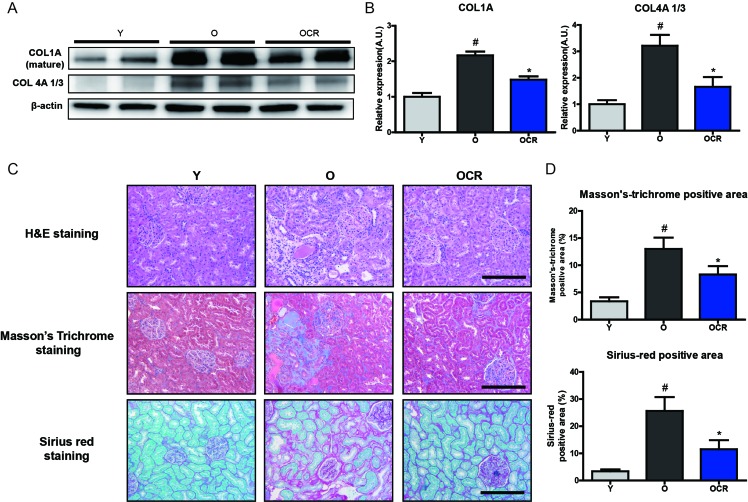
Age-associated renal fibrosis is related with renal function decline during aging. Imbalance between accumulation and degradation of extracellular matrix is key feature of fibrosis. In this study, RNA-sequencing (RNA-Seq) results based on next-generation sequencing (NGS) data were analyzed to identify key proteins that change during aging and calorie restriction (CR). Among the changed genes, A2M and MMP2, which are known to interact, exhibited the highest between centrality (BC) and degree values when analyzed by protein-protein interaction (PPI). Both mRNA and protein levels of MMP2 and A2M were increased during aging. Furthermore, the interaction between MMP2 and A2M was verified by immunoprecipitation and immunohistochemistry. MMP2 activity was further measured under the presence or absence of A2M-MMP2 interaction. MMP2 activity, which was increased under the absence of A2M-MMP2 interaction, was significantly decreased under the presence of interactions in aged kidney. We further hypothesized that the interaction between A2M-MMP2 played a role in the inactivation of MMP2 leading to accumulation of ECM including collagen type I and IV. Aged kidney showed highly accumulated MMP2 substrate proteins despite of increased MMP2 protein expression and CR blunted these accumulation. Additional analysis revealed that the signal transducer and activator of transcription (STAT) 3 transcriptional factor was significantly increased thus increasing A2M expression during aging. STAT3 activating cytokines were also highly increased in aged kidney. In conclusion, the results of the present study indicate that A2M-MMP2 interaction has a role in age-associated renal ECM accumulation and in the suppression such fibrosis by CR.
年龄相关的肾纤维化与衰老过程中肾功能下降有关。细胞外基质积累与降解之间的失衡是纤维化的关键特征。在本研究中,对基于下一代测序(NGS)数据的RNA测序(RNA-Seq)结果进行分析,以鉴定在衰老和热量限制(CR)过程中发生变化的关键蛋白质。在这些变化的基因中,已知相互作用的A2M和MMP2在通过蛋白质-蛋白质相互作用(PPI)分析时,表现出最高的介数中心性(BC)和度值。衰老过程中MMP2和A2M的mRNA和蛋白质水平均升高。此外,通过免疫沉淀和免疫组织化学验证了MMP2与A2M之间的相互作用。在存在或不存在A2M-MMP2相互作用的情况下进一步测量MMP2活性。在老年肾脏中,不存在A2M-MMP2相互作用时MMP2活性增加,而存在相互作用时MMP2活性显著降低。我们进一步假设A2M-MMP2之间的相互作用在MMP2失活中起作用,导致包括I型和IV型胶原在内的细胞外基质积累。尽管MMP2蛋白表达增加,但老年肾脏中MMP2底物蛋白高度积累,而CR可抑制这些积累。进一步分析显示,衰老过程中转录信号转导子和激活子(STAT)3转录因子显著增加,从而增加A2M表达。老年肾脏中STAT3激活细胞因子也高度增加。总之,本研究结果表明,A2M-MMP2相互作用在年龄相关的肾细胞外基质积累中起作用,并且CR可抑制这种纤维化。