From the Dalla Lana School of Public Health, University of Toronto, Toronto, Ontario, Canada.
Sex Transm Dis. 2018 Jun;45(6):368-373. doi: 10.1097/OLQ.0000000000000752.
There are complex, synergistic, and persistent sexually transmitted infection (STI) epidemics affecting gay, bisexual and other men who have sex with men (gbMSM) in every major urban centre across North America. We explored the spatial architecture of egocentric sexual networks for gbMSM in Toronto, Canada.
Our integrative mixed methods study included in-depth interviews with 31 gbMSM between May and July 2016. During interviews, participants mapped their egocentric sexual network for the preceding 3 months geographically. At the end, a self-administered survey was used to collect sociodemographic characteristics, online technology use, and STI testing and history.
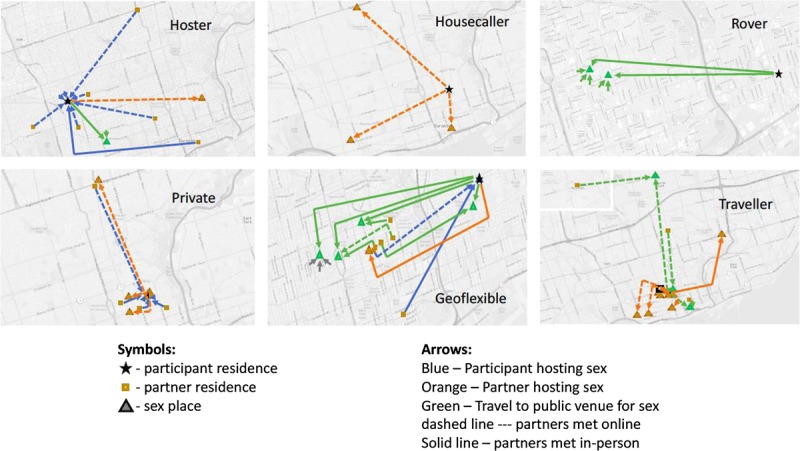
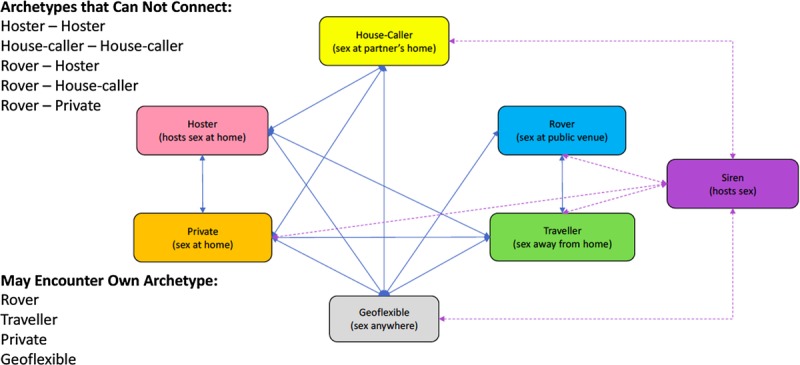
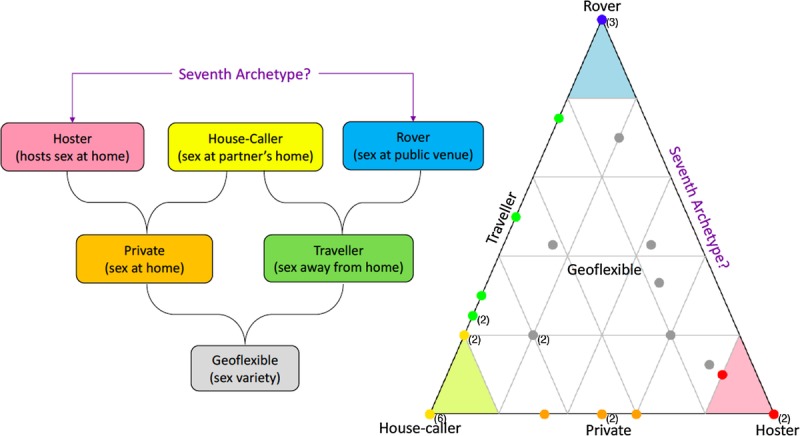
We identified 6 geosexual archetypes: hosters, house-callers, privates, rovers, travellers, and geoflexibles. Hosters always, or almost always (≥80%), hosted sex at their home. House-callers always, or almost always (≥80%), had sex at their partner's home. Rovers always or almost always (≥80%) had sex at public venues (eg, bath houses, sex clubs) and other public spaces (eg, parks, cruising sites). Privates had sex in private-their own home or their partner's (part hoster, part house-caller). Travellers had sex away from their home, either at a partner's home or some other venue or public space (part house-caller, part rover). Geoflexibles had sex in a variety of locations-their home, their partner's home, or public venues. All hosters and rovers, and to a lesser extent, geoflexibles, reported a history of syphilis and human immunodeficiency virus.
Prioritizing interventions to hosters, rovers, and geoflexibles may have an important impact on reducing STI transmission.
在北美每个主要城市中心,都存在着复杂、协同且持续存在的性传播感染(STI)疫情,影响着男同性恋、双性恋和其他与男性发生性关系的男性(gbMSM)。我们探索了加拿大多伦多 gbMSM 的以自我为中心的性网络的空间结构。
我们的综合混合方法研究包括 2016 年 5 月至 7 月期间对 31 名 gbMSM 的深入访谈。在访谈中,参与者在地理上绘制了他们在前 3 个月的以自我为中心的性网络。最后,使用自我管理的调查收集了社会人口统计学特征、在线技术使用以及性传播感染检测和历史。
我们确定了 6 种性地理原型:主人、上门者、私人、漫游者、旅行者和地理灵活者。主人总是或几乎总是(≥80%)在家里接待性。上门者总是或几乎总是(≥80%)在伴侣的家里发生性行为。漫游者总是或几乎总是(≥80%)在公共场所以及其他公共场所(如浴场、性俱乐部、公园、巡游场所)发生性行为。私人在私人场所(自己的家或伴侣的家)发生性行为(部分主人,部分上门者)。旅行者在家以外的地方发生性行为,要么在伴侣的家里,要么在其他场所或公共场所(部分上门者,部分漫游者)。地理灵活者在各种场所发生性行为,包括自己的家、伴侣的家或公共场所以及其他公共场所。所有的主人和漫游者,以及在较小程度上的地理灵活者,都报告了梅毒和人类免疫缺陷病毒的病史。
优先考虑针对主人、漫游者和地理灵活者的干预措施,可能对减少性传播感染的传播有重要影响。