Kruly Paula de Castro, Giannini Marcelo, Pascotto Renata Corrêa, Tokubo Laíse Midori, Suga Uhana Seifert Guimarães, Marques Any de Castro Ruiz, Terada Raquel Sano Suga
Department of Dentistry, State University of Maringa, Maringa, Parana, Brazil.
Department of Restorative Dentistry, State University of Campinas, Piracicaba, São Paulo, Brazil.
PLoS One. 2018 Feb 21;13(2):e0191942. doi: 10.1371/journal.pone.0191942. eCollection 2018.
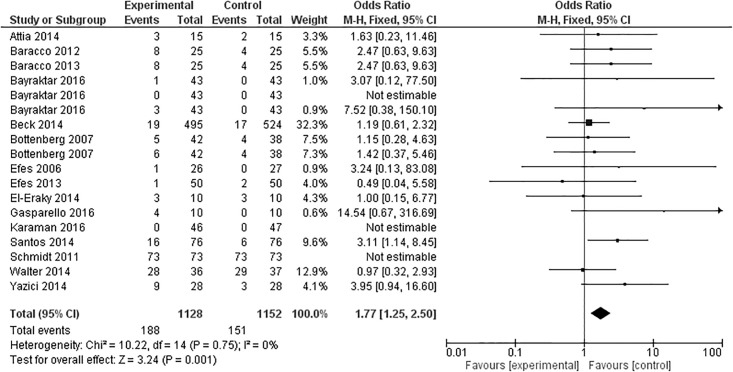
Polymerization shrinkage of resin composite can compromise the longevity of restorations. To minimize this problem, the monomeric composition of composites have been modified. The objective of this study was to conduct a meta-analysis to assess the clinical behavior of restorations performed with low polymerization shrinkage resin composite in comparison with traditional methacrylates-based resin composite. This systematic review was registered at Prospero data system (CRD42015023940). Studies were searched in the electronic databases PubMed, Web of Science, Scopus, Lilacs and EMBASE according to a predefined search strategy. The inclusion criteria were as follow: (1) randomized controlled clinical trials with at least six months of follow-up; (2) studies investigating composites with monomers designed to reduce polymerization shrinkage; (3) studies conducted with class I or II restorations in the permanent dentition; and (4) studies that assessed at least one of the following criteria: marginal integrity/adaptation, marginal discoloration, recurent caries, retention of composite restorations, and postoperative sensitivity. Two independent reviewers analyzed the articles to determine inclusion and risk of bias. The search conducted in the databases resulted in a total of 14,217 studies. After reviewing the references and citations, 21 articles remained. The longest clinical follow-up time was 60 months. The meta-analysis of the data in the included studies demonstrated that only one variable (marginal adaptation after 12 months) showed statistically significant outcomes, in which methacrylates-based composites presented significantly better results than resin composites containing modified monomers. The good level of the scientific evidence as well as the overall low risk of bias of the included studies indicate that composites with silorane, ormocer or bulk-fill type modified monomers have a clinical performance similar to conventional resin composites.
树脂复合材料的聚合收缩会影响修复体的使用寿命。为了尽量减少这个问题,人们对复合材料的单体成分进行了改良。本研究的目的是进行一项荟萃分析,以评估与传统甲基丙烯酸酯基树脂复合材料相比,使用低聚合收缩树脂复合材料进行修复的临床效果。该系统评价已在国际前瞻性系统评价注册库(CRD42015023940)登记。根据预先确定的检索策略,在电子数据库PubMed、科学网、Scopus、拉丁美洲和加勒比卫生科学数据库以及EMBASE中检索相关研究。纳入标准如下:(1)随访时间至少6个月的随机对照临床试验;(2)研究使用旨在减少聚合收缩的单体的复合材料;(3)针对恒牙列I类或II类修复体开展的研究;(4)评估以下至少一项标准的研究:边缘完整性/适应性、边缘变色、继发龋、复合树脂修复体的固位以及术后敏感性。两名独立的评审员对文章进行分析,以确定纳入情况和偏倚风险。在数据库中进行的检索共得到14217项研究。在查阅参考文献和引文后,剩余21篇文章。最长的临床随访时间为60个月。纳入研究数据的荟萃分析表明,只有一个变量(12个月后的边缘适应性)显示出具有统计学意义的结果,其中甲基丙烯酸酯基复合材料的结果明显优于含改性单体的树脂复合材料。纳入研究的科学证据水平良好以及总体偏倚风险较低,表明含硅氧烷、有机陶瓷或大体积填充型改性单体的复合材料的临床性能与传统树脂复合材料相似。