Bonciani M, Schäfer W, Barsanti S, Heinemann S, Groenewegen P P
Laboratorio Management e Sanità, Institute of Management, Scuola Superiore Sant'Anna, Pisa, Italy.
Netherlands Institute for Health Services Research-NIVEL, Utrecht, The Netherlands.
BMC Health Serv Res. 2018 Feb 21;18(1):132. doi: 10.1186/s12913-018-2913-4.
There is no clear evidence as to whether the co-location of primary care professionals in the same facility positively influences their way of working and the quality of healthcare as perceived by patients. The aim of this study was to identify the relationships between general practitioner (GP) co-location with other GPs and/or other professionals and the GP outcomes and patients' experiences.
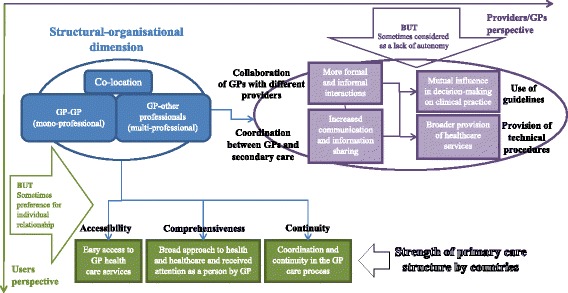
We wanted to test whether GP co-location is related to a broader range of services provided, the use of clinical governance tools and inter-professional collaboration, and whether the patients of co-located GPs perceive a better quality of care in terms of accessibility, comprehensiveness and continuity of care with their GPs. The source of data was the QUALICOPC study (Quality and Costs of Primary Care in Europe), which involved surveys of GPs and their patients in 34 countries, mostly in Europe. In order to study the relationships between GP co-location and both GPs' outcomes and patients' experience, multilevel linear regression analysis was carried out.
The GP questionnaire was filled in by 7183 GPs and the patient experience questionnaire by 61,931 patients. Being co-located with at least one other professional is the most common situation of the GPs involved in the study. Compared with single-handed GP practices, GP co-location are positively associated with the GP outcomes. Considering the patients' perspective, comprehensiveness of care has the strongest negative relationship of GP co-location of all the dimensions of patient experiences analysed.
The paper highlights that GP mono- and multi-disciplinary co-location is related to positive outcomes at a GP level, such as a broader provision of technical procedures, increased collaboration among different providers and wider coordination with secondary care. However, GP co-location, particularly in a multidisciplinary setting, is related to less positive patient experiences, especially in countries with health systems characterised by a weak primary care structure.
关于初级保健专业人员在同一机构工作是否会对他们的工作方式以及患者所感知的医疗质量产生积极影响,目前尚无明确证据。本研究的目的是确定全科医生(GP)与其他全科医生和/或其他专业人员同处一地与全科医生的工作成果及患者体验之间的关系。
我们想测试全科医生同处一地是否与提供更广泛的服务、临床治理工具的使用以及跨专业协作有关,以及同处一地的全科医生的患者在可及性、医疗服务的全面性和连续性方面是否认为医疗质量更好。数据来源是QUALICOPC研究(欧洲初级保健的质量和成本),该研究涉及对34个国家(主要在欧洲)的全科医生及其患者进行调查。为了研究全科医生同处一地与全科医生的工作成果及患者体验之间的关系,我们进行了多层次线性回归分析。
7183名全科医生填写了全科医生问卷,61931名患者填写了患者体验问卷。与至少一名其他专业人员同处一地是参与研究的全科医生最常见的情况。与单人执业的全科医生诊所相比,全科医生同处一地与全科医生的工作成果呈正相关。从患者的角度来看,在所有分析的患者体验维度中,医疗服务的全面性与全科医生同处一地的负相关关系最强。
本文强调,全科医生的单学科和多学科同处一地与全科医生层面的积极成果相关,例如提供更广泛的技术程序、不同提供者之间加强协作以及与二级医疗更广泛的协调。然而,全科医生同处一地,尤其是在多学科环境中,与患者体验不太积极相关,特别是在初级保健结构薄弱的卫生系统国家。