Section of Immunobiology, Department of Ophthalmology, University Hospital, LMU Munich, Mathildenstr. 8, 80336, Munich, Germany.
Division Virus-associated carcinogenesis (F170), German Cancer Research Center (DKFZ), 69120, Heidelberg, Germany.
J Neuroinflammation. 2018 Feb 21;15(1):54. doi: 10.1186/s12974-018-1088-6.
Uveitis is a potentially blinding inflammatory disease of the inner eye with a high unmet need for new therapeutic interventions. Here, we wanted to investigate the suppressive effect of the intraocular application of the small molecule dihydroorotate dehydrogenase (DHODH)-inhibitor PP-001 on experimental relapsing rat uveitis and furthermore determine its effect on proliferation and cytokine secretion of human peripheral blood lymphocytes (PBL) and human retinal pigment epithelial (RPE) cells in vitro.
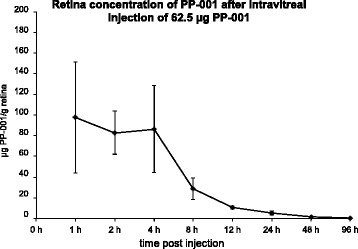
Spontaneously relapsing uveitis was induced in rats by immunization with interphotoreceptor retinoid-binding protein (IRBP) peptide R14. PP-001 was injected intravitreally after resolution of the primary disease to investigate further relapses. Proliferation and metabolic activity of phytohemagglutinin (PHA)-stimulated human peripheral lymphocytes with and without PP-001 and cytokine secretion were determined by XTT assay and bioplex bead assay. The RPE cell line ARPE-19 as well as primary human RPE cells treated with PP-001 or anti-vascular endothelial growth factor (VEGF) antibody bevacizumab were also investigated for metabolic activity and cytokine/chemokine secretion.
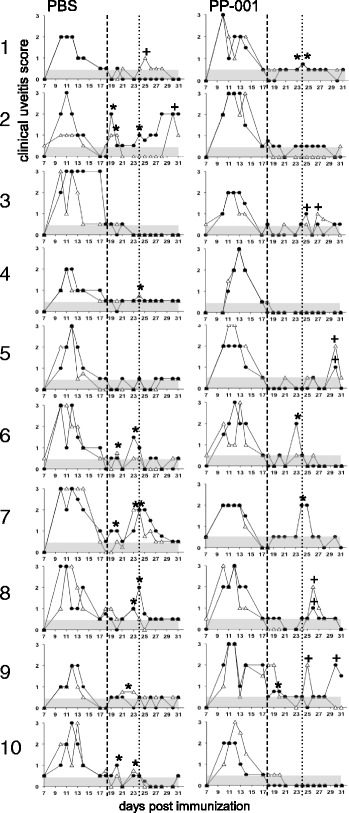
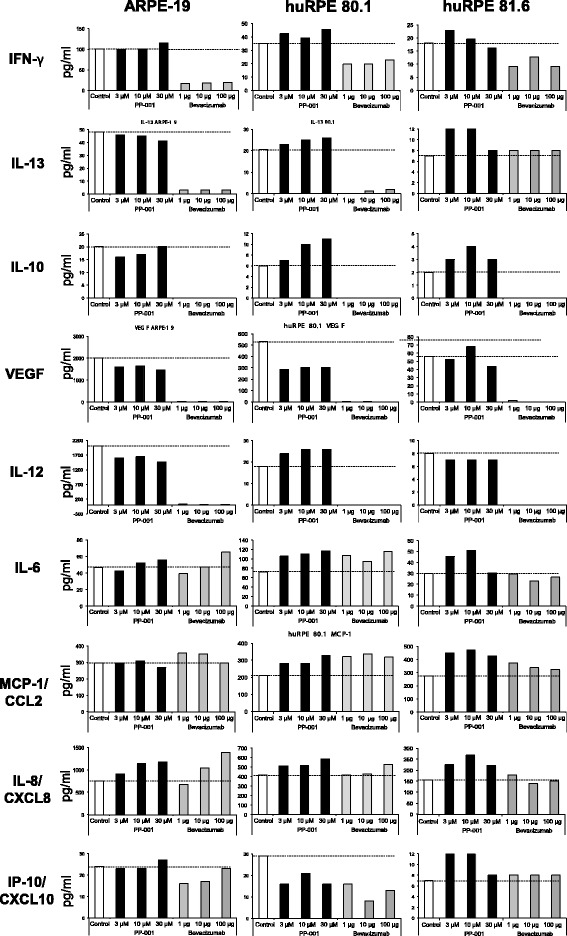
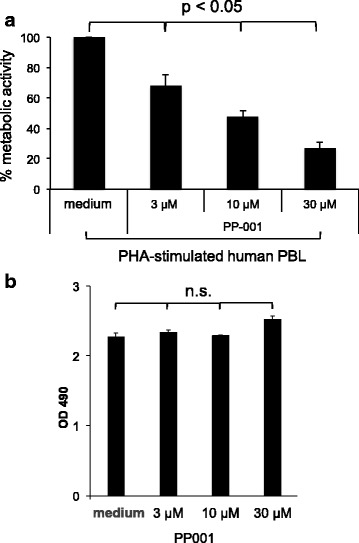
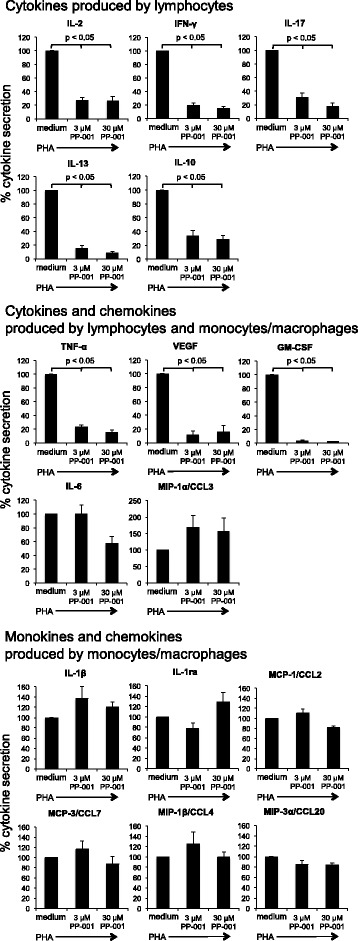
Injection of PP-001 into rat eyes reduced the number of relapses by 70%, from 20 relapses (57% of the rats affected) in the control group to 6 relapses (33% of the rats) in the treatment group. In human PBL cultures, PP-001 reduced the proliferation in a dose-dependent manner. The secretion of several cytokines such as IL-17, IFN-γ, and VEGF was suppressed by PP-001, as previously observed with rat T cells in the experimental autoimmune uveitis (EAU) model. In contrast, human RPE cells were not affected by PP-001, while the anti-VEGF antibody bevacizumab severely impaired the secretion of various cytokines including VEGF.
For the first time, intravitreal injection of PP-001 demonstrated an effective, but transient reduction of relapses in the rat EAU model. In vitro PP-001 suppressed proliferation and cytokine/chemokine secretion of human lymphocytes, while neither human RPE cell line ARPE-19 nor primary RPE cells were affected.
葡萄膜炎是一种潜在致盲性的眼内炎症性疾病,对新的治疗干预措施的需求很高。在这里,我们想研究小分子二氢乳清酸脱氢酶 (DHODH) -抑制剂 PP-001 对实验性复发大鼠葡萄膜炎的抑制作用,并进一步确定其对体外人外周血淋巴细胞 (PBL) 和人视网膜色素上皮 (RPE) 细胞增殖和细胞因子分泌的影响。
通过用间视网膜视黄醇结合蛋白 (IRBP) 肽 R14 免疫诱导自发性复发葡萄膜炎,在原发性疾病缓解后通过玻璃体内注射 PP-001 来研究进一步的复发。通过 XTT 测定和生物素化珠测定来测定植物血凝素 (PHA) 刺激的人外周血淋巴细胞的增殖和代谢活性,以及有和没有 PP-001 的细胞因子分泌。还研究了用 PP-001 或抗血管内皮生长因子 (VEGF) 抗体贝伐单抗处理的 RPE 细胞系 ARPE-19 以及原代人 RPE 细胞的代谢活性和细胞因子/趋化因子分泌。
向大鼠眼睛注射 PP-001 可将复发次数减少 70%,从对照组的 20 次(57%的大鼠受影响)减少到治疗组的 6 次(33%的大鼠)。在人 PBL 培养物中,PP-001 呈剂量依赖性地降低增殖。PP-001 抑制了几种细胞因子的分泌,如 IL-17、IFN-γ 和 VEGF,这与实验性自身免疫性葡萄膜炎 (EAU) 模型中大鼠 T 细胞观察到的情况相同。相比之下,人 RPE 细胞不受 PP-001 影响,而抗 VEGF 抗体贝伐单抗严重损害了包括 VEGF 在内的各种细胞因子的分泌。
首次在大鼠 EAU 模型中,玻璃体内注射 PP-001 显示出有效的,但短暂的复发减少。体外 PP-001 抑制了人淋巴细胞的增殖和细胞因子/趋化因子分泌,而人视网膜色素上皮细胞系 ARPE-19 和原代 RPE 细胞均不受影响。