Riccio Gennaro, Antonucci Salvatore, Coppola Carmela, D'Avino Chiara, Piscopo Giovanna, Fiore Danilo, Maurea Carlo, Russo Michele, Rea Domenica, Arra Claudio, Condorelli Gerolama, Di Lisa Fabio, Tocchetti Carlo G, De Lorenzo Claudia, Maurea Nicola
Department of Pharmacy, Federico II University, Naples, Italy.
Department of Biomedical Sciences and CNR Institute of Neuroscience, University of Padova, Padova, Italy.
Front Physiol. 2018 Feb 6;9:38. doi: 10.3389/fphys.2018.00038. eCollection 2018.
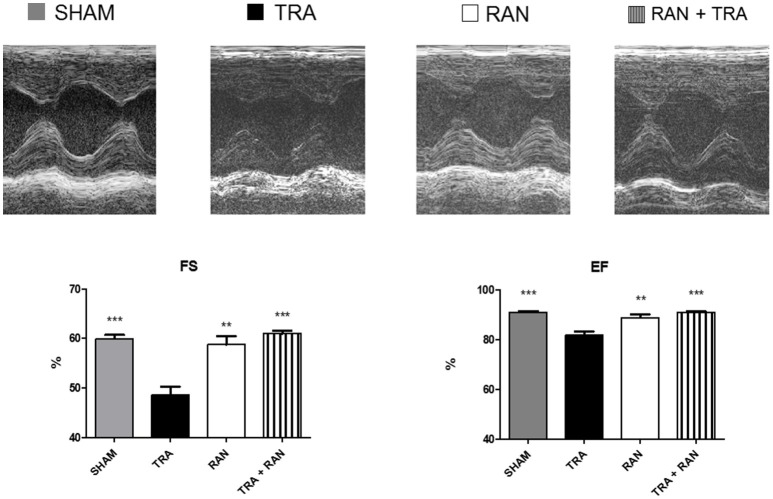
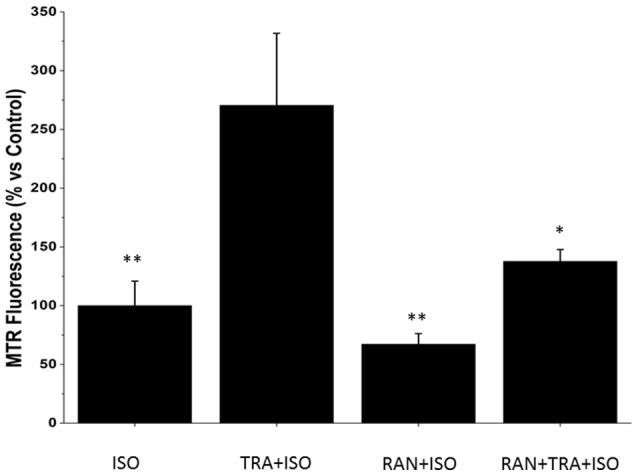
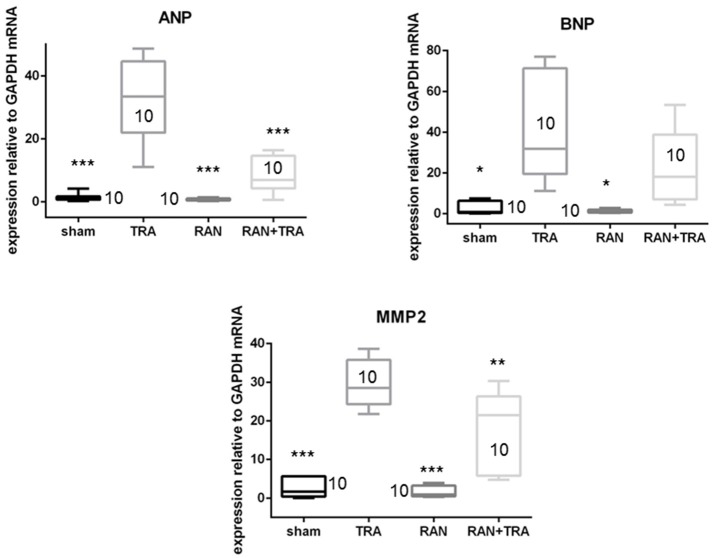
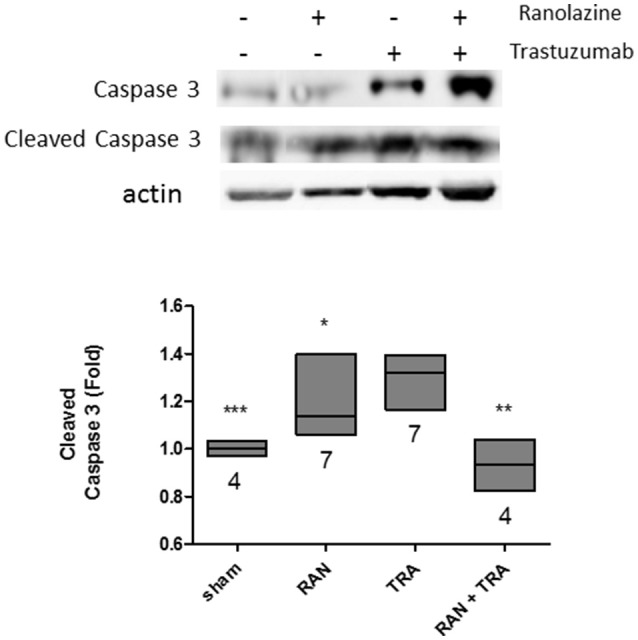
The ErbB2 blocker trastuzumab improves survival in oncologic patients, but can cause cardiotoxicity. The late Na+ current inhibitor ranolazine has been shown to counter experimental HF, including doxorubicin cardiotoxicity (a condition characterized by derangements in redox balance), by lowering the levels of reactive oxygen species (ROS). Since ErbB2 can modulate ROS signaling, we tested whether trastuzumab cardiotoxicity could be blunted by ranolazine via redox-mediated mechanisms. Trastuzumab decreased fractional shortening and ejection fraction in mice, but ranolazine prevented heart dysfunction when co-administered with trastuzumab. Trastuzumab cardiotoxicity was accompanied by elevations in natriuretic peptides and matrix metalloproteinase 2 (MMP2) mRNAs, which were not elevated with co-treatment with ranolazine. Trastuzumab also increased cleavage of caspase-3, indicating activation of the proapoptotic machinery. Again, ranolazine prevented this activation. Interestingly, Neonatal Rat Ventricular Myocytes (NRVMs), labeled with MitoTracker Red and treated with trastuzumab, showed only a small increase in ROS compared to baseline conditions. We then stressed trastuzumab-treated cells with the beta-agonist isoproterenol to increase workload, and we observed a significant increase of probe fluorescence, compared with cells treated with isoproterenol alone, reflecting induction of oxidative stress. These effects were blunted by ranolazine, supporting a role for Na inhibition in the regulation of redox balance also in trastuzumab cardiotoxicity.
表皮生长因子受体2(ErbB2)阻断剂曲妥珠单抗可提高肿瘤患者的生存率,但会导致心脏毒性。晚期钠离子电流抑制剂雷诺嗪已被证明可通过降低活性氧(ROS)水平来对抗实验性心力衰竭,包括阿霉素心脏毒性(一种以氧化还原平衡紊乱为特征的病症)。由于ErbB2可调节ROS信号传导,我们测试了雷诺嗪是否可通过氧化还原介导的机制减轻曲妥珠单抗的心脏毒性。曲妥珠单抗可降低小鼠的缩短分数和射血分数,但与曲妥珠单抗联合给药时,雷诺嗪可预防心脏功能障碍。曲妥珠单抗心脏毒性伴随着利钠肽和基质金属蛋白酶2(MMP2)mRNA水平升高,而与雷诺嗪联合治疗时这些水平并未升高。曲妥珠单抗还增加了半胱天冬酶-3的裂解,表明促凋亡机制被激活。同样,雷诺嗪可预防这种激活。有趣的是,用MitoTracker Red标记并用曲妥珠单抗处理的新生大鼠心室肌细胞(NRVMs)与基线条件相比,ROS仅略有增加。然后,我们用β-激动剂异丙肾上腺素对曲妥珠单抗处理的细胞进行应激以增加工作量,并观察到与单独用异丙肾上腺素处理的细胞相比,探针荧光显著增加,反映了氧化应激的诱导。这些作用被雷诺嗪减弱,支持了钠抑制在曲妥珠单抗心脏毒性的氧化还原平衡调节中的作用。