Guariglia-Oropeza Veronica, Orsi Renato H, Guldimann Claudia, Wiedmann Martin, Boor Kathryn J
Food Safety Laboratory, Department of Food Science, Cornell University, Ithaca, NY, United States.
Front Microbiol. 2018 Feb 6;9:120. doi: 10.3389/fmicb.2018.00120. eCollection 2018.
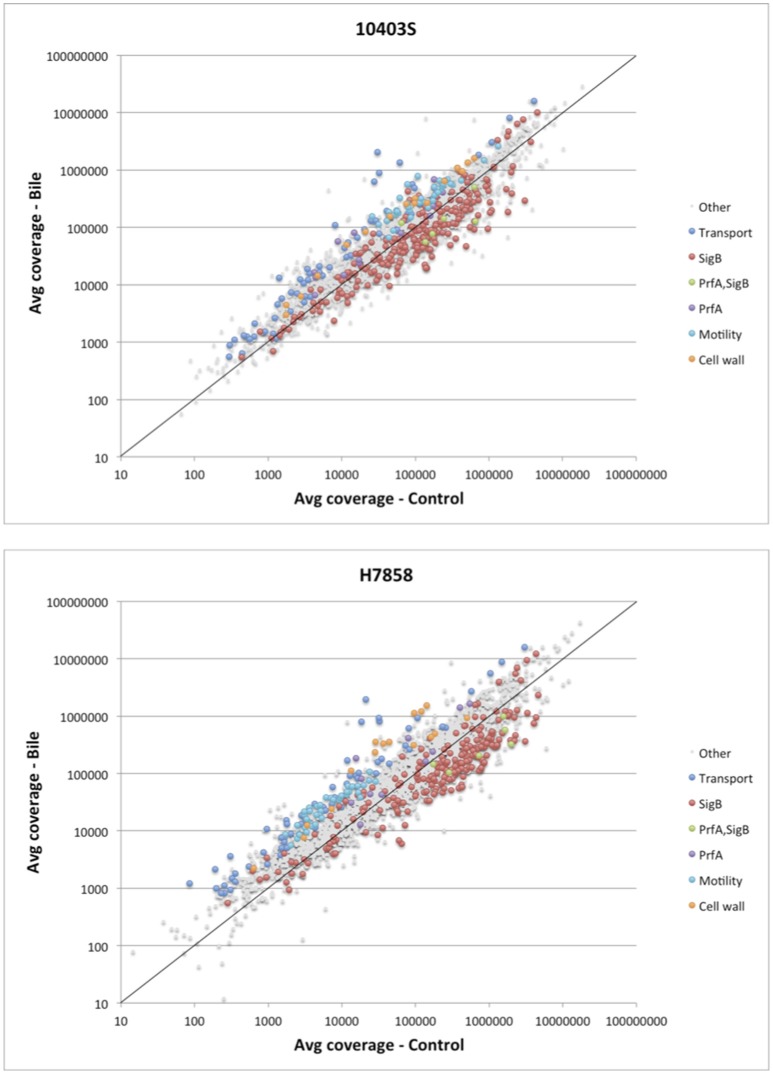
uses a variety of transcriptional regulation strategies to adapt to the extra-host environment, the gastrointestinal tract, and the intracellular host environment. While the alternative sigma factor SigB has been proposed to be a key transcriptional regulator that facilitates adaptation to the gastrointestinal environment, the ' transcriptional response to bile exposure is not well-understood. RNA-seq characterization of the bile stimulon was performed in two strains representing lineages I and II. Exposure to bile at pH 5.5 elicited a large transcriptomic response with ~16 and 23% of genes showing differential transcription in 10403S and H7858, respectively. The bile stimulon includes genes involved in motility and cell wall modification mechanisms, as well as genes in the PrfA regulon, which likely facilitate survival during the gastrointestinal stages of infection that follow bile exposure. The fact that bile exposure induced the PrfA regulon, but did not induce further upregulation of the SigB regulon (beyond that expected by exposure to pH 5.5), suggests a model where at the earlier stages of gastrointestinal infection (e.g., acid exposure in the stomach), SigB-dependent gene expression plays an important role. Subsequent exposure to bile induces the PrfA regulon, potentially priming for subsequent intracellular infection stages. Some members of the bile stimulon showed lineage- or strain-specific distribution when 27 genomes were analyzed. Even though null mutants showed increased sensitivity to bile, the SigB regulon was not found to be upregulated in response to bile beyond levels expected by exposure to pH 5.5. Comparison of wildtype and corresponding Δ strains newly identified 26 SigB-dependent genes, all with upstream putative SigB-dependent promoters.
利用多种转录调控策略来适应宿主外环境、胃肠道环境以及细胞内宿主环境。虽然替代西格玛因子SigB被认为是促进适应胃肠道环境的关键转录调节因子,但对胆汁暴露的转录反应尚不清楚。在代表I和II谱系的两个菌株中对胆汁刺激子进行了RNA测序表征。在pH 5.5条件下暴露于胆汁引发了大量的转录组反应,在10403S和H7858中分别有~16%和23%的基因显示出差异转录。胆汁刺激子包括参与运动性和细胞壁修饰机制的基因,以及PrfA调控子中的基因,这些基因可能有助于在胆汁暴露后的胃肠道感染阶段存活。胆汁暴露诱导了PrfA调控子,但没有诱导SigB调控子的进一步上调(超出暴露于pH 5.5所预期的水平),这表明在胃肠道感染的早期阶段(例如,胃中的酸暴露),SigB依赖性基因表达起重要作用。随后暴露于胆汁会诱导PrfA调控子,可能为随后的细胞内感染阶段做好准备。当分析27个基因组时,胆汁刺激子的一些成员显示出谱系或菌株特异性分布。尽管缺失突变体对胆汁的敏感性增加,但未发现SigB调控子在对胆汁的反应中上调超过暴露于pH 5.5所预期的水平。野生型和相应缺失菌株的比较新鉴定出26个SigB依赖性基因,均具有上游假定的SigB依赖性启动子。